控制的错觉:为什么越想掌控,越容易过度干预
The appetite for control lives inside the agent; influence lives in the world. The two are easily confused because markets, organizations, and other people are shaped mainly by variables no single actor set in motion. Taleb shows how luck disguises itself as skill, Kahneman how a coherent story stands in for evidence, and Langer proved with an experiment that merely being able to press the button manufactures the belief that one's act mattered — and what is dangerous is that this illusion, once it reaches the level of action, makes us intervene on noise, swap robustness for fragility, and treat one-off events as controllable processes.
1. The urge to control is not the same as influence
In every trading room there comes a moment when, after a run of gains, the trader begins to believe he saw it coming; in every office there comes a moment when, after the dashboard turns green, the manager begins to believe he steered the ship. This feeling of "I am in control" grows with the number of levers on the desk — the more knobs, the more firmly one feels the wheel in one's hands.
But the location of the feeling and the location of the cause are not the same. The appetite for control lives inside the agent; influence lives in the world. The two are easily confused because the systems we most care about — markets, ecosystems, organizations, and other people — are shaped mainly by variables no single actor set in motion. That a person can press a button does not mean the button is connected to the outcome he wants to change.
So the first step is not to ask how much control we have, but to separate two things: a genuine causal contribution to an outcome, and the psychological satisfaction of having done something. The first is sparse; the second is cheap and always available.
2. Luck sits outside the controlled line of sight
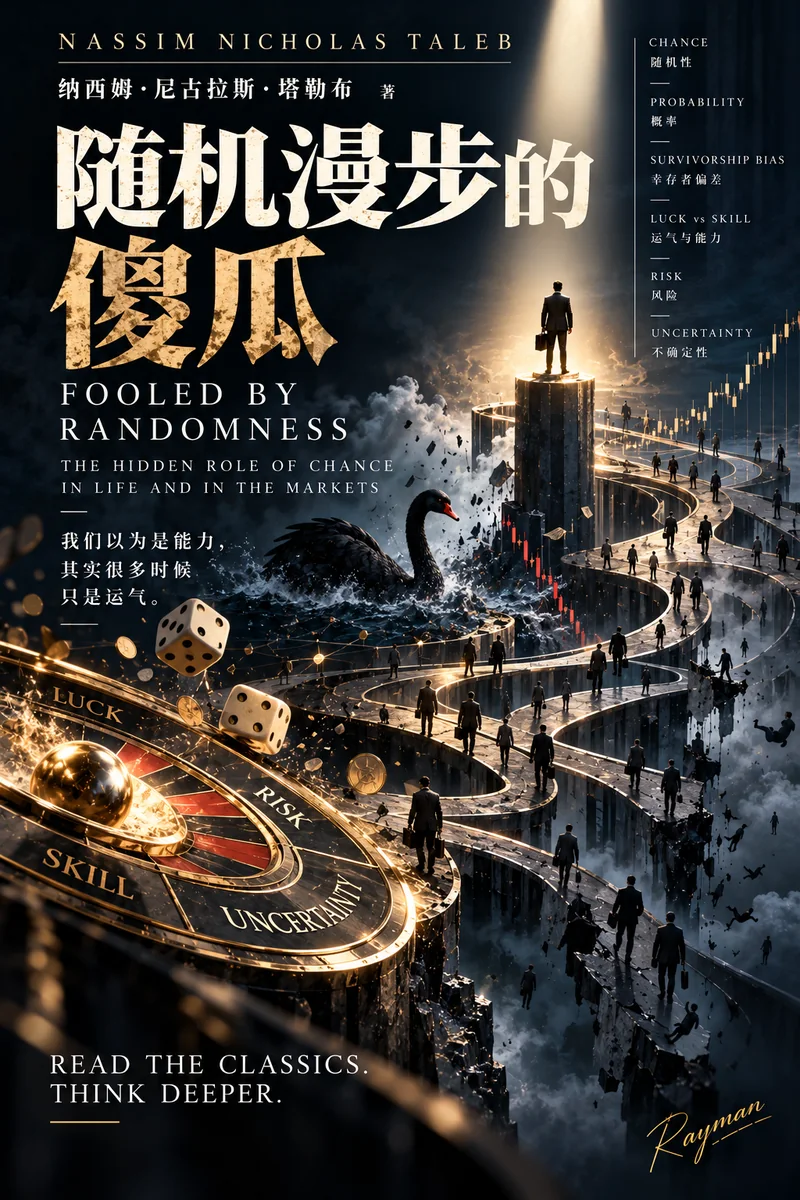
There is an asymmetry here. Success is credited to one's own move; failure is pushed onto fortune. Yet the baseline is that most outcomes are dominated by variables outside the actor's control. Taleb, in Fooled by Randomness, puts the point bluntly: along a random walk, the person who survives to the end looks most like a genius, and the difference between him and those who dropped out midway is often a sliver of variance, not a sliver of skill.
The Black Swan pushes the illusion one step further: after an event occurs we immediately supply it with a cause, and then feel that we understood it all along. That retrospective narrative is itself part of the control illusion — it rewrites what was unintelligible into a story we now appear to command. Worth marking: this is a structural claim about variance, not a moral claim about traders. In domains with tiny samples and enormous swings, the winner is often the luckiest, not the best.
3. The illusion is built in, not a mistake
Why is this illusion so stubborn? Because it is not an error someone makes but a byproduct of the cognitive machinery itself.
Kahneman, in Thinking, Fast and Slow, gives the key: once a person holds a coherent story, confidence outruns what the evidence can support; he later named this overconfidence the "illusion of validity." Beneath it lies "what you see is all there is" (WYSIATI) — the cause you can see gets treated as the whole cause. A story that hangs together is easier to accept than a heap of messy but real factors.
Langer (1975, Journal of Personality and Social Psychology, 32(2): 311–328) pinned the mechanism down harder: when people are allowed a small choice — which lottery ticket to take, whether to press the button — their estimate of their own chance of winning rises, even though the choice changes nothing. The trick is that the mere ability to act produces the belief that one's act mattered. Three ingredients manufacture the feeling most readily: a choice, familiarity, and the appearance of an ordered sequence. The feedback loop amplifies the illusion: once you have intervened, you default to crediting yourself with whatever followed.
4. The cost: over-intervention
What is dangerous is not the belief but the action it triggers. Once the control illusion reaches the level of behavior, it inflicts real damage along three paths.
First, acting on random noise creates volatility that was not there. A system that was merely fluctuating gets a new disturbance injected by every "correction"; you think you are taming it, but you are adding frequency.
Second, a fragile, centrally levered system replaces a robust, self-correcting one, simply because "we trust our knob." Hayek, in "The Use of Knowledge in Society" (American Economic Review, 1945), is clear: knowledge of concrete circumstance is dispersed among countless individuals, and the center can never aggregate it fully. Centralized control does not remove uncertainty; it only moves the information away from where it acts. The system looks more controllable because it is more obedient, not because it is safer.
Third, a one-off, non-repeatable event gets treated as a controllable process. After a crisis we write rules for the last crisis and then believe we have controlled crises. The next one will almost certainly arrive somewhere else.
A counterpoint must be added at once: not all intervention is bad; the problem is intervening where feedback is absent or merely retroactive. Where feedback is real, intervention is learning; where it is not, intervention is performance.
5. The counter: control is not all illusion
Overstating the case is a mistake. Where feedback is tight, cause is local, and repetition is frequent, control is real: the surgeon, the pilot in normal conditions, the engineer debugging, the baker. Kahneman himself stresses that expertise is real in "valid environments" — stable, fast-feedback, repeatable.
Tetlock, in Superforecasting, offers the sharper contrast: the best forecasters are not those who feel in charge, but those who treat their judgements as testable hypotheses and keep revising them. The difference lies in calibration, not in a sense of mastery.
And one more addition: some domains we genuinely can quantify — insurance, vaccines, weather. Bernstein, in Against the Gods, tells how humanity invented a whole toolkit to convert uncontrollable uncertainty into something priceable, divisible, and insurable. So the question was never "do we have control" but "is this a domain where control can be learned, and have we earned the feedback?" Mark the limit too: even real control has boundaries; the surgeon controls the incision, not the healing.
6. Judgement: three tests
To tell real leverage from felt control before acting, three tests help.
- Is the feedback verifiable, or merely retroactive? Can you distinguish "my action caused the outcome" from merely "the outcome followed my action"? The former needs a repeatable, contrastive loop; the latter needs only a story.
- Is the cost of the intervention paid by the one who benefits? If the lever-puller does not bear the downside, that "control" is borrowed — it bets someone else's future and keeps only the upside.
- With the lever removed, does the system still run? Robust control survives the removal of the controller; illusory control collapses the moment it is taken away, because its only product was the feeling.
Three limits as well: in genuinely uncertain domains the honest move is to widen the base — options, diversity, redundancy — rather than turn the knob harder; some outcomes should be insured or accepted, not controlled; and confusing felt control with real control is most dangerous exactly where the stakes are highest and the feedback slowest, because there we discover last that the knob was never connected to anything.
Close: the appetite for control is not a weakness to be shamed but a structural feature of any agent that can act. The discipline is to ask, before pulling the lever, whether it was ever connected to anything at all.