继承的背叛:为什么每一次真正的传承,都先是一次改写
The Aeneid carried over every instrument Homer owned — ships, gods, fate, the underworld, single combat — and replaced the question he was actually asking. The same war then means two different things. Tradition transmits questions, not contents; and the test of an inheritance is not fidelity but whether the original question still bites
I. The Old Man Carried Out of the Fire
In September of 19 BC, Virgil lay dying at Brundisium. According to the biographical tradition that comes down to us through Suetonius, he kept asking for the chest holding his manuscript and meant to burn the Aeneid himself; no one brought it. After his death Varius and Tucca prepared it for publication at Augustus' request, making only slight corrections and leaving the incomplete lines exactly as they stood.
A poem its author wanted destroyed, published because an emperor ordered it: that is where Latin literature's central work comes from. The detail is worth pausing on. What we call a tradition was, from the beginning, the outcome of a decision rather than a natural transmission.
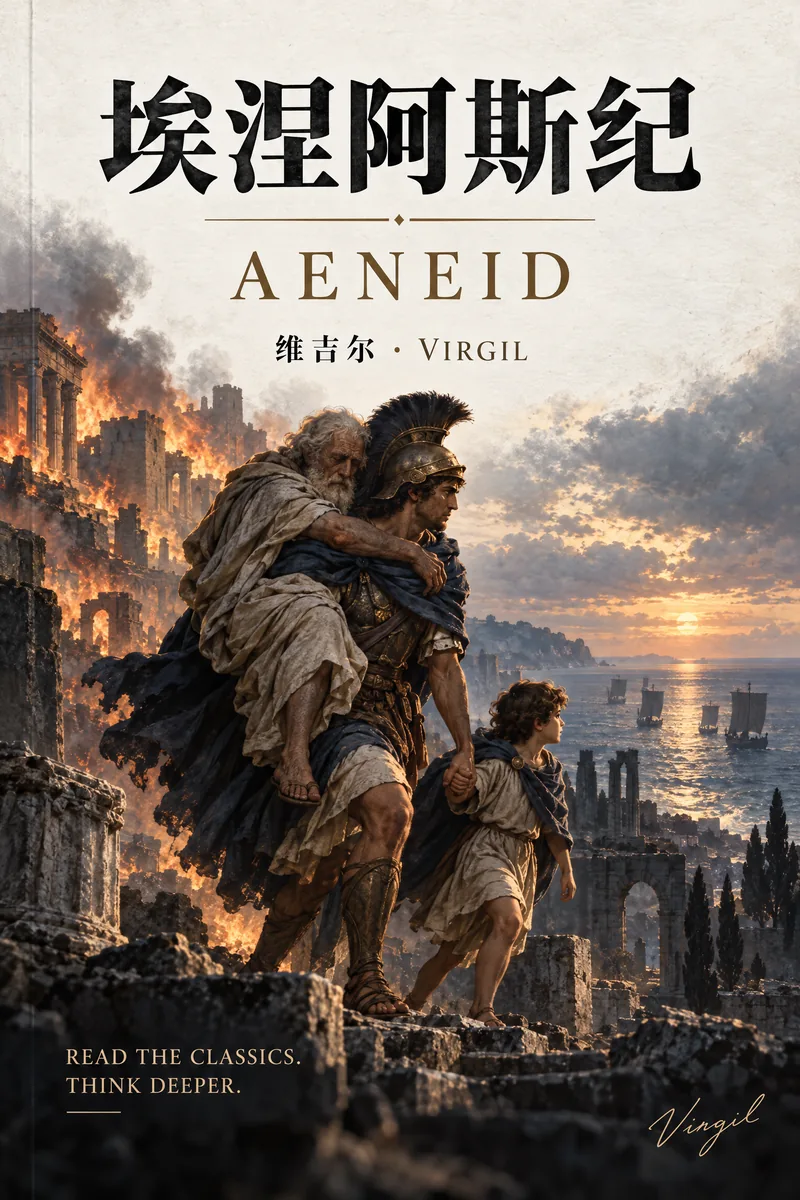
The poem itself opens on a defeat. On the night Troy falls, Aeneas carries his father Anchises out of the city, leads his small son Iulus by the hand, and loses his wife Creusa behind him in the dark. He does not turn back to look for her. The first protagonist of the Western epic is a man on the losing side — someone who carries his household on his shoulders and leaves it burning behind him.
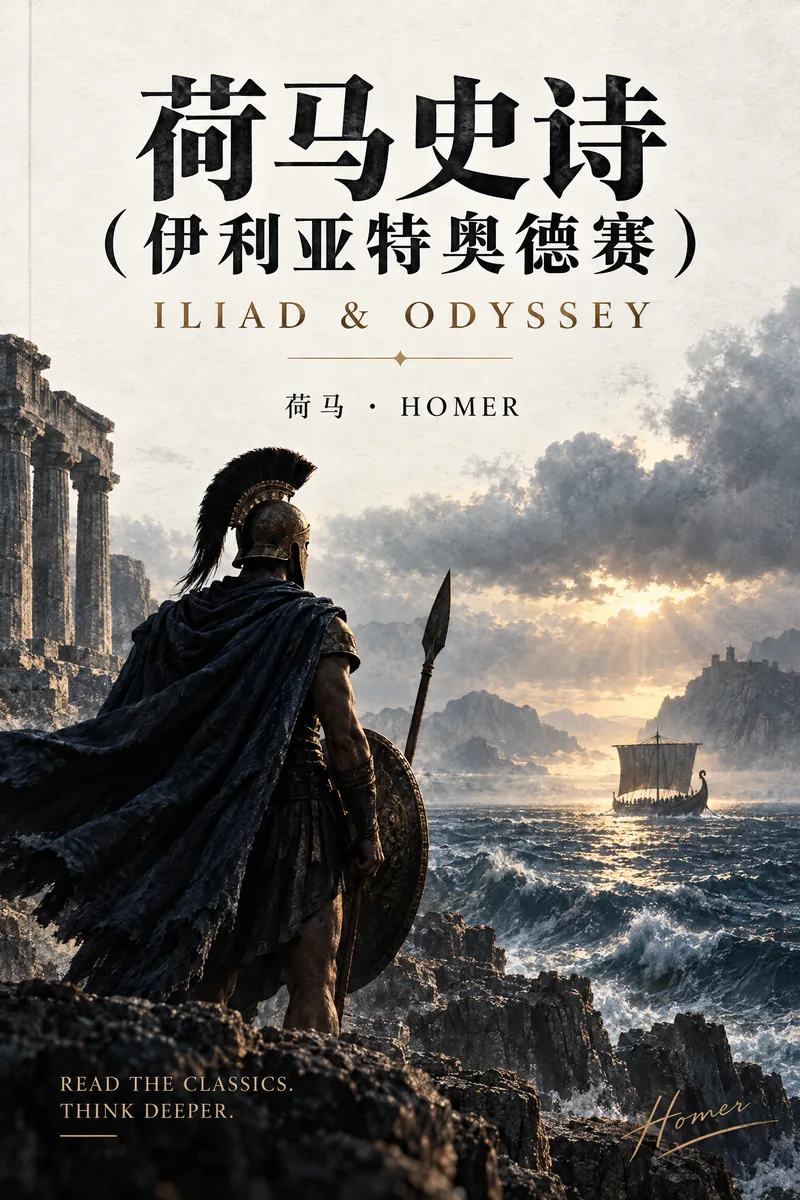
Set that beside Homer. The Iliad, dated by tradition to the eighth century BC, begins: "Sing, goddess, the anger of Peleus' son Achilles." The Aeneid begins: "I sing of arms and the man" — arma virumque cano. From wrath to weapons and a man: the first word of the Western epic moves from a passion to an instrument.
II. Every Instrument Kept, the Question Replaced
Virgil takes over nearly the whole of Homer's toolkit: the fleet and the storm, divine intervention and prophetic fate, the journey to the underworld, the shield carved with scenes, the funeral games, the single combat between champions. Structurally, the first six books imitate the wanderings of the Odyssey and the last six the war of the Iliad. Even the war is the same war — Troy — only seen from the losing side.
But one thing is not carried across: what Homer was asking.
The Iliad's question is the price of anger. Achilles withdraws over a woman taken from him, Greeks die in numbers, his stand-in Patroclus goes into battle in his armour and is killed by Hector, and so he returns, kills Hector, and drags the body around the walls. The epic ends with Hector's funeral, not with the fall of Troy. It does not ask who wins. It asks what revenge destroys along with its target once a man has been humiliated.
The Aeneid asks something else. It asks how to continue after losing.
Once the question changes, the virtues have to be rearranged. Aeneas' fixed epithet is pius — dutiful, god-fearing, faithful to his father, his son, his mission. The Homeric hero defines himself by winning a share of honour, timē; Aeneas defines himself by endurance and execution. He cannot be angry, because anger belongs to those still competing. He is already under way.
The bill comes due in the last book. Turnus is struck down and begs on his knees to have his body returned to his father. Aeneas hesitates — then sees on Turnus' shoulder the belt of Pallas, the boy he failed to save. Virgil writes that he is set ablaze with fury and terrible anger (furiis accensus et ira terribilis, 12.946–947), drives the sword in, and says: Pallas takes this stroke, Pallas exacts the penalty.
It is the only moment in the poem when Aeneas acts like a Homeric hero. It is also a direct violation of everything Anchises told him in the underworld — that Rome's art would be to spare the conquered and war down the proud (parcere subiectis et debellare superbos, 6.853). Turnus at that instant is the conquered.
Virgil does not resolve the contradiction. He leaves it in the final line.
That is the invoice for changing the question: the new question cannot produce a clean ending.
III. A Footnote Promoted to the Centre
If Virgil were the only case, we could call it the licence of a genius. He is not. The same aftermath of the same war was rewritten a second time, in Athens.
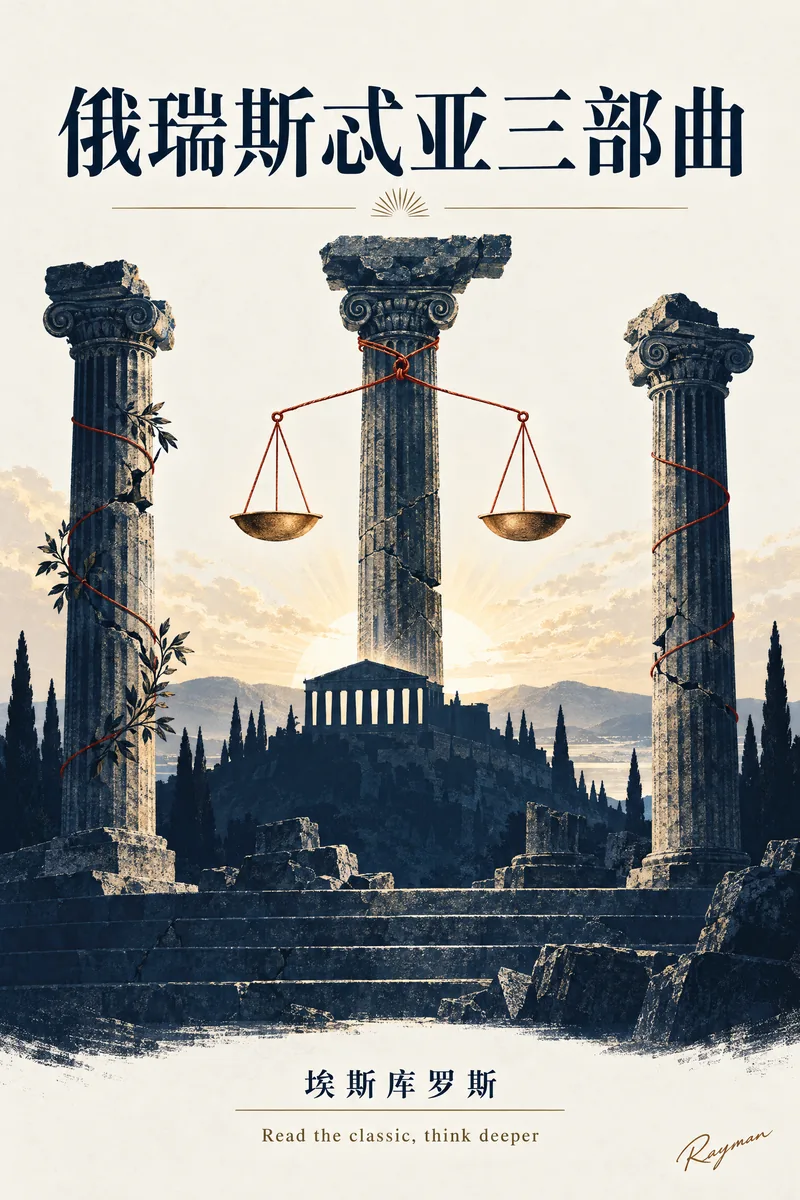
In 458 BC Aeschylus' Oresteia took first prize. The trilogy follows Agamemnon home from Troy to be killed by his wife Clytemnestra, then their son Orestes killing his mother in revenge, then the Furies hunting him. By the logic of Homer's world, the third play can only end in another round of blood debt; revenge is a chain with no exit.
Aeschylus supplies a courtroom. Athena establishes the court on the Areopagus, casts the deciding vote herself, and Orestes is acquitted. The Furies are persuaded to stay in the city and are renamed the Eumenides, the Kindly Ones.
Notice where the material comes from. In Book One of the Odyssey, Athena encourages Telemachus and mentions Orestes in passing — a young man who avenged his father and won a name for himself. It is a simile, a sentence, a footnote.
Aeschylus promotes that sentence into an institution.
So tradition is not the transfer of a text but the decision about which sentence deserves to count as the text. The largest rewrites usually happen at the margins.
And the limit sits in the same place: the price is that the Furies must be renamed and moved inside the walls. What gets pacified is not only violence but the old order's own voice. "From revenge to law" is also an absorption.
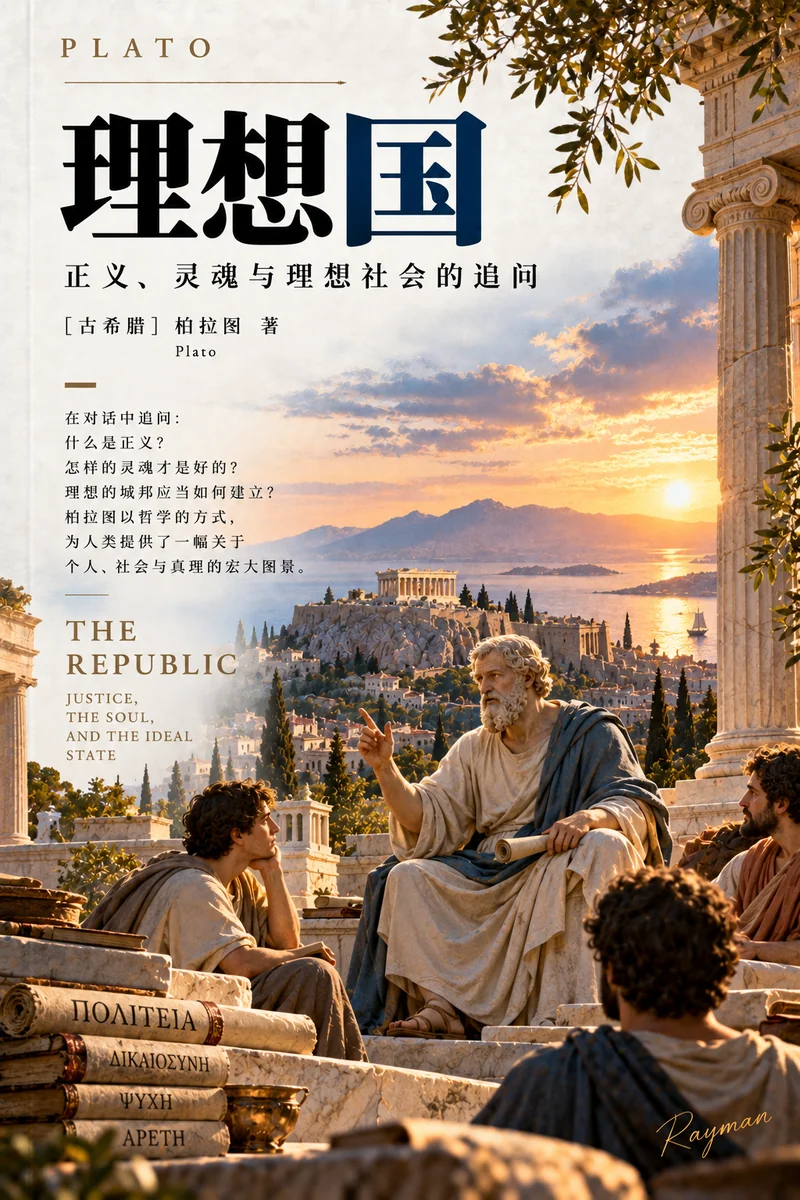
There is a more extreme version of the same chain: deletion. In Book Ten of the Republic, Plato expels the imitative poets from the city on the grounds that imitation stands three removes from the truth. He does not rewrite Homer; he tries to cancel him. Which only shows that rewriting is not an attitude one may adopt or decline but a cost that must be paid — even the choice to delete requires first deciding what to delete, and that decision is already a rearrangement.
IV. "I Merely Pass It On" Is the Most Effective Rhetoric of Rewriting
Every successful inheritor has said the same sentence: I did not invent this, I only passed it on.
Confucius put it in four characters: I transmit and do not create; I trust and love the old, and privately compare myself to old Peng (Analects 7.1). The force of the line is that it disguises editorial work as porterage. According to Sima Qian's account in the Records of the Grand Historian, of three thousand ancient poems Confucius took three hundred and five. The number has been argued over ever since, but the act of cutting belongs to the tradition itself. Claiming to merely transmit is precisely how the selection acquires authority: say that this is my judgement and you may object; say that this is how the ancients had it and you can only accept.
Virgil uses the same construction. He sings the story of his ancestors — and puts Augustus inside Anchises' prophecy. In the underworld the father points at a soul not yet born and says, "This is the man, this is he" (hic vir, hic est, 6.791), and what follows is the commission to rule the nations. A prophecy about the future with the present regime as its content.
Dante pushes the chain one link further. He makes Virgil his guide through Hell and Purgatory, and then, in the thirtieth canto of the Purgatorio, Beatrice appears and Virgil is gone — unbaptised, he must remain in Limbo. The inheritor eventually has to leave the source outside the gate, or he cannot enter his own heaven.
Harold Bloom's The Anxiety of Influence (1973) states the mechanism: strong poets win their place by misreading their predecessors, by misprision. His vocabulary is psychological; what it describes is structural. Without misreading there is no place to stand.
Edward Gibbon published the first volume of The Decline and Fall in 1776, and chapters fifteen and sixteen attributed part of the collapse to the spread of Christianity, causing a scandal. He was doing the same thing: rearranging thirteen centuries of material into an Enlightenment moral tale. And what a reader meets in Gibbon today is first of all Gibbon's own century.
V. Three Objections, and a Verdict That Is Not a Binary
Objection one: this is propaganda, not inheritance.
The hardest evidence comes from Virgil himself. He wanted it burned. When an author judges that his work should not exist and a power judges that it must, the work is no longer purely a transmission; it has been requisitioned. To read it as cultural continuity may be to mistake the result of a requisition for a natural outcome.
Objection two: the rewritten have no voice.
Abandoned, Dido curses: let someone rise from my bones as an avenger (exoriare aliquis nostris ex ossibus ultor, 4.625). Turnus begs and is killed. The conquered are indeed written into the poem, but they are written in the mode of being overcome. In this transaction, "inheritance" is the victor's vocabulary.
Objection three: fidelity is possible, and necessary.
The whole labour of philology is resistance to rewriting: collating manuscripts, weighing variant readings, tracing quotations. The Dunhuang scrolls, the Dead Sea Scrolls, the Guodian bamboo slips — every such find reminds us that the "original" in our hands may be one edition among several. If we deny that not changing anything is a meaningful goal, then "all inheritance is rewriting" collapses into "anything goes", which is neither true nor respectful of the costs.
So the verdict cannot be fidelity versus rewriting. It has to rest on three testable questions.
- Is the original question preserved? Carrying over the instruments, swapping the question, and still claiming fidelity yields borrowing, not inheritance. Borrowing is easy to recognise: the new work can be contradicted by the old question and never answers it.
- Does the rewriter admit the rewriting? The danger of "I transmit and do not create" is not the rewriting but the denial. An inheritor who admits the rewrite hands the choice back to the reader; one who denies it takes the choice into authority.
- Can the original still talk back? This is the hardest test. The Aeneid is alive because Turnus' plea and Aeneas' stroke remain a standing refutation of the poem's own commission. Two thousand years of argument is evidence that the rewritten were not fully silenced.
The limit has to be stated plainly: these three tests apply only to traditions that left texts behind. Oral cultures, and cultures erased thoroughly enough, leave no counter-text; we cannot even know what was rewritten. About them the only honest answer is that we do not know. This is exactly why preservation has independent value — it does not produce meaning, but it keeps the material for a future objection.
Virgil paid. He wrote an ending he was not satisfied with and asked for it to be burned.
The mark of a successful inheritance is not that it convinces everyone. It is that later generations still have to go back and argue with it.