锁定的窗口期:为什么更好的方案常常输给更早的方案
From QWERTY to broad-gauge railways: the popular story of the worse standard winning does not survive scrutiny. What is worth learning is how short the window is before a choice becomes irreversible
A story everyone knows, and the crack in it
"The QWERTY keyboard was deliberately designed to be inefficient, so the typebars would not jam; the more scientific Dvorak layout lost to inertia." The story appears in nearly every textbook that discusses path dependence. It is compact, dramatic, and it delivers a comforting conclusion: markets make mistakes, and they make them for a very long time.
The trouble is that the evidence behind the story is far weaker than its fame.
In 1985 the economic historian Paul David published "Clio and the Economics of QWERTY" in the American Economic Review, turning the arrangement of typewriter keys into one of the most famous cases in economics: the letter order was not optimal, yet it dominated the market, and once enough people had learned it, nobody had an incentive to change. David's verdict was a single sentence, and a heavy one: competition in the absence of perfect futures markets drove the industry prematurely into standardization on the wrong system.
Five years later two economists, Stan Liebowitz and Stephen Margolis, read the same historical record and drew the opposite conclusion, publishing it as "The Fable of the Keys" in the Journal of Law and Economics. They traced the original source of the claim that Dvorak was faster: those experiments compared already-trained Dvorak users against QWERTY users who had never received systematic training. Testing trained people against untrained people all but guarantees the result. In the more rigorous tests they could locate, proficient typists on the two layouts showed no significant difference in speed.
Later research also unsettled the premise that the layout was designed to be slow. Koichi and Motoko Yasuoka argued in 2011 that the early form of QWERTY had more to do with how telegraph operators transcribed Morse code than with any deliberate attempt to slow typists down.
So the most popular version of the story — the worse standard won because users were lazy — is at best unproven. And that points to something more important: the entire discussion of lock-in has long rested on an unexamined premise, namely that we know which option was inferior.
The mechanism holds; the conclusion does not
Set the specific QWERTY case aside, and the mechanism does not depend on it. David's central concept is non-ergodicity: when the value of a technology rises with the number of people adopting it, and adopters' choices in turn shape the technology's subsequent evolution, the process does not converge automatically on a fixed outcome. Early accidents keep shaping the final configuration. W. Brian Arthur formalized this as lock-in under increasing returns in a 1989 paper in The Economic Journal.
There is a distinction here that has to be kept sharp. Increasing returns can predict lock-in — that one option becomes hard to displace. It cannot predict inferiority — that the locked-in option is worse than the alternatives it beat. The two are constantly conflated, and the price of conflating them is that every claim of "the market chose wrong" collapses into a retrospective judgement made with the benefit of hindsight.
Put differently, the real contribution of path dependence is not "better technologies lose." It is that better and worse do not form a complete ranking in advance. When a technology has already spread before its rivals appear, and when complementary products, training systems, and industry conventions have all been built around it, the supposedly superior alternative is usually superior only in a hypothetical world with the installed base subtracted.
What makes lock-in hard: three mechanisms
To understand lock-in, you have to see what holds it in place. There are at least three distinct mechanisms, and they differ greatly in reversibility.
First, switching costs settle in people rather than in equipment. Remington did not merely sell typewriters; it trained typists, and in doing so it shaped the finger memory of an entire generation. For a firm, the cost of replacing a machine is calculable; the cost of retraining every typist and absorbing the productivity dip during the transition is a separate account. When switching costs settle mainly in people, processes, and conventions, they compound over time, because every new cohort of trained workers reinforces the existing standard. This also explains why the keyboard layout barely moved when typewriters gave way to computers: what was locked in was people, and people turn over more slowly than machines.
Second, complementary assets are dispersed, so conversion has to happen all at once. Railway gauge is the harder case. Brunel chose a seven-foot broad gauge for the Great Western Railway, against the prevailing standard gauge of four feet eight and a half inches. Broad gauge offered genuine advantages in speed and stability, but every junction with the national network became a problem, and the Gauge Act of 1846 fixed standard gauge as the legal specification for new lines. Broad gauge did not vanish immediately — it survived until 1892, when it was converted wholesale within a few months. Note the temporal shape: conversion was deferred for decades and then completed inside a very short window. Dispersed complementary assets make incremental conversion infeasible, so the choice is either no move at all or a total one.
Third, a roadmap can serve as a coordination device, and that kind of lock-in is productive. Moore's Law was never merely an observation; it was also an expectation. When the whole industry believes transistor density will rise on a certain cadence, thousands of equipment, materials, and design firms can place their bets in parallel instead of waiting for someone else to move first. From the 1990s onward, the International Technology Roadmap for Semiconductors — produced jointly by national semiconductor industry associations from 1998 to 2015, and succeeded by the IEEE-led IRDS — wrote that expectation down as a public document. Here lock-in is not inertia but public infrastructure that turns scattered investment into coordinated action. It is the mirror image of the "worse standard won" narrative: convergence itself created capabilities that did not previously exist.
The counter-case: lock-in is a cost, not a wall
Presenting lock-in as destiny is the most common exaggeration in this literature. At least three cases show that exit is possible, and that the price is merely a price.
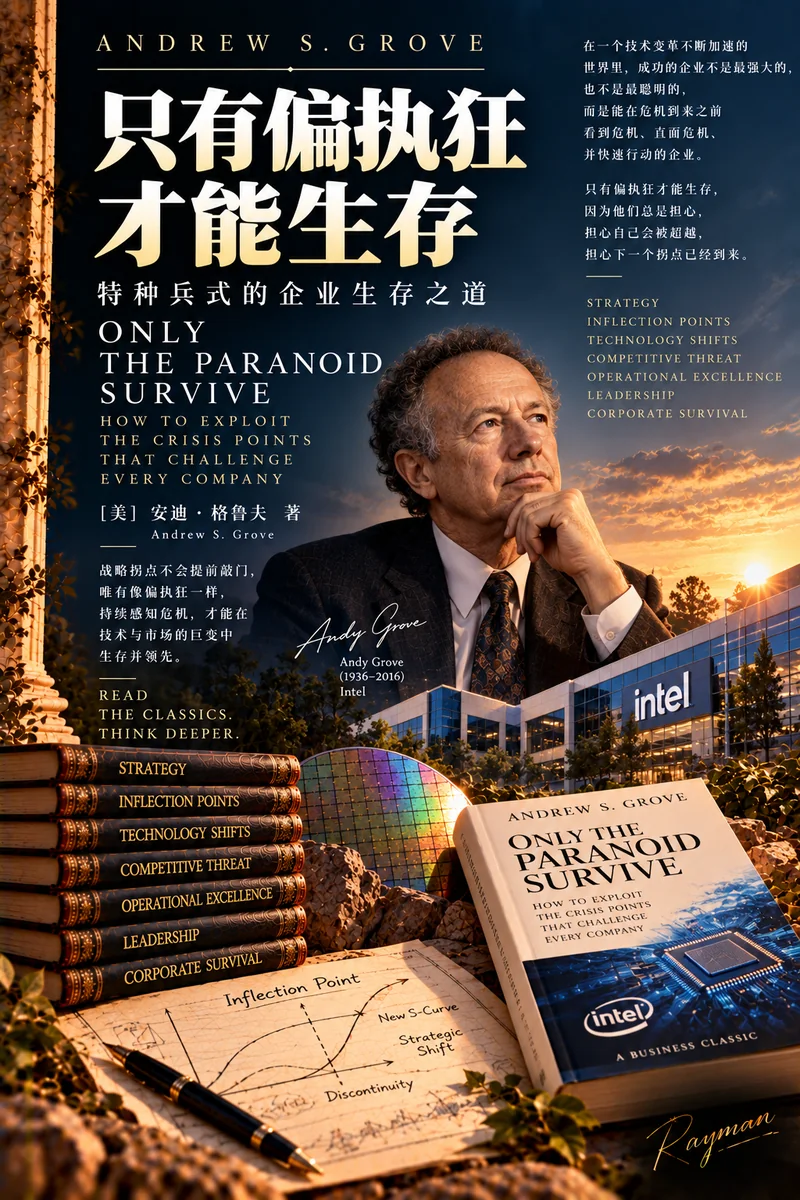
The first comes from Intel. In the mid-1980s the company's memory business was being crushed by Japanese price competition, while the organization still defined itself as a memory company. In Only the Paranoid Survive, Andy Grove recalls a conversation with Gordon Moore: if the board threw us out and brought in a new chief executive from outside, what would he do? The answer was to get out of memory. Intel then redirected its resources wholesale toward microprocessors. Lock-in was real, but its nature was high switching cost, not impossibility.
The second case is its mirror image: a standard can also be opened deliberately, and the one who opens it may not collect the returns. When IBM launched the personal computer in 1981, it used a purchased Intel 8088 chip and a purchased operating system, and published the hardware and BIOS specifications. That decision let the whole industry build compatible machines, and it also sent the value flowing along the open interfaces toward the suppliers of processors and operating systems. Walter Isaacson returns to this point repeatedly in The Innovators: the digital revolution was driven not by isolated inventions but by collaborative networks willing to share interfaces. IBM created the standard and failed to keep it.
The third case is earlier. In the 1950s Bell Labs ran a series of workshops that deliberately diffused transistor technology to outside firms rather than locking the patents in a vault. The result was a transistor industry spreading across the whole of electronics — giving up exclusivity over the standard in exchange for the scale of an ecosystem. Crystal Fire traces exactly this path from laboratory to industry.
The judgement: what needs managing is not which standard is better, but how wide the window is
Gathering these threads yields a more useful frame than "markets choose wrong." What needs managing is not whether an option is the best one — that usually cannot be answered in advance — but how long the choice can remain reversible, and what reversal costs. Three questions measure that window:
- Where do switching costs settle? Costs embedded in equipment depreciate; costs embedded in people, processes, and conventions compound.
- Are complementary assets concentrated or dispersed? Concentrated ones permit gradual replacement; dispersed ones demand a single, total conversion, which makes the decision to move — or not — more consequential in advance.
- Is the standard coordinating other people's expectations? If its value comes mainly from letting many independent actors bet in parallel, then its sub-optimality is part of how it works rather than a defect.
The most easily overlooked line in David's paper is also the diagnosis of this management problem: the failure lies in the absence of perfect futures markets. When nobody can bet on the future, an industry can only choose on currently visible returns, and so it converges too early. Conversely, institutional arrangements that make waiting feasible — tradable standards, joint research with exit options, shareable interfaces — come closer to the substance of the problem than exhortations to pick the right technology.
Finally, the limits, stated plainly. First, the evidence behind QWERTY, the most famous case of all, is not strong enough to carry the weight textbooks place on it; using it to prove that the worse option wins is over-citation. Second, in some domains premature divergence is far more dangerous than a sub-optimal standard: the value of safety codes, medical protocols, and communication standards comes mainly from everyone using the same one, which makes optimality a secondary variable. Third, Peter Thiel's argument in Zero to One applies here too: the value of a design depends on how long it lasts rather than how new it is — the returns are typically decided by the last move, not the first. Together these three point to one conclusion: competition among standards is not a contest of merit but a discipline of timing, cost, and coordination.