World History 2005 Daily Pick
1491
《1491》
- Published
- 2005
- Category
- World History
- Original language
- en
- Source list
- Daily Pick
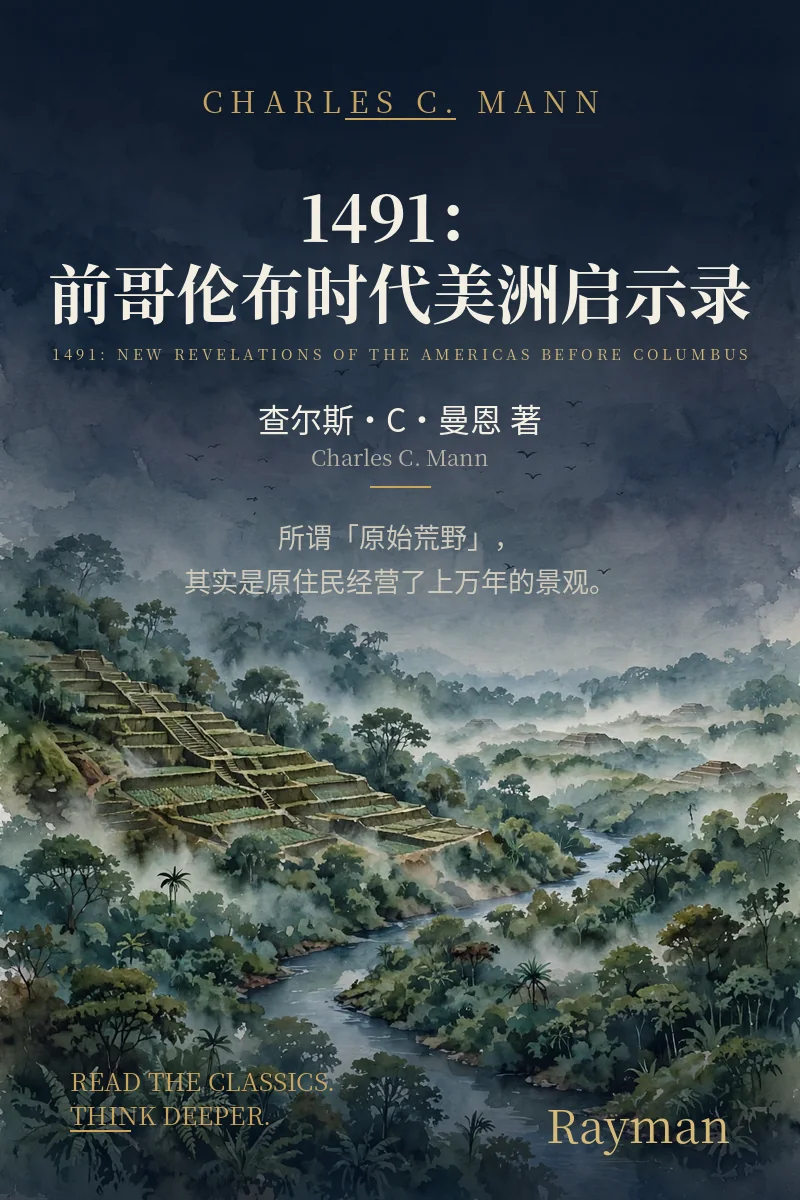
The supposedly pristine wilderness was in fact a landscape managed by Indigenous peoples for millennia
Imported from a third-party reading list or added as a daily pick — bibliographic facts, the source framing, and a full reading guide.
Source theme
The supposedly pristine wilderness was in fact a landscape managed by Indigenous peoples for millennia
What is this book about?
A work of non-fiction by the American science journalist Charles C. Mann, first published by Alfred A. Knopf in 2005 (462 pages), with a UK edition from Granta under the title Ancient Americans, a second edition from Vintage in 2011 and a Spanish edition in 2013. It rebuilds the pre-Columbian Americas along three threads. The first asks when and by which routes humans arrived, showing how the Clovis-first consensus and the model of a single migration across the Bering land bridge came to be challenged. The second concerns population size: High Counters (Henry F. Dobyns estimated close to one hundred million) and Low Counters (David Henige, Numbers from Nowhere) derive wildly different orders of magnitude from the same fragmentary evidence. The third concerns environmental transformation: Mann argues that the Americas were not a virgin wilderness but a landscape long shaped by fire, slash-and-burn cultivation and soil improvement, to the point that Indigenous peoples functioned as a keystone species affecting the survival and abundance of many others. The book opens with Holmberg's Mistake, the twentieth-century ethnographic error of reading the Beni savanna of Bolivia as pristine nature when it was in fact an abandoned managed system following demographic collapse. Mann is explicit that there is no scholarly consensus and acknowledges the controversies. The formal Chinese edition is 1491: 前哥伦布时代美洲启示录, translated by Hu Yinan and published by CITIC Press in March 2014 (ISBN 9787508644028, 536 pages) in its history classics series, with later reissues in 2016 and 2021 under the title 历史的碰撞:1491.
Why read it?
Its sharpest contribution is not filling a gap in American history but dismantling an observation baseline that has been mistaken for a natural fact. The counter-intuitive thesis: the pristine wilderness Europeans encountered after 1492 was largely a secondary landscape produced by the collapse of Indigenous populations under Old World pathogens and the subsequent regrowth of forest—the aftermath of a catastrophe was misrecorded as the state of nature before humans arrived. The portable frame is baseline contamination by observation time: any claim that a place was always thus should first ask on which side of a rupture the observer stands. Applied to ecological restoration, urban renewal or the sampling bias of AI training data, the first question is not whether the data suffice but whether the sampling moment falls just after a discontinuity. The stance is plainly refutable: the Wikipedia article states outright that there is no consensus; the High Counters versus Low Counters dispute remains unsettled; and its further reading includes research explicitly described as contra Mann, denying that pre-Columbian Amazonians built the rainforest into its present form. Attributing a hemisphere's landscape to human making is a strong, falsifiable claim. What changes is the question, from what this land was originally like to what licenses 1492 as nature's zero point. Evidence of standing (three counted items): (1) a standalone English Wikipedia article recording the 2005 Knopf first edition, the 2006 National Academies Communication Award, Kevin Baker's 2005 review, the High/Low Counters dispute, the erosion of the Clovis consensus, the carrying-capacity account of the Maya collapse and the contra Mann Amazonian study—not merely a mention on the author's page; (2) an authoritative award: the 2006 National Academies Communication Award for the best creative work that helps the public's understanding of topics in science, engineering or medicine, quoted verbatim in the article; (3) an authoritative long review: Kevin Baker's '1491': Vanished Americans in The New York Times Book Review of 9 October 2005, which called the approach in the best scientific tradition, carefully sifting the evidence, never jumping to hasty conclusions, while noting that nearly everything about the Indians is currently a matter of contention. Supplementary context, not counted separately: (4) a formal Chinese edition from CITIC Press, March 2014, translated by Hu Yinan (ISBN 9787508644028), whose Douban author note also records the National Academies Communication Award; (5) further reviews by Alan Taylor in The Washington Post and Michael Coe in American Scientist. The three counted items span three distinct source types: encyclopedic standalone entry, authoritative award and authoritative review media. Time test: first published 2005, twenty-one years before 2026-11-13, satisfying the five-year threshold. Source note: today's themes include history, so the An Zhengming pool (60 titles, 19 in history) and the Hacker Books pool (8 in history) were checked first; the former is dominated by Chinese general histories and textbook-style entries, and the latter's two central works, The Dawn of Everything and The Making of the Atomic Bomb, are already in the library, so an independent search was used. HN mention counts are not treated as evidence of classic status. Not counted: the exact Douban rating and rating count for the Chinese edition were not obtained (a search snippet showed 8.1, unverified and below 8.5), Goodreads figures were not obtained, the WeRead recommendation value was not obtained, and no Google Scholar count was obtained; none is invented.
Core Ideas
- Wilderness is the product of a historical event, not a natural state: after 1492 Old World pathogens collapsed Indigenous populations and forest regrew, so Europeans saw a secondary landscape in the wake of a catastrophe and misrecorded it as primeval nature before humans—Holmberg's Mistake is the book's methodological entry point.
- Humans as a keystone species: Indigenous peoples shaped their environment over millennia with fire, slash-and-burn cultivation and soil improvement such as Amazonian terra preta; Mann borrows the ecological notion of a keystone species to argue that they affected the survival and abundance of many other species, so untouched nature scarcely existed on this continent.
- The methodology of population estimates matters more than the number: High Counters (Dobyns, roughly one hundred million) and Low Counters (Henige, Numbers from Nowhere) derive radically different orders of magnitude from the same fragmentary evidence, exposing every assumption in the chain of inference rather than a difference in arithmetic.
- The erosion of the Clovis consensus: from a single migration across the Bering land bridge about 13,500–12,900 years ago to evidence of earlier dates and multiple waves, the book makes the rewriting of scientific consensus by new evidence part of its narrative.
- The position is refutable: the Wikipedia article states that there is no consensus and that Mann acknowledges controversies, and it lists research explicitly described as contra Mann denying that pre-Columbian Amazonians substantially reshaped the rainforest; attributing a hemisphere's landscape to human making is a falsifiable strong claim, not an innocuous truism.
What questions does this book try to answer?
- When we call the state of a landscape in a given year a natural baseline, might that baseline itself be the aftermath of an unaccounted demographic and ecological catastrophe—and how would one detect such a rupture in restoration ecology or carbon accounting?
- With fragmentary evidence and every number resting on a long chain of inference, what is sufficient to overturn an order-of-magnitude population estimate: new material evidence, or the falsification of a single link in the chain?
- If landscapes are the product of long management, which is more faithful to history—preserving wilderness or restoring Indigenous management practices—and what follows from treating the former as a universal standard?
Who should read it?
Readers concerned with colonial history, environmental history and the starting point of the Anthropocene; people in restoration ecology, climate policy or data sampling who need a tool for detecting baselines contaminated by the moment of observation; and non-fiction readers who prefer live scientific disputes to settled conclusions. It is not for those wanting a textbook general history or a chronology of events—it offers criteria about evidence and the observer's position rather than a list of facts—and it asks the reader to accept three parallel strands that keep switching between archaeology and demography.
How to Read It
Read in the original order and do not skip the introduction or Holmberg's Mistake: the three parts of the book—population and origins, cultural complexity, environmental transformation—all unfold from that misreading, so fix the idea that the observer stands after a catastrophe before entering the High/Low Counters dispute and Amazonian dark earth. Whenever a striking number appears, write out its chain of inference and note which assumptions remain untested. It pairs especially well with this edition's Normal Accidents: one shows that what looks like natural order is the result of long human management, the other that what looks like a freak accident is the normal output of a system's structure—both dismantle the gap between appearance and structure, at the scale of millennia and of seconds respectively. Chinese readers should use the 2014 CITIC Press translation by Hu Yinan, and distinguish it from the 2021 reissue titled 历史的碰撞:1491 and from the author's 1493, which treats the global ecological exchange after Columbus rather than continuing this book's subject.
