Literature & Fiction 2017 AZM's list
A Luminous Republic
《光明共和国》
- Published
- 2017
- Category
- Literature & Fiction
- Original language
- es
- Source list
- Politics, Sociology & Institutional Critique
The order of white civilization and the fear of what lies outside it.
Imported from a third-party reading list or added as a daily pick — bibliographic facts, the source framing, and a full reading guide.
Source theme
The order of white civilization and the fear of what lies outside it.
What is this book about?
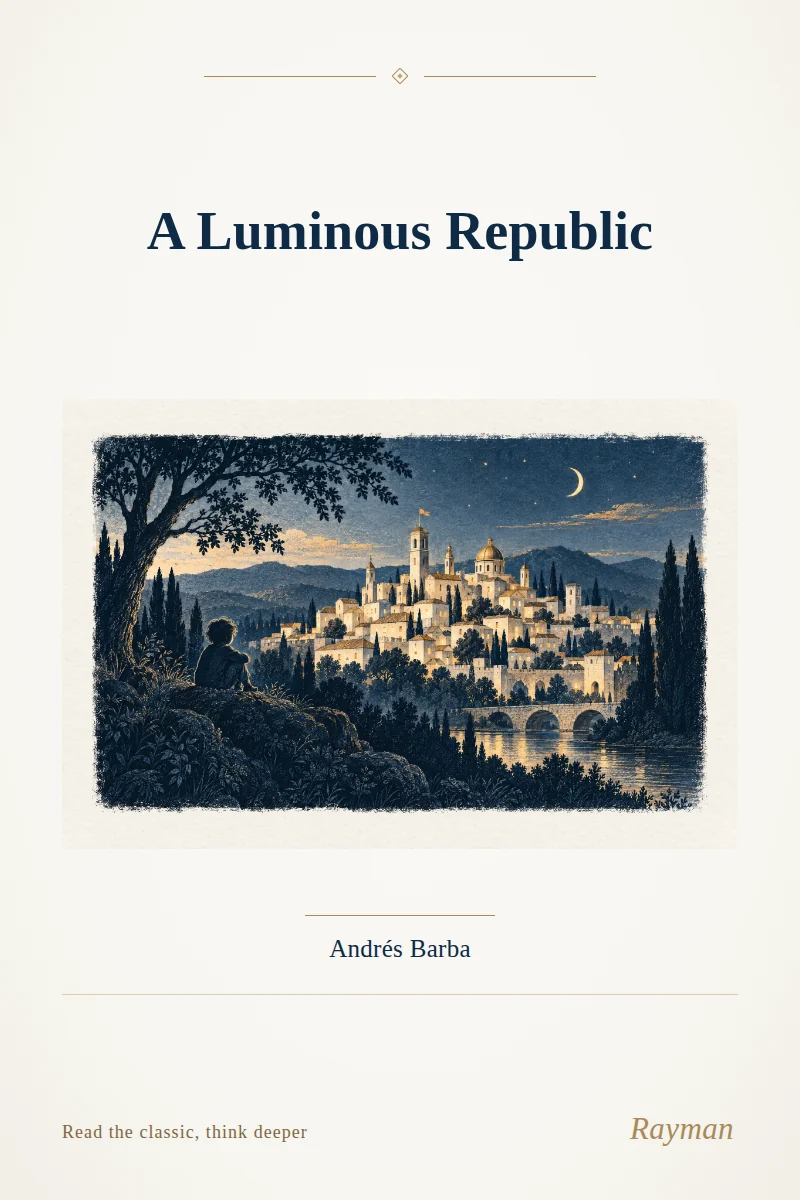
A tropical town is suddenly home to thirty-two children: they speak a language no one understands, have no parents, refuse placement, and seem to have grown out of the forest itself. Their presence loosens the town's middle-class order bit by bit, and fear, suspicion, and exclusion follow. Barba turns this premise into a finely built allegorical novel about what happens when a self-described civilization meets outsiders it can neither classify nor control.
Why read it?
A finely built allegory. On the surface it is about a group of wild children; underneath it explores the fear and fracture that appear when a white Western civilization confronts an "other" it frames as colored or savage. The novel lets you accept the children first, then watches the "civilized" side slide toward exclusion and violence, so that naive trust in the civil order is hard to keep by the end.
Core Ideas
- A civil order built on hypocrisy and exclusion is extremely fragile and does not survive one shock from outside.
- Faced with an "other" it cannot classify, a supposedly civilized society shows fear and fracture first.
- When order is shaken, it is often the self-described civilized side that reveals its inner cruelty.
- The children who speak an unknown language and refuse placement are themselves a question put to the existing order.
What questions does this book try to answer?
- Where does the deep civilizational fear and fracture come from when a Western society faces racial change and multiculturalism?
- Why does a society tend to exclude an "other" it cannot classify rather than take it in?
Who should read it?
For readers of political allegory and for anyone following questions of race and immigration in the contemporary West. It is short and restrained, and works perfectly well as a plain novel; read one layer deeper, though, and the questions it raises are more unsettling than the story.
How to Read It
On the surface it is about wild children; underneath it is about the hypocrisy, fear, and violence a Western society shows when an outside civilization presses on it. Barba is a Spanish writer, and the book is short, cool in tone, and almost free of moralizing — which is what makes it stay with you. Watch one thing as you read: hardly anyone in the story thinks of himself as a perpetrator.