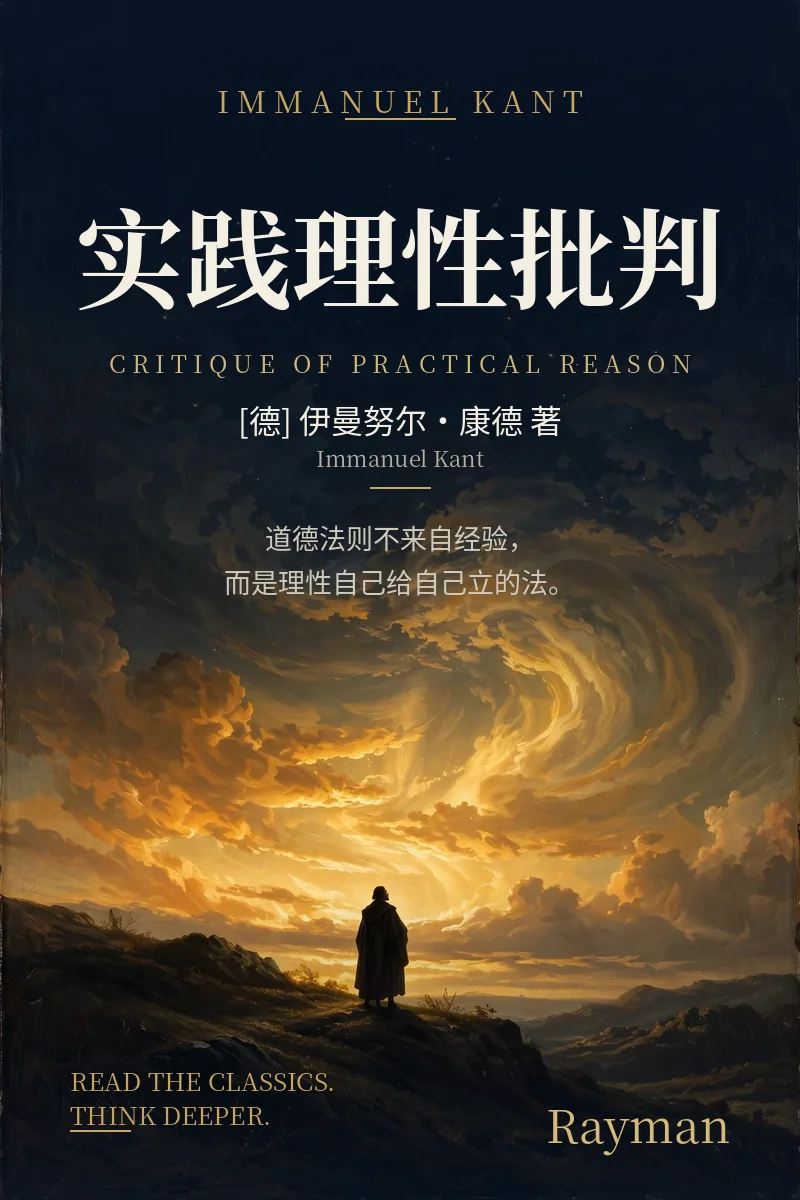
Philosophy 1788 Daily Pick
Critique of Practical Reason
《实践理性批判》
- Published
- 1788
- Category
- Philosophy
- Original language
- de
- Source list
- Daily Pick
The moral law is not derived from experience but legislated by reason for itself
Imported from a third-party reading list or added as a daily pick — bibliographic facts, the source framing, and a full reading guide.
Source theme
The moral law is not derived from experience but legislated by reason for itself
What is this book about?
Published in 1788, the Critique of Practical Reason is the second of Kant's three critiques. Where the first asked what I can know, this one asks what I ought to do, and narrows the question into a technical claim: can pure reason be practical by itself, determining the will without the aid of any empirical motive? The work falls into a doctrine of elements and a doctrine of method; the former divides into an analytic and a dialectic. The analytic begins from the principles of practical reason, eliminates one by one every practical rule grounded in self-love, happiness or example, and arrives at the single moral law. It then treats the order of the concepts of good and evil, and closes by establishing respect (Achtung) as the only moral feeling that reason itself produces. The dialectic confronts the antinomy of the highest good and introduces the practical postulates of immortality and the existence of God. The book is short; its argument is extremely dense.
Why read it?
Because most of the premises of modern moral discourse are either grounded or rewritten here. Deontology, human dignity, autonomy, the prohibition on treating persons merely as means — terms still in use today and still used loosely — receive strict definition and derivation in this book. It is also superb mental training: Kant appeals neither to intuition nor to sentiment but demands that every step be checkable, and the reader is forced to examine what his or her own unquestioned moral convictions actually rest on. There is a further by-product: understanding why the inference that good outcomes justify available means is, on Kant's view, mistaken from the outset.
Core Ideas
- The moral law must hold unconditionally for every rational being, so its ground cannot be drawn from anything empirical — not from happiness, sympathy, upbringing or custom.
- The fact of reason: we are directly conscious of an ought, and this consciousness cannot itself be derived from anything else. It is the starting point of the argument, not its conclusion.
- Freedom and the moral law support one another: freedom is the ratio essendi of the moral law, while the moral law is the sole ratio cognoscendi of freedom.
- Autonomy: the law the will obeys is one it gives itself, not an external authority, divine command or utilitarian calculation. Every heteronomous ethics degrades morality into a means to something else.
- Respect is the only moral feeling produced by reason: it humbles self-love while disclosing one's dignity as a legislator.
- The highest good — virtue united with proportionate happiness — cannot be fully realised in this life, which drives practical reason to the postulates of immortality and the existence of God.
What questions does this book try to answer?
- Can pure reason be practical by itself, determining the will without any empirical motive?
- When duty conflicts with one's own happiness, on what ground ought one still to obey the moral law?
- Freedom cannot be known theoretically; on what basis does practical reason assert its reality?
- If virtue and happiness cannot be proportionate in this life, must immortality and the existence of God be postulated?
Who should read it?
Readers concerned with ethics, philosophy of law and political philosophy; professionals who must decide what ought to be done rather than merely what can be done — in law, medicine, public administration and engineering safety; and anyone who has read the Critique of Pure Reason and wants the other half of Kant's system. Beginners should read a secondary guide before the text itself.
How to Read It
Start with the preface and introduction, where the fact of reason is introduced; without it the rest of the book loses its focus. Then take the first chapter of the analytic on the principles of practical reason, following the elimination argument of the three theorems step by step. Chapter three, on the incentives of pure practical reason, is where Kant is most himself, and the chapter on the concepts of good and evil can be deferred. Save the dialectic for last. Among English translations, Gregor's is standard; Pluhar's is more literal. Read it alongside Obedience to Authority, recommended the same day: one asks on what ground a person should legislate for himself, the other records how readily people hand that legislative authority to someone else.