Literature & Fiction 1953 Daily Pick
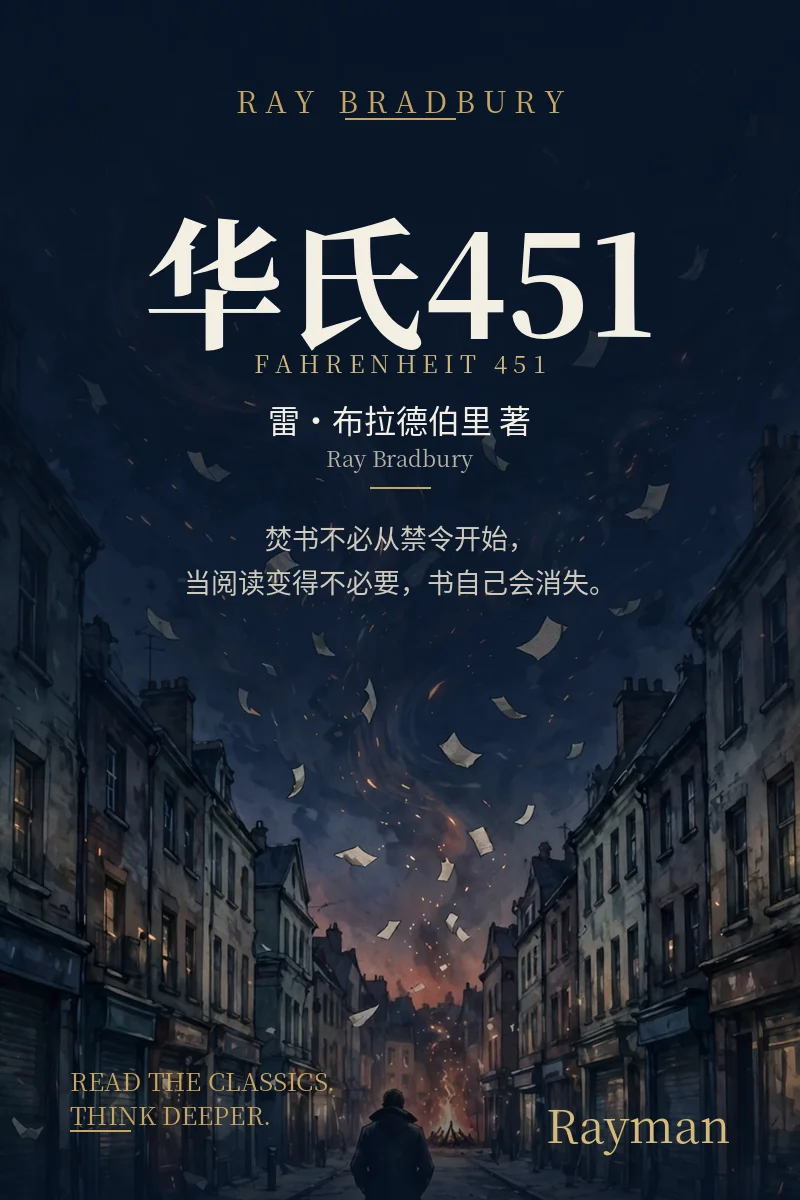
Fahrenheit 451
《华氏451》
- Published
- 1953
- Category
- Literature & Fiction
- Original language
- en
- Source list
- Daily Pick
Book burning need not begin with a ban: once reading becomes unnecessary, books disappear on their own
Imported from a third-party reading list or added as a daily pick — bibliographic facts, the source framing, and a full reading guide.
Source theme
Book burning need not begin with a ban: once reading becomes unnecessary, books disappear on their own
What is this book about?
Published by Ballantine Books in October 1953, this is the dystopian novel Ray Bradbury expanded from his 1951 novella The Fireman. It is set in a future where books are outlawed and firemen are employed not to put out fires but to start them. Guy Montag has spent ten years at the work before a chance encounter leads him to question what he has been destroying. The book falls into three sections, The Hearth and the Salamander, The Sieve and the Sand and Burning Bright, and follows an enforcer becoming a carrier of what he was meant to erase. His information environment consists of wall-sized interactive television, Seashell ear-thimbles and reading matter abridged into summaries. What the novel describes in most detail is not the machinery of prohibition but the ordinary functioning of a society that no longer needs books: texts shortened, replaced by entertainment, revised under pressure from one group after another, until burning them becomes a public spectacle. A scattered group of people commit what they have read to memory, substituting recollection for paper.
Why read it?
Because it turns censorship from a political event into a set of conditions that can be checked one by one, and because its conclusion runs against intuition: the burning is not where tyranny begins but where it ends up. Bradbury later insisted repeatedly that the culprit is the people, not the state. Captain Beatty says as much in the novel — no decree came down from the government; technology, mass exploitation and minority pressure did the work — while Faber says the American population simply stopped reading on its own. The transferable framework has three parts: content compressed to fit a shorter attention span, reading displaced by less demanding entertainment, and group pressure that leads publishers to censor themselves first. None of the three requires a ban, yet together they make a book unnecessary. That is worth holding against a present in which content is effectively unlimited and answers are instantaneous: preventing people from reading is far less effective than making reading unnecessary. Nor is the book harmlessly canonical. The New York Times reviewed it unfavourably in 1953, accusing Bradbury of a virulent hatred of radio, television, film, sport and the automobile; Anthony Boucher and J. Francis McComas faulted it as padded and too often mere verbal brilliance; and his later reframing of the theme from political censorship to mass media has itself been read as diluting institutional responsibility. What changes is how you ask: from who is banning books to what structure of attention makes a book not worth reading. Evidence of standing: (1) a standalone Wikipedia article for the novel, giving 19 October 1953 and Ballantine Books; (2) the 1954 American Academy of Arts and Letters Award in Literature, the 1954 Commonwealth Club of California Gold Medal, the 1984 Prometheus Hall of Fame Award and the 2004 Retro Hugo Award, all listed on that article; (3) substantial contemporary reviews in The New York Times (1953, unfavourable), Galaxy Science Fiction (Groff Conklin, 1954) and the Chicago Sunday Tribune (August Derleth, 1954); (4) number seven on the New York Public Library list of top check-outs of all time, offered here as context rather than counted. The Chinese translation, Hua Shi 451 by Yu Eryan (Shanghai Translation Publishing House, 2017, ISBN 9787532775491), is an officially published edition; the 2005 Chongqing Press edition holds 8.1 on Douban from 2,184 ratings, below the 8.5 / 1,000 threshold, so it is not counted. Goodreads rating counts were not obtained and are not cited.
Core Ideas
- The minimal sufficient condition for censorship is not a ban but the disappearance of demand: once content is abridged for shorter attention, reading is displaced by easier entertainment, and group pressure makes publishers censor themselves first, burning a book is only the last step. Those three tests are enough to judge an information environment; no decree need appear.
- The responsibility lies with the public, not the state. Through Beatty and Faber the novel reverses the causal order: people stopped reading first, and institutions then wrote the accomplished fact into rules. Bradbury later said repeatedly that what he had written was about mass media such as television marginalising the reading of literature.
- Entertainment is not merely diversion but a form of governance: burnings are staged as spectacles, wall screens supply unbroken companionship, and ear-thimbles build an emotional barrier. Compliance needs no coercion if non-compliance can be made troublesome, lonely and dull.
- Memory is the last carrier, but not a solution. Those who learn books by heart preserve the text while turning it from a public object that can be consulted and disputed into private content sealed inside individuals. Once readability and checkability come apart, knowledge loses the chance to be refuted.
- Revision has many authors. In his 1979 coda Bradbury wrote that there is more than one way to burn a book and that every minority feels entitled to tear out a page. Censorship can therefore be distributed across countless well-meaning hands, with no one required to admit to censoring.
What questions does this book try to answer?
- If no book is banned but nobody is willing to finish one, has freedom of expression already failed?
- When content can be generated without limit, what is actually scarce: books, attention, or the patience to be contradicted by a text?
- Does placing responsibility on public taste conveniently absolve institutional censorship?
- When a text survives only in memory and cannot be consulted or checked, what is being preserved: knowledge, or a copy of knowledge?
Who should read it?
People in content, product and recommender systems who decide daily what others will see; readers concerned with the information environment rather than with prohibition alone; teachers and parents puzzled by why long texts no longer get finished. It is not for anyone after a straightforward chase narrative: the book supplies a framework for judging attention, and the plot is the device that pushes that framework to its limit.
How to Read It
Read the first section to establish the causal line about who abandoned reading first. Then dwell on Beatty's account in the second section — no decree came from the government — which is the book's most counter-intuitive claim, and set it beside Faber's remark that people simply stopped reading on their own. The third section moves quickly and can be taken in one sitting. Keep one tension in view: in 1953 Bradbury worried about books being removed from shelves, while in a 2007 interview he said readers had mistaken his subject and that the book was about mass media marginalising literature. That shift is itself material for argument. The Chinese edition by Yu Eryan (Shanghai Translation Publishing House, 2017) is the one to use. If reading it alongside Brave New World, note that the two books treat pleasure very differently.
Reading Notes
2026-11-09
The strongest device is not who orders the burning but that the public had abandoned books voluntarily, making censorship a result rather than a cause. The causal story is thin: media, institutions and working life do no explanatory work, so nothing can show the attribution running the wrong way.
The novel shifts where responsibility sits. The usual dystopian picture makes the destruction of books a prohibition imposed from above; this one offers a harder version to argue with: people had already been drawn away by amusement that was faster, lighter and easier to satisfy, books became unnecessary and mildly antisocial, and the ban merely added paperwork to a settled fact. Burning is not the beginning of oppression but the aftermath of indifference. What changes is the direction of the question. If books were put down voluntarily, the question is not how to preserve them but what kind of daily life made sustained attention stop seeming worthwhile. Reversing the fireman's role into that of the burner simply writes the maintenance of order and the erasure of memory as two faces of one routine. That step lifts the work above a general complaint about censorship. The easily missed point is how single the explanation is. Nearly all causal weight rests on amusement making people give books up willingly: how technology altered the cost of reading, how working hours squeezed attention, how households and schools transmitted habits, how publishing and distribution changed — none of these do explanatory work and all appear as scenery. A single cause keeps the narrative clean, but it also explains too many situations to be corrected by any one of them. The counter-case has to be put plainly. Deciding whether amusement actually caused the abandonment requires comparisons: what happened in communities where amusement was equally abundant yet reading did not decline, whether reading recovered once working hours fell, how circulation figures moved before any ban appeared. The live question is modest: vary the cost of media, disposable time and conditions of circulation one by one, and note which change breaks the causal chain in the book.
