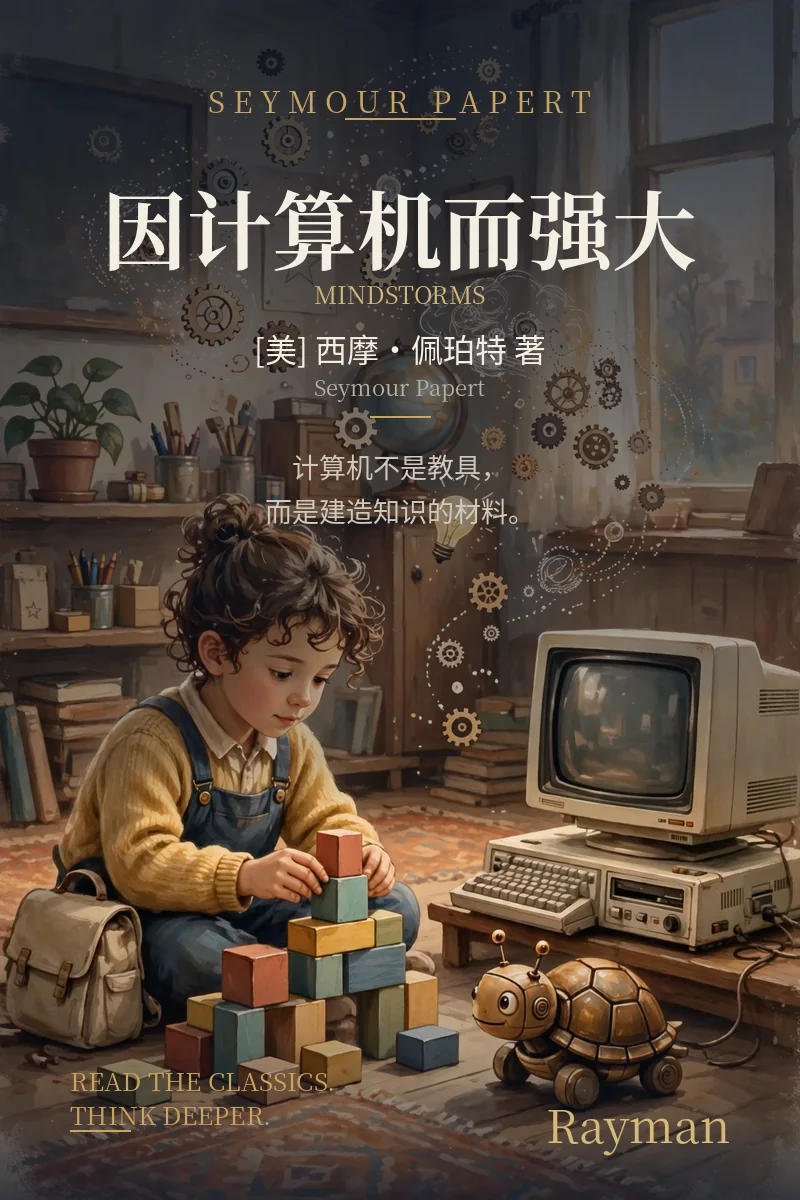
Education & Reflection 1980 Daily Pick
Mindstorms
《因计算机而强大》
- Published
- 1980
- Category
- Education & Reflection
- Original language
- en
- Source list
- Daily Pick
The computer as material for building knowledge, not a teaching machine
Imported from a third-party reading list or added as a daily pick — bibliographic facts, the source framing, and a full reading guide.
Source theme
The computer as material for building knowledge, not a teaching machine
What is this book about?
Published in 1980, Mindstorms is the central educational work of Seymour Papert, a mathematician and a pioneer of artificial intelligence. Its question is concrete: what happens to school if every child has a computer? Papert's answer ran against the prevailing one. The point of the computer is not to deliver instruction more efficiently but to let children build things that run, break and can be repaired — turning abstract knowledge into objects they can handle. Drawing on Logo, the language he helped create, and on Turtle graphics, he shows how children learn geometry and logic inside a 'microworld': a restricted but complete environment in which exploration is possible. He also sketches the 'samba school', where learners gather around projects they actually care about rather than being sorted by age. The book fuses Piaget's genetic epistemology with Papert's own work in artificial intelligence, and states the view later called constructionism.
Why read it?
Most current discussion of AI and education asks how technology can make instruction more efficient — precisely the framing Papert criticised more than four decades ago. His question is more fundamental: what kind of material lets a child build knowledge rather than receive it? The book offers not just a position but a transferable test: for any educational technology, ask what the learner gets to construct. It is also an honest counter-example: when Logo entered schools at scale, evaluations did not show achievement gains, and that gap deserves the attention of anyone now selling AI into classrooms.
Core Ideas
- Constructionism: knowledge is not transmitted but built by the learner while constructing a concrete artefact; 'objects-to-think-with' carry concepts better than abstract explanation.
- Microworlds: cut a complex domain down to an environment with few rules and immediate feedback, where trial and error is safe — Turtle graphics is a microworld for geometry.
- Debugging as a model of learning: a failing program is not a failure but an externalised version of 'where is my thinking wrong'; people who debug code learn to debug their own reasoning.
- Against technological determinism: computers do not improve education by themselves, and treating them as automatic instructors merely repackages old teaching in a more expensive shell.
What questions does this book try to answer?
- If knowledge must be built rather than transmitted, what exactly is teaching doing?
- Why does school mathematics convince so many children that they have no mathematical gift, a conviction rarely produced elsewhere?
- By what standard should an educational technology be judged: test scores, or what learners can build?
Who should read it?
For teachers, curriculum designers and anyone building AI products for education; also for parents, because it changes how you interpret a child's 'I can't do this'. Readers interested in cognitive science and the Piagetian tradition will find it a compact introduction to constructionism. Those looking for immediately applicable lesson procedures will not find them here.
How to Read It
Focus on the first four chapters, where 'objects-to-think-with' and the microworld idea are established; the middle chapters on mathematics and 'school math' are the sharpest and can be read on their own. Papert argues by anecdote and example, so it helps to note down the specific practices he is arguing against. For the later argument, continue with The Children's Machine (1993) and set it against recent empirical work on computational thinking.