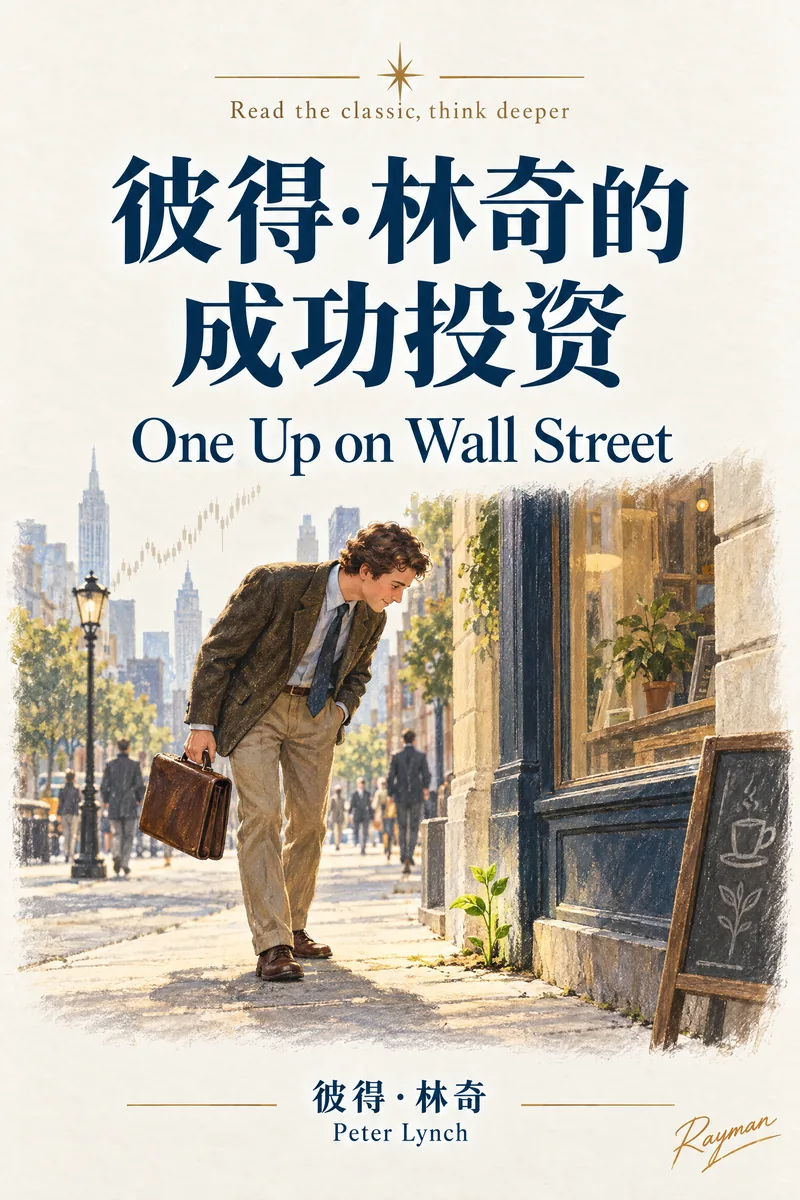
Investment 1989
One Up on Wall Street
《彼得·林奇的成功投资》
- Published
- 1989
- Category
- Investment
- Difficulty
- Beginner
- Reading time
- ~10 hours
- Original language
- en
The Classic Index is not an objective scientific measure. It is this site's personal curation score.
What is this book about?
Lynch argues that amateur investors hold an information advantage over institutions in industries and consumer situations they know firsthand, and that with basic fundamental homework they can buy tenbaggers before Wall Street notices. He also insists that a good company is not automatically a good stock — price decides the return.
Why read it?
It pulls equity research back into daily life: you may notice a store improving before any analyst does. It is equally honest about the line that matters — business quality and stock returns are two different things.
Core Ideas
- The amateur’s edge comes from direct observation of products and industries, not from faster access to information.
- Companies fall into recognizable categories: slow growers, stalwarts, fast growers, cyclicals, turnarounds, and asset plays.
- A good company is not automatically a good stock; the purchase price determines the return.
- Do not sell a sound company merely because its price has fallen, so long as the fundamentals hold.
What questions does this book try to answer?
- Do ordinary investors have a real edge over institutions, and where does it lie?
- How does one distinguish a good company from a good stock?
Who should read it?
For ordinary investors willing to research individual companies. It reads easily, though a little financial literacy helps.
Related Books
If you like this book