Literature & Fiction 1951 AZM's list
The Conformist
《同流者》
- Published
- 1951
- Category
- Literature & Fiction
- Original language
- it
- Source list
- Politics, Sociology & Institutional Critique
An ordinary man drifts into complicity with tyranny.
Imported from a third-party reading list or added as a daily pick — bibliographic facts, the source framing, and a full reading guide.
Source theme
An ordinary man drifts into complicity with tyranny.
What is this book about?
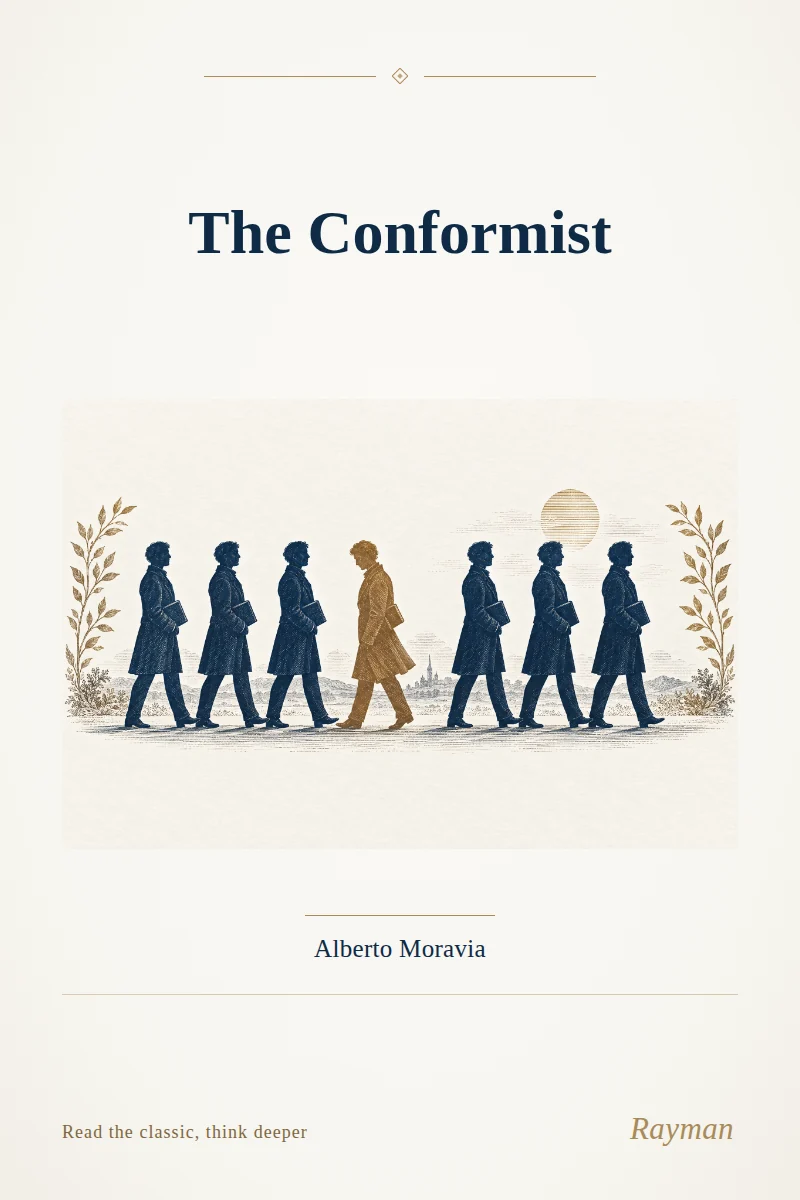
Moravia's 1951 novel. Its protagonist, Marcello, is an ordinary man under Fascist rule. What he wants is not power but normality — to be accepted by the mainstream, to stop seeming odd. For the sake of that security he walks step by step into the Fascist assassination apparatus and becomes a tool in its hands. The novel does not ask how bad men do evil; it asks something colder: why a man who is not a fanatic, who does not truly believe the ideology, would willingly hand himself over.
Why read it?
A landmark of Italian realism, but its subject is not heroes or villains — it is the most ordinary person you know. Moravia's insight is that what turns people into accomplices of tyranny is usually not belief but an obsession with being normal: not wanting to be the odd one, not wanting to be shut out. It unsettles more than any theory, because you will recognize a piece of yourself in Marcello — and that recognition is the point.
Core Ideas
- A blind pursuit of "normality" and mediocrity drives ordinary people to give up thinking for themselves.
- What turns a person into an accomplice of tyranny is often not belief but the fear of being shut out by the mainstream.
- The banality of evil does not grow overnight; it breeds quietly inside an individual.
- To fit in and stop feeling like an outsider, a person may sell his soul without much resistance.
What questions does this book try to answer?
- Why would a man who is no fanatic — who does not even believe in the system — become an accomplice of tyranny?
- How does the banality of evil actually breed, step by step, inside an ordinary person?
Who should read it?
For readers who come to fiction with an interest in political psychology, and for anyone wanting to understand the position of ordinary people under a totalitarian regime. It is a patient psychological novel: the plot is not driven by suspense but by the layered dissection of one man's inner life.
How to Read It
Moravia is merciless: his conformist is not coerced by violence but volunteers to sell his soul in order to fit in and stop feeling like an outsider. Do not rush to judge Marcello; first ask whether each of his steps of "compliance" looked reasonable at the time — that is where the real horror lies. It is a psychological novel with a slow tempo, best read calmly rather than chased for plot.