World History 2012 Daily Pick
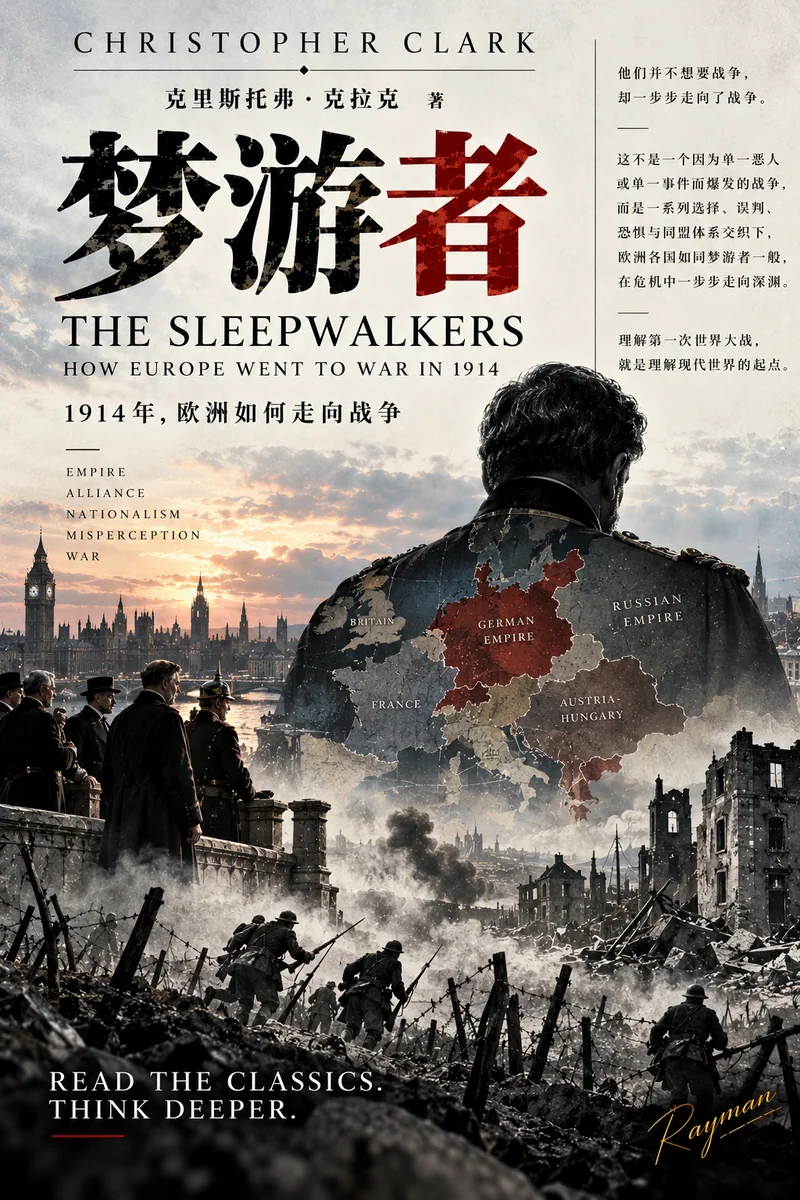
The Sleepwalkers
《梦游者》
- Published
- 2012
- Category
- World History
- Original language
- en
- Source list
- Daily Pick
No one truly wanted the war, yet Europe walked into it: Clark asks not who was guilty but how it happened
Imported from a third-party reading list or added as a daily pick — bibliographic facts, the source framing, and a full reading guide.
Source theme
No one truly wanted the war, yet Europe walked into it: Clark asks not who was guilty but how it happened
What is this book about?
The Sleepwalkers is a 2012 book by the Australian historian Christopher Clark devoted to the origins of the First World War. It refuses the usual question of who lit the fuse, and instead takes apart the decade before the summer of 1914: the escalating hostility between Austria-Hungary and Serbia, the internal structures of the various decision-making centres, the chain effects of alliance commitments, and signal after signal that was misread. Clark keeps his focus on the decision-making centres at Vienna, Berlin, St Petersburg, Paris, London, and Belgrade, following how the people, institutions, and factions within them chose under conditions of incomplete information and mutual suspicion. The book falls into three parts: the roads to Sarajevo, the crisis of 1914, and the aftermath. Its conclusion is counter-intuitive — the war was not the plot of any single power but the combined product of many, controlled fully by none.
Why read it?
It is one of the most forceful refutations of simple attribution. We are used to blaming a catastrophe on a villain or a nation's ambition; Clark shows instead that a system with many participants, fragmented information, and layered commitments can push everyone toward war without anyone genuinely wanting it. That logic of structural failure is not confined to history — it applies equally to corporate decisions, investment judgements, and choices of technology: when everyone acts with local rationality, the whole can still slide into disaster. The value of reading it lies not in remembering who was right or wrong, but in learning to recognise the moments when a system is drifting out of control and no one is touching the brake — and in understanding how the fragmentation of decision-making itself becomes the greatest source of risk.
Core Ideas
- Shared responsibility rather than single guilt: the war was not the plot of one power but the outcome of interaction and mutual escalation among Austria-Hungary, Serbia, Russia, Germany, France, Britain, and others; asking who was most to blame obscures the real mechanism.
- The fragmentation of decision-making: diplomacy and military policy were dispersed among monarchs, prime ministers, foreign ministers, chiefs of staff, and factions, without a single will or coordination — a state often sent contradictory signals to itself.
- The chain effect of alliances: commitments that looked defensive automatically magnified a local conflict into a general war; once signed, treaties narrowed the room for manoeuvre in a crisis.
- The Balkans were the fuse, not the whole charge: Serbia's expansionist claims and Austria-Hungary's existential anxiety formed a structural powder keg, and the assassination at Sarajevo was the accident that fell on dry kindling.
- The sleepwalker metaphor: the decision-makers were not unconscious but deliberately taking risks, with little foresight of the consequences; all of them weighed, calculated, and bet, and woke to find themselves already at war.
- Contingency interwoven with structure: individual choices, misjudgements, and luck mattered as much — history is not a necessary script, but structural tension magnifies the consequences of accidental events without limit.
What questions does this book try to answer?
- Why did a great war that almost no one truly wanted nonetheless happen?
- Should responsibility rest with individuals, with states, or with the system as a whole?
- Were the decision-makers taking deliberate risks, or were they being pushed along by structure?
Who should read it?
Suited to readers interested in world history, international relations, and strategy; especially useful to those who must make complex decisions — managers, investors, policy researchers — because it describes a transferable mode of failure rather than a mere episode of the past. Readers who already know the basic outline of the First World War will gain most. No specialist training in history is required.
How to Read It
The book is long; there is no need to read it straight through. Begin with Part One to see how the long hostility between Austria-Hungary and Serbia took shape; then read Part Two, which follows the escalation day by day from late June to early August 1914 and is the tensest stretch of the book; finish with Part Three and the conclusion. As you read, attend to the detail of multiple voices within each state — it explains the outbreak better than the motives of any single decision-maker. Read it alongside The Guns of August for the military course of the war once it began, and against The Rise and Fall of the Great Powers for the structural shifts of national power. The Chinese edition is The Sleepwalkers, published by CITIC Press.