Finance 2000
When Genius Failed
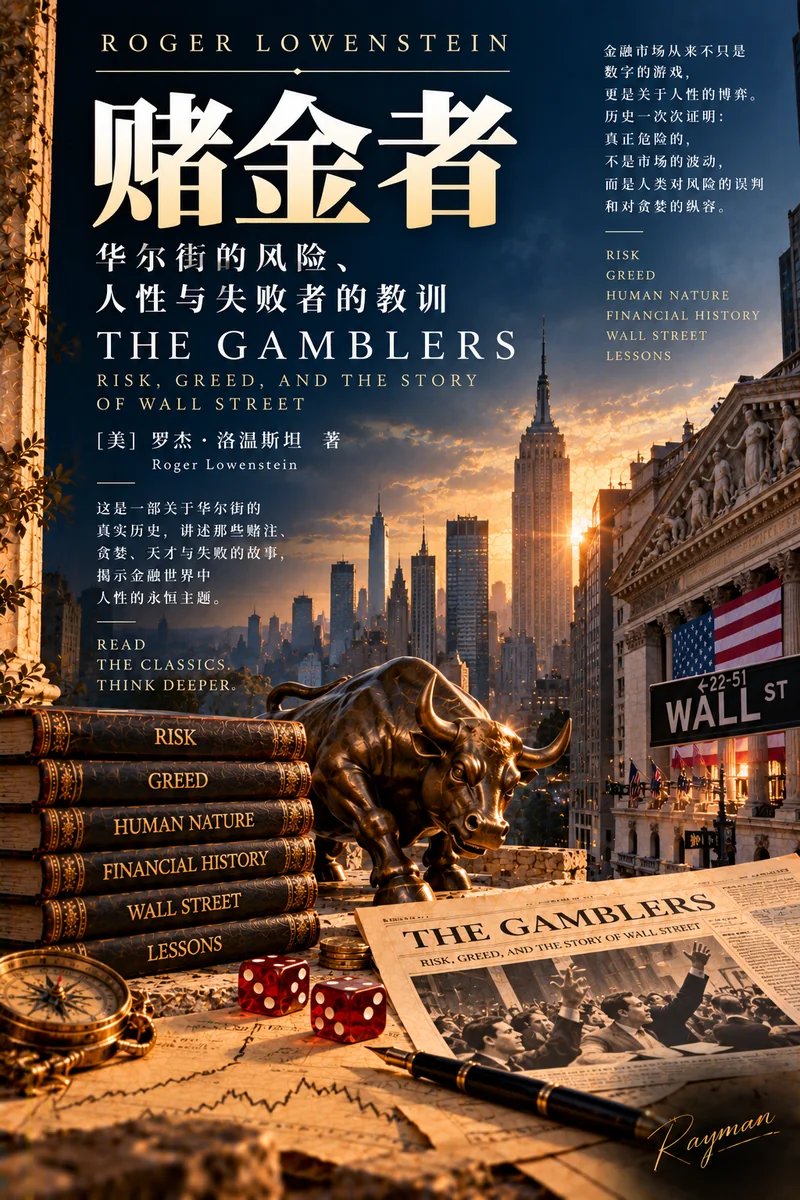
《赌金者》
The Rise and Fall of Long-Term Capital Management
- Published
- 2000
- Category
- Finance
- Difficulty
- Intermediate
- Reading time
- ~10 hours
- Original language
- en
The Classic Index is not an objective scientific measure. It is this site's personal curation score.
What is this book about?
Long-Term Capital Management gathered two Nobel laureates and some of Wall Street’s best traders, then collapsed under leverage within months in 1998, forcing the New York Fed to convene a private rescue. Lowenstein writes not about the models but about overconfidence and the illusion of liquidity.
Why read it?
It is the fullest case study of why brilliance is not durability: the models assumed prices would converge, but leverage decides whether you survive until they do. Anyone relying on borrowed money or short-term funding should read it as an anatomy of risk.
Core Ideas
- High leverage turns a modest deviation into an unrecoverable loss; a “small probability” event becomes close to a certainty at a sufficiently large position.
- Correlations converge under stress: positions that looked diversified fall together in a panic.
- Liquidity is precisely what disappears when you need it, and historical data cannot measure it.
- When one institution’s failure threatens the whole system, market discipline tends to give way to rescue.
What questions does this book try to answer?
- Why did the most sophisticated quantitative team misjudge risk so completely?
- Does the principle of letting firms bear their own losses survive contact with systemic risk?
Who should read it?
For investors, risk managers, and readers of financial history. Basic financial literacy is enough; the model details are not the point.
Related Books
If you like this book