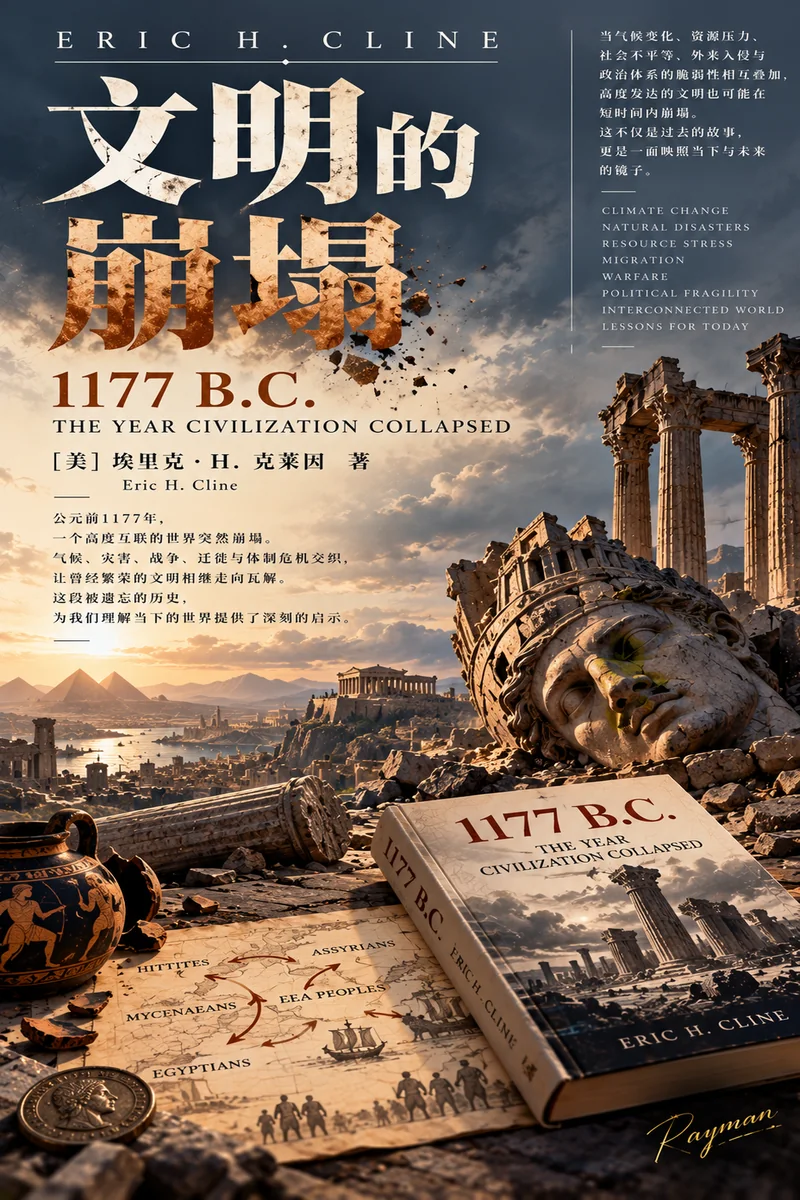
World History 2014 Daily Pick
1177 B.C.
《文明的崩塌》
- Published
- 2014
- Category
- World History
- Original language
- en
- Source list
- Daily Pick
The Late Bronze Age Mediterranean did not fall to a single invasion but to a systemic collapse produced by multiple simultaneous shocks
Imported from a third-party reading list or added as a daily pick — bibliographic facts, the source framing, and a full reading guide.
Source theme
The Late Bronze Age Mediterranean did not fall to a single invasion but to a systemic collapse produced by multiple simultaneous shocks
What is this book about?
1177 B.C. is the American archaeologist Eric H. Cline's 2014 book on the collapse of the Late Bronze Age world. Around 1177 BCE the great powers of the eastern Mediterranean — Mycenae, the Hittite empire, Ugarit, and others — fell within a few decades, while Egypt, though it repelled the invaders it called the Sea Peoples, never recovered its former strength. Cline rejects the traditional single-cause explanation of foreign invasion. Setting archaeological evidence alongside cuneiform tablets, Hittite and Egyptian records, and studies of climate and earthquakes, he argues that the collapse was a 'perfect storm' produced by drought, famine, internal revolt, the breakdown of trade networks, and invasion acting together. Drawing on collapse theory, he treats the Late Bronze Age Mediterranean as a highly interconnected international trading system whose prosperity and fragility had the same source, and closes by comparing that case with today's globalized world.
Why read it?
The book demonstrates one of the most useful habits in historical thinking: when confronted with a catastrophe, ask how many causes coincided rather than rushing to name a single culprit. The Late Bronze Age Mediterranean resembles the modern world in striking structural ways — high specialization, long-distance dependence, trade networks that look permanent. Cline's method is especially valuable for anyone who assesses risk: genuine systemic risk usually comes not from one shock but from several stresses arriving at once, after a system has lost its redundancy. The narrative is clear and brisk, making it the most accessible entry into the question of why complex societies collapse.
Core Ideas
- Single-cause explanations cannot account for the Late Bronze Age collapse; drought, famine, internal revolt, broken trade routes, and invasion combined into a 'perfect storm'.
- A highly interconnected trading system brings prosperity and fragility together: the deeper the specialization, the larger the cascading losses when the network fails.
- The invaders called the Sea Peoples are better understood as a consequence and amplifier of collapse than as its sole cause.
- The interdependence of the great powers — diplomacy, dynastic marriage, gift exchange, trade — became the channel through which crisis propagated when the system came under strain.
- The collapse of a civilization is rarely a sudden destruction; it is a process in which redundancy is exhausted over decades.
What questions does this book try to answer?
- Why does a prosperous, interconnected, apparently stable civilization disintegrate within one or two generations?
- When several crises arrive at once, what determines whether a society recovers?
- What structural similarities exist between today's globalized world and the Late Bronze Age Mediterranean?
Who should read it?
Readers interested in world history, ancient civilizations, and archaeology, and equally those concerned with systemic risk — anyone working on investing, supply chains, geopolitics, or risk management will profit directly from the 'multiple shocks' framework. No archaeological background is required; the author presents technical evidence accessibly.
How to Read It
Read it in order; the book builds its case for how the collapse happened step by step and is not long. Focus on how the author fits evidence of different kinds together rather than on memorizing which event occurred in which year. Read it alongside Joseph Tainter's The Collapse of Complex Societies: Tainter supplies the theoretical frame — diminishing returns and the cost of complexity — while Cline supplies the concrete case, and together they turn 'collapse' from a story into a mechanism.