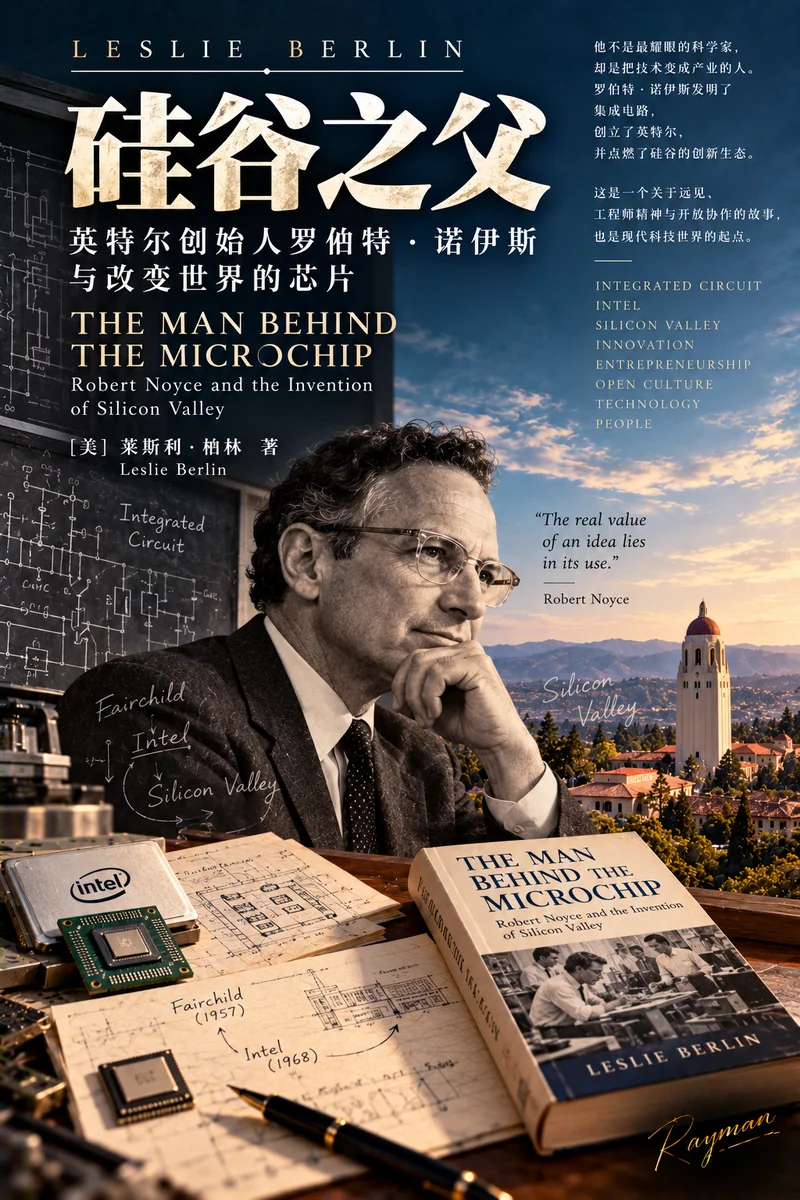
Technology & Science 2005 Daily Pick
The Man Behind the Microchip
《硅谷之父》
- Published
- 2005
- Category
- Technology & Science
- Original language
- en
- Source list
- Daily Pick
A technical breakthrough persists as an industry only when paired with institutions that let engineers share in the rewards
Imported from a third-party reading list or added as a daily pick — bibliographic facts, the source framing, and a full reading guide.
Source theme
A technical breakthrough persists as an industry only when paired with institutions that let engineers share in the rewards
What is this book about?
The Man Behind the Microchip is the historian Leslie Berlin's 2005 biography of Robert Noyce. Noyce was a co-inventor of the integrated circuit and a co-founder of two companies, Fairchild Semiconductor and Intel. Berlin begins with his Iowa childhood in 1927 and follows him through physics training at MIT and Shockley Semiconductor Laboratory to the departure of the 'traitorous eight' in 1957 and the founding of Fairchild, then to his 1959 proposal for an integrated circuit built on the planar process, and finally to the creation of Intel with Gordon Moore in 1968. Berlin writes about institutions as much as about a person: she traces how Noyce deliberately built a flat, open, failure-tolerant corporate culture, and how venture capital, equity compensation, and engineer-founded startups became a repeatable model. The book is also a history of how Silicon Valley came to be.
Why read it?
This is a key biography for understanding why the semiconductor industry took the shape it did. Noyce's life runs through every crucial transition from the transistor to the integrated circuit and the microprocessor, yet his real influence was organizational: he showed that a technical breakthrough only persists when paired with institutions that let engineers share in the rewards. For those working in materials, devices, equipment, and supply chains, the book's specifics — how the planar process solved reliability and manufacturability, how silicon displaced germanium, how a laboratory becomes volume manufacturing — are more concrete than any industry report. For managers it is a casebook on how a culture can be deliberately designed.
Core Ideas
- The integrated circuit came from collective conditions plus individual insight: Hoerni's planar process supplied the technical premise, and Noyce's interconnection scheme turned it into a manufacturable chip.
- The planar process was the watershed of semiconductor manufacturing: protecting junctions beneath an oxide layer solved reliability and manufacturability at once, and opened the way to later lithographic integration.
- Silicon displaced germanium not only through material properties but through the combined pressures of process, cost, and supply chain.
- Noyce's managerial legacy was institutional design: flat structures, open communication, shared equity and options, and tolerance of failure, which let talent start companies again without leaving the ecosystem.
- Individual genius needs an environment that can replicate its results; Silicon Valley's distinctiveness lay in turning a single success into a repeatable process.
What questions does this book try to answer?
- What conditions must a technical breakthrough pass through before it becomes a large-scale industry?
- Between the individual creativity of engineers and the institutions of a company, which shapes the other?
- Why does a region keep producing new companies rather than a single successful firm?
Who should read it?
Suited to people working in semiconductors and electronic materials, managers in hardware and manufacturing, founders, and readers interested in the history of the technology industry. Anyone who wants to understand how chips came to be made and how Silicon Valley formed will get more concrete detail here than from industry reports. No technical background is required, though readers curious about process detail will get more out of it.
How to Read It
Reading in chronological order works best, since the book follows Noyce's career. The key sections are the Fairchild years — the planar process and the integrated circuit — and the early Intel years of memory and the microprocessor, which together determined the shape of today's industry. Read it alongside Crystal Fire: that book covers the invention of the transistor at Bell Labs, while this one covers how it was industrialized, and the pair forms a complete prehistory of the industry chain.