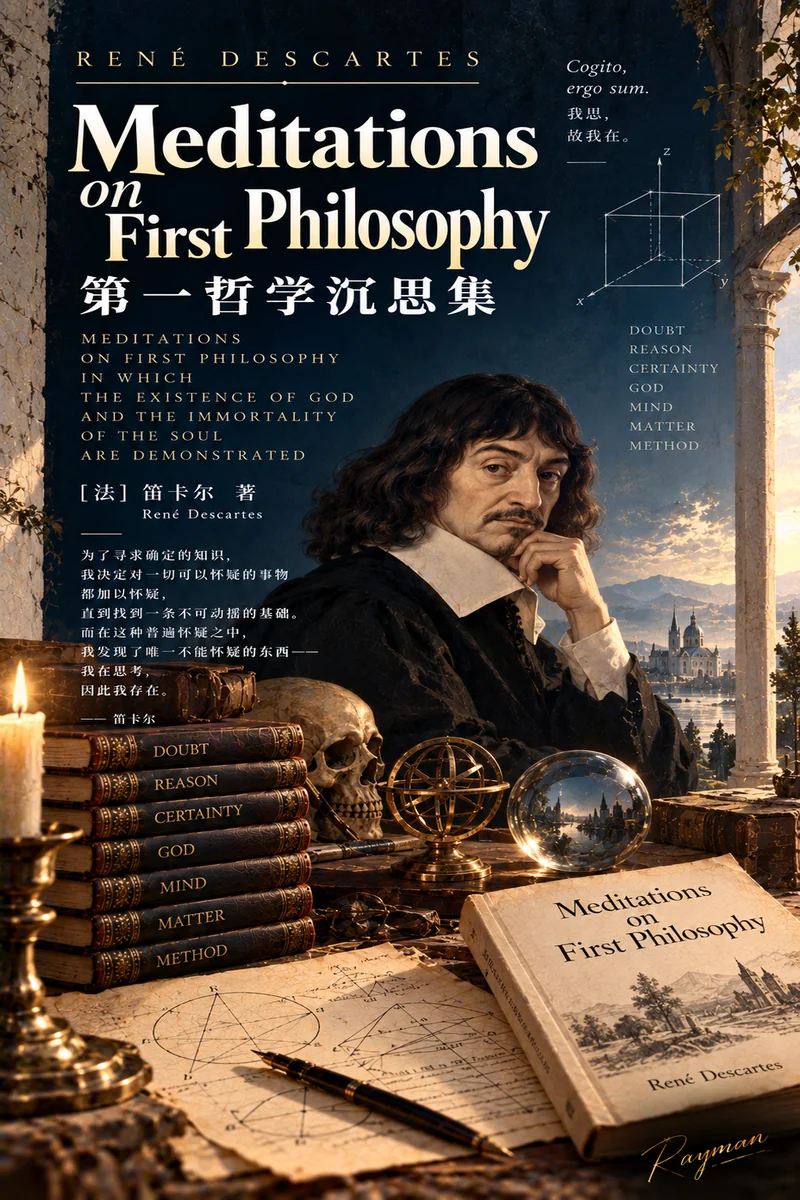
Philosophy 1641 Daily Pick
Meditations on First Philosophy
《第一哲学沉思集》
- Published
- 1641
- Category
- Philosophy
- Original language
- la
- Source list
- Daily Pick
Using universal doubt as a method to find an indubitable foundation for knowledge
Imported from a third-party reading list or added as a daily pick — bibliographic facts, the source framing, and a full reading guide.
Source theme
Using universal doubt as a method to find an indubitable foundation for knowledge
What is this book about?
Meditations on First Philosophy is the work with which Descartes, publishing in Latin in 1641, placed epistemology at the center of philosophy. It consists of six meditations, accompanied by objections from contemporaries such as Hobbes, Arnauld, and Gassendi together with Descartes's replies. The first meditation launches a systematic doubt: whatever can be called into question — sensory experience, the external world, even mathematical truths — is set aside, so that insecure beliefs can be cleared away and an indubitable starting point located. The second meditation reaches the cogito: even if everything else can be doubted, the existence of the thinking 'I' cannot. From there Descartes argues for the existence and perfection of God, proposes clarity and distinctness as the criterion of truth, distinguishes mind and body as two kinds of substance, identifies extension as the essence of material things, and concludes that mind and body are really distinct. Written as a first-person exercise rather than a treatise, the book established the problems of knowledge, certainty, and the mind-body relation that modern philosophy has argued about ever since.
Why read it?
This is the shortest path to understanding where modern philosophy begins. Descartes turns doubt from a rhetorical gesture into a method: he does not ask us to disbelieve everything, but to see which beliefs survive scrutiny. That procedure later became a common instrument of both science and philosophy, visible from hypothesis testing to falsifiability. For a contemporary reader its practical value is a trained habit — telling apart 'it seems so to me' from 'I can demonstrate it'. The book is also short and clearly structured, one of the few foundational works of philosophy that can be read in full.
Core Ideas
- Methodological doubt: any belief that can possibly be doubted is suspended, in order to reach a starting point that cannot be doubted.
- The cogito: even if everything else can be doubted, the existence of the doubting, thinking 'I' cannot.
- Clarity and distinctness are the criterion of truth, and the reliability of that criterion is ultimately guaranteed by God's perfection.
- Mind and body are two different kinds of substance: the essence of mind is thought without extension, the essence of body is extension, and the two can be conceived clearly and distinctly apart.
- Error does not come from the intellect itself but from the will reaching beyond what the intellect clearly perceives.
What questions does this book try to answer?
- What can I know with absolute certainty?
- What is the relation between mind and body, and what exactly am I?
- Can sensory experience provide a reliable foundation for knowledge?
Who should read it?
Readers who want to fill in the foundations of philosophy: students in philosophy and the humanities, scientifically trained readers curious about epistemology and method, and anyone in the habit of asking what entitles them to a belief. No prior history of philosophy is required, but patience with a slow, rigorous argument is.
How to Read It
Read the six meditations in order; they are short enough for one sitting, and the First and Second Meditations are the core and deserve close attention. The Objections and Replies need not be read in full, but Arnauld's objections and Descartes's replies are the most useful for understanding his actual position. Read it alongside Damasio's Descartes' Error, which takes the real distinction of mind and body from the Sixth Meditation as its target; the pair makes a line of argument spanning more than three centuries visible.