World History 1981
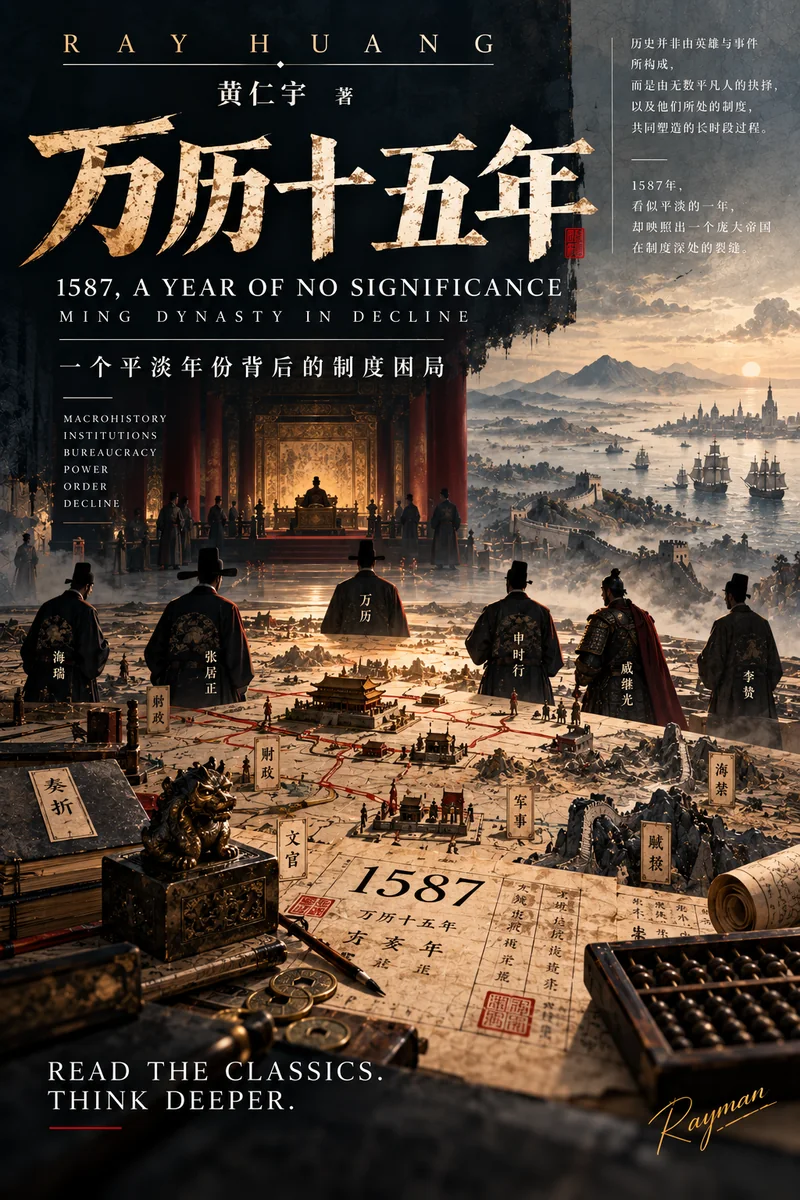
1587, A Year of No Significance
《万历十五年》
The Ming Dynasty in Decline
- Published
- 1981
- Category
- World History
- Difficulty
- Intermediate
- Reading time
- ~12 hours
- Original language
- en
The Classic Index is not an objective scientific measure. It is this site's personal curation score.
What is this book about?
Huang examines a single unremarkable year in the Ming dynasty to show how the empire’s institutional structure — its fiscal system, its bureaucracy, its moralized politics — had already foreclosed the possibility of reform. His method is to read a whole system through a few individuals and small events.
Why read it?
It demonstrates a distinctive historiographical method — macro-history — that explains structural failure through the daily texture of institutions. It is also one of the most widely read works of Chinese history of the twentieth century, and a good entry point for thinking about why systems fail to adapt.
Core Ideas
- The Wanli emperor and his officials were constrained by an institutional order none of them could change alone.
- The Ming fiscal system could not count and mobilize resources the way a modern state must.
- Governance rested on moral rhetoric and personal relationships rather than on impersonal, formal rules.
- Huang argues the dynasty’s failure was structural and long-running, already visible in an ordinary year.
What questions does this book try to answer?
- Why does a vast empire lose its capacity for self-correction while outwardly calm?
- How much room for action does an individual retain inside a structural trap?
Who should read it?
For readers interested in Chinese history and institutional analysis. No specialist training is required; the narrative is welcoming.
Related Books
If you like this book