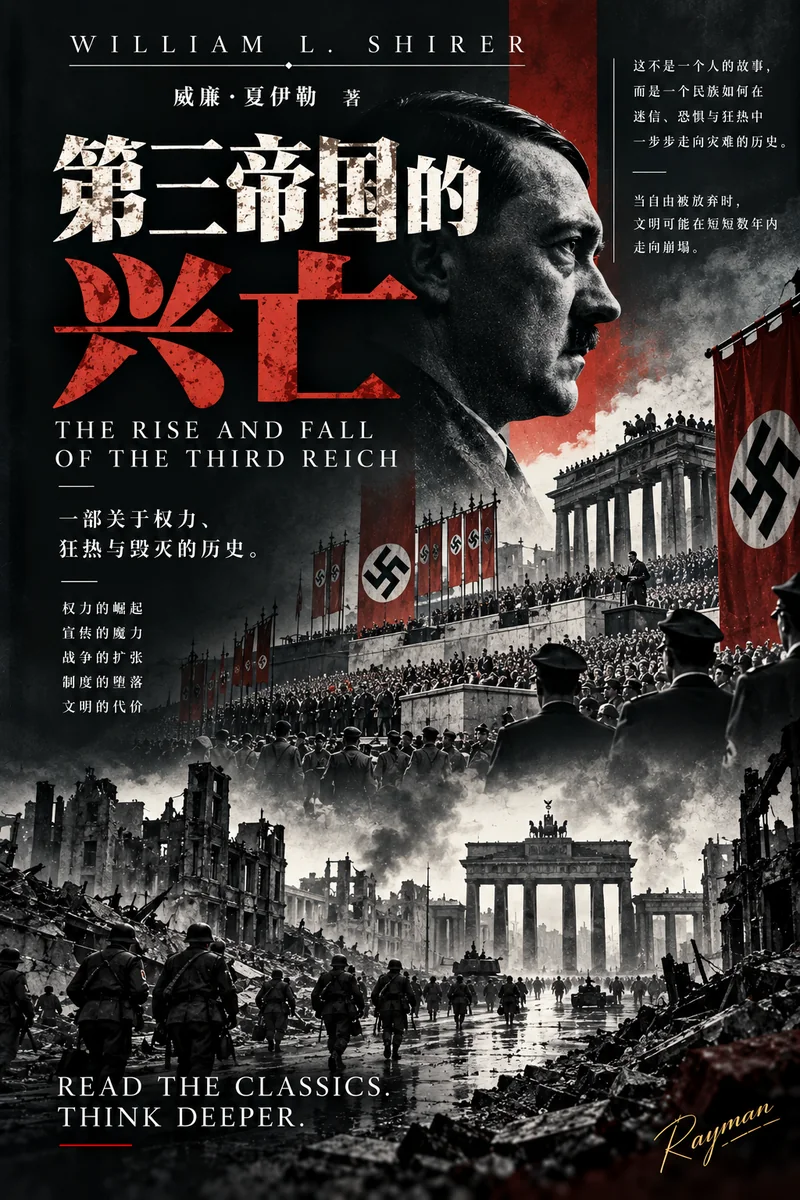
World History 1960
The Rise and Fall of the Third Reich
《第三帝国的兴亡》
- Published
- 1960
- Category
- World History
- Difficulty
- Intermediate
- Reading time
- ~30 hours
- Original language
- en
The Classic Index is not an objective scientific measure. It is this site's personal curation score.
What is this book about?
Shirer, a journalist turned historian, narrates Nazi Germany from its origins to its collapse, drawing heavily on captured documents and on his own reporting from Berlin in the 1930s. It remains one of the most widely read single-volume histories of the period.
Why read it?
It shows how a modern society dismantled its own constitutional order step by step, and it argues from documents rather than hindsight. Several of its interpretive frames have since been revised by historians, so it works best as a starting narrative rather than a final verdict.
Core Ideas
- The Nazi seizure of power was incremental, exploiting legal procedure and institutional weakness rather than a single coup.
- Terror and propaganda worked together; neither alone explains the regime’s grip.
- The regime’s internal structure was often chaotic, with competing fiefdoms, which shaped how policy was actually made.
- Shirer’s interpretive frame, with its appeal to a German national character, has since been widely contested by historians.
What questions does this book try to answer?
- How does a constitutional state slide into dictatorship while staying formally legal?
- How should responsibility be divided between individuals and institutions?
Who should read it?
For readers new to modern history. Follow it with later scholarship to see where its interpretation has been contested.
Related Books
If you like this book