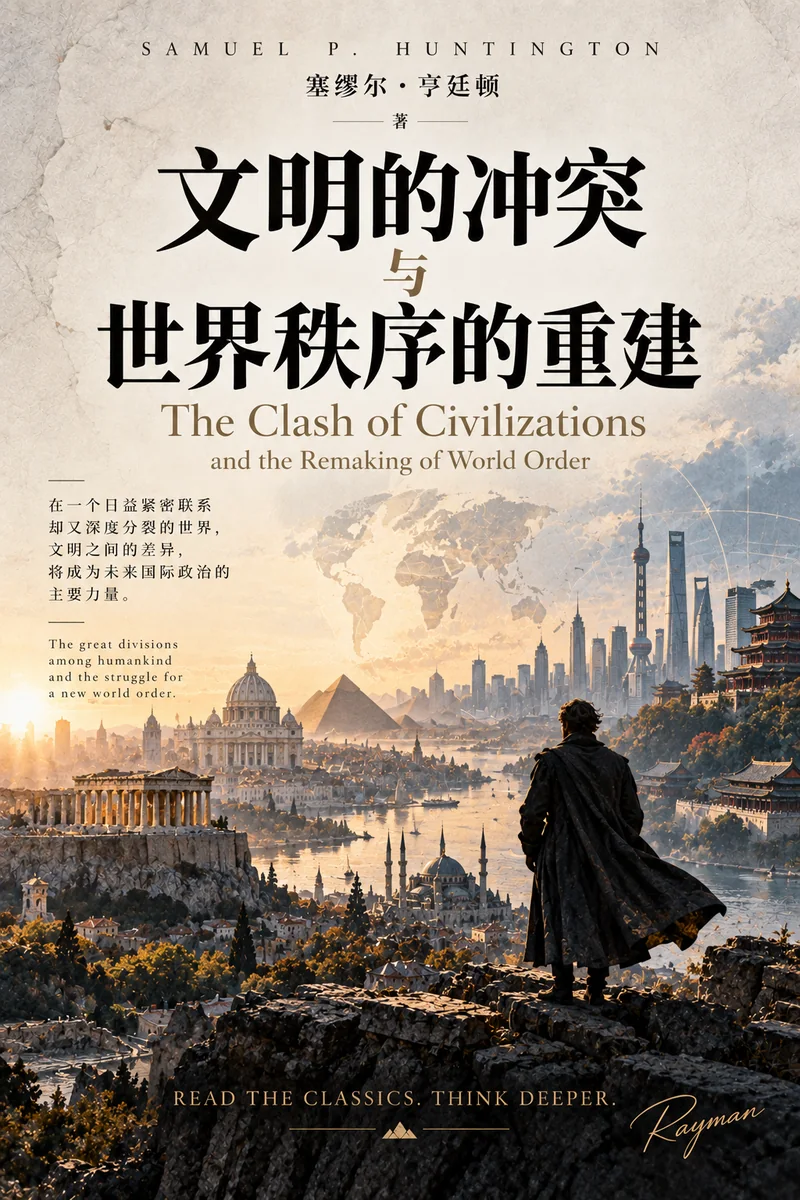
World History 1996
The Clash of Civilizations and the Remaking of World Order
《文明的冲突与世界秩序的重建》
And the Remaking of World Order
- Published
- 1996
- Category
- World History
- Difficulty
- Intermediate
- Reading time
- ~18 hours
- Original language
- en
The Classic Index is not an objective scientific measure. It is this site's personal curation score.
What is this book about?
Huntington advances a predictive thesis: with the Cold War over, the main fault lines of global conflict would shift from ideology and economics to civilizational and cultural identity. It is a claim about the future rather than a description of the present, and much of the scholarly debate since has tested whether it explains post-1991 conflict or distorts it.
Why read it?
Even where it is wrong, it named the categories that policy discourse has used for three decades, and its critics — constructivists and area specialists alike — are best understood against it. Reading it closely is a case study in how a bold thesis shapes and misshapes a field.
Core Ideas
- Once ideology lost its organizing power, cultural and religious identity became the primary axis of group conflict.
- Civilizations are posited as the broadest cultural entities, with fault lines where violence is said to concentrate.
- Western universalism is presented as a source of friction rather than a neutral framework.
- The thesis predicts conflict between civilizations; critics argue it understates conflict within them and the role of states and interests.
What questions does this book try to answer?
- What draws the lines of conflict after the Cold War?
- Is “civilization” an analytical tool or a political construction?
Who should read it?
For readers following international relations and identity politics. Read the methodological critiques alongside it so the thesis stays a thesis.
Related Books
If you like this book