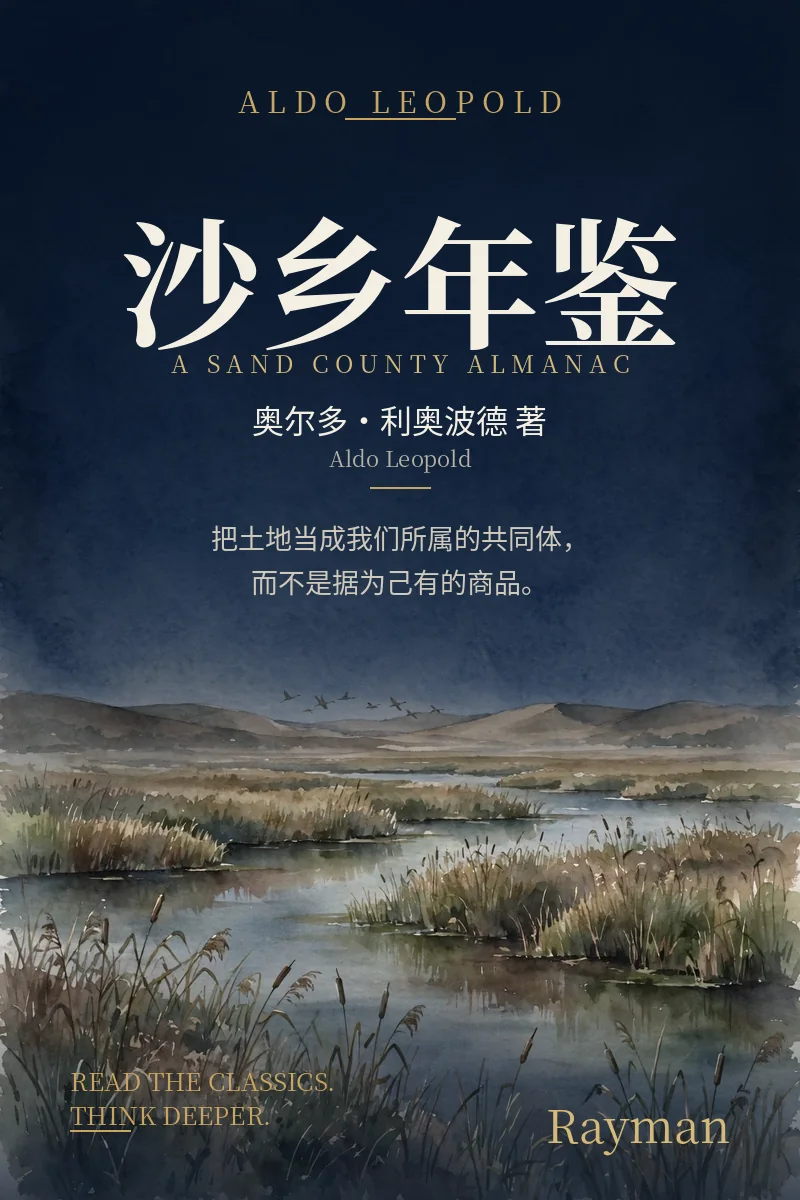
Classic Essays 1949 Daily Pick
A Sand County Almanac
《沙乡年鉴》
- Published
- 1949
- Category
- Classic Essays
- Original language
- en
- Source list
- Daily Pick
Treat the land as a community to which we belong, not a commodity we own
Imported from a third-party reading list or added as a daily pick — bibliographic facts, the source framing, and a full reading guide.
Source theme
Treat the land as a community to which we belong, not a commodity we own
What is this book about?
A collection of essays and philosophical papers by the American ecologist Aldo Leopold (1887–1948), first published posthumously by Oxford University Press in 1949 and edited by his son Luna Leopold. The book falls into three parts. The first records, in the order of the four seasons, the author's first-hand observations of ecological restoration on his farm in Sand County, Wisconsin—snowmelt, oak tree rings, the migration of geese, and the deer paradox that followed the extermination of wolves. The second gathers informal pieces written over forty years of travel through Wisconsin, Iowa, Arizona, Sonora, Oregon, Manitoba and beyond. The third turns to the philosophy behind wildlife conservation and closes with the celebrated essay The Land Ethic: A thing is right when it tends to preserve the integrity, stability, and beauty of the biotic community; it is wrong when it tends otherwise. Leopold argues for converting human beings from conquerors of the land-community into plain members of it, redefining conservation as a state of harmony between men and land. Little noticed at publication, the paperback became a surprise bestseller with the environmental awakening of the 1970s; it has sold over two million copies and been translated into at least fourteen languages. Formal Chinese editions include the Yilin Press 2019 translation by Hou Wenhui and the People's Literature Publishing House 2022 translation by Cao Minglun.
Why read it?
It is not the terminus of lyrical nature writing but an expansion of the boundary of ethics. The counter-intuitive thesis: managing land as a resource, however well, still presupposes human sovereignty; the real turn happens when the criterion of right is rewritten from economic interest to the integrity, stability, and beauty of the biotic community. The portable frame is the conqueror-versus-member distinction. Any technical system that treats nature as a variable to be optimized lands on the opposite side of Leopold; applied to carbon accounting, restoration projects and AI-driven environmental monitoring, the first question is not whether the data are fine-grained enough but on which side of the community the decision-maker places himself. Nor is it innocuous: the land ethic is faulted for sliding from ecological facts directly to ethical oughts, for the vagueness of beauty as a criterion, and for the collision between wilderness protection and local livelihoods in developing-world contexts—objections that form exactly the fulcrum for rereading. What changes is the question, from how to use nature more efficiently to in what sense humans may claim to stand outside it. Evidence of standing: (1) a standalone English Wikipedia article recording the 1949 Oxford University Press first edition, posthumous editing by Luna Leopold, the defining Land Ethic quotation, the 1990 American Nature Study Society poll naming it (with Rachel Carson's Silent Spring) one of the two most honored environmental works of the 20th century, over two million copies sold and at least fourteen translations; (2) a 1949 New York Times Book Review notice, quoted by both the OUP edition description and the Wikipedia article (a trenchant book, full of vigor and bite); (3) publisher endorsement: Oxford University Press's own blog published A Sand County Almanac at 75: the evolution of the land ethic on 22 April 2024, written by Buddy Huffaker and Leah Bieniak of the Aldo Leopold Foundation; (4) Chinese reader platforms: the 2019 Yilin Press edition (Hou Wenhui) holds 8.4 on Douban from 262 ratings, the 2018 Jiangxi People's Press edition 8.8 from 179 ratings, the WeRead recommendation value stands at 85.8%, and a 2022 People's Literature Publishing House translation by Cao Minglun is formally published. These span at least four distinct source types: encyclopedia entry, authoritative review media, publisher site and Chinese reader platform. Time test: first published 1949, 77 years ago as of 2026-11-12. Goodreads exact figures were not obtained this run and are not fabricated. Not counted: Hacker News mention counts and Baidu Scholar citation figures, per the evidence rules.
Core Ideas
- The criterion shift of the land ethic: a thing is right when it tends to preserve the integrity, stability, and beauty of the biotic community, not when it maximizes human economic return. This extends ethics from person-to-person relations to the whole community.
- The conqueror-versus-member distinction: humanity has treated land as property within its sovereignty; Leopold asks us to rewrite that identity as plain membership. Conservation ceases to be resource management and becomes a state of harmony between men and land.
- Ecological literacy precedes policy: the seasonal observations, the passenger-pigeon extinction and the deer paradox after wolf extermination together show that well-meant policies backfire without understanding how land works; ethical judgement rests on long field observation.
- The position is open to refutation: critics object that it slides from ecological description straight to ethical norm, that beauty is a vague criterion, and that wilderness protection collides with indigenous and local livelihoods—serious objections that make it a testable stance rather than an innocuous truth.
What questions does this book try to answer?
- If right is defined as preserving the integrity, stability, and beauty of the biotic community, what test should urban expansion, fallow farmland, or a dammed river each pass to count as right?
- In what sense can humans be members of the land community rather than its conquerors, and what would that identity shift mean at the level of institutions, property rights, and everyday life?
Who should read it?
Readers concerned with environmental ethics, conservation and land policy; writers of nature observation, rural non-fiction and essays; and anyone who wants to test whether slogans such as sustainable development rest on an ethical criterion at all. It is not for readers looking for an action checklist or a technical manual—it offers a conversion of stance, not procedures—and suits those willing to follow slow seasonal observation to a sharp conclusion.
How to Read It
Read in the original order: take the four seasonal observation sections first and resist jumping ahead to The Land Ethic—the sharpness of the third part rests entirely on the field detail accumulated earlier, and passages such as Thinking Like a Mountain and the geese arrival piece are the keys to the criterion shift. While reading The Land Ethic, keep three questions at hand: whether the criterion is operational, how membership would land in practice, and where a critic would enter. It pairs well with this edition's The Beginning of Infinity: one traces progress to unbounded knowledge creation, the other confines progress to human responsibility toward land, and the two press on the boundary of human agency from opposite directions. Chinese readers can use the 2019 Yilin Press translation by Hou Wenhui (Classics of Yilin series) or the 2022 People's Literature Press translation by Cao Minglun; beware of older renderings of the title such as 沙郡岁月.
