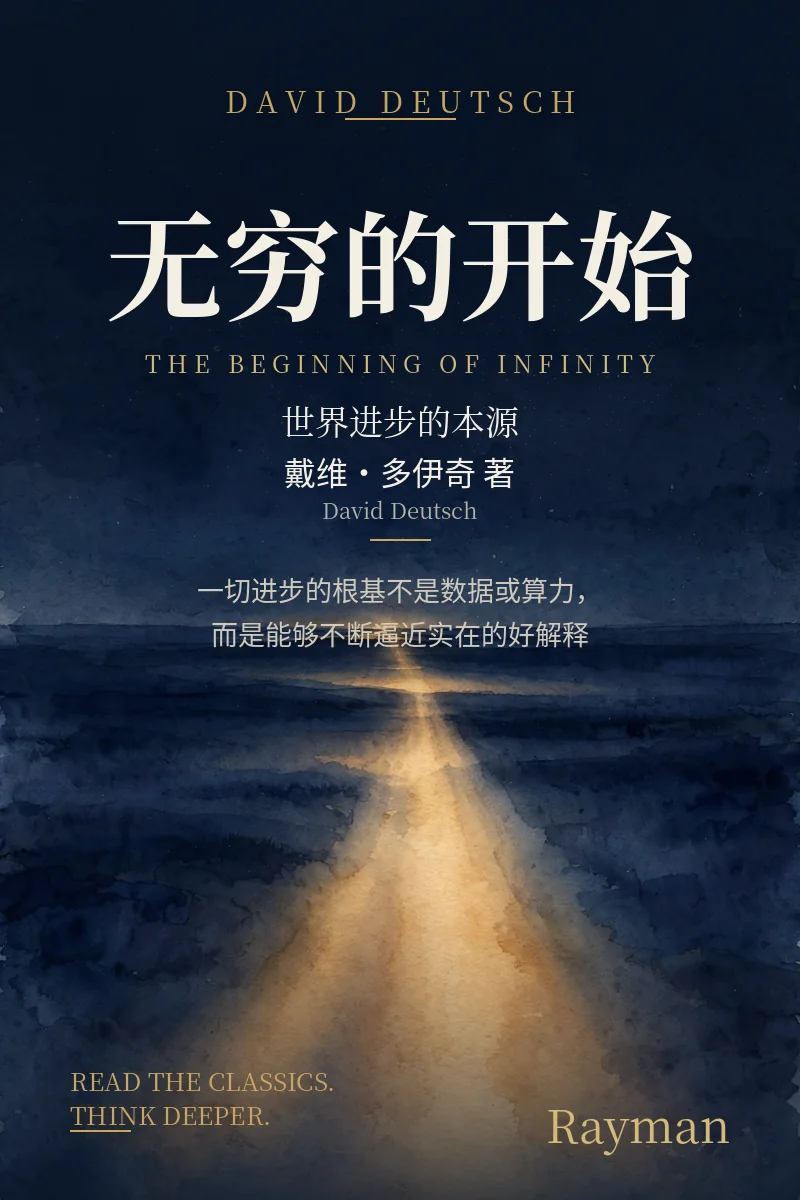
Artificial Intelligence 2011 Daily Pick
The Beginning of Infinity
《无穷的开始》
- Published
- 2011
- Category
- Artificial Intelligence
- Original language
- en
- Source list
- Daily Pick
The foundation of all progress is not data or computation but good explanations that approximate reality without limit
Imported from a third-party reading list or added as a daily pick — bibliographic facts, the source framing, and a full reading guide.
Source theme
The foundation of all progress is not data or computation but good explanations that approximate reality without limit
What is this book about?
A cross-disciplinary work by the British quantum physicist David Deutsch, Professor of Physics at Oxford and a Fellow of the Royal Society, one of the founders of quantum computation. Published in 2011 by Allen Lane in the UK (March) and Viking in the US (July), with a Penguin paperback in 2012. Its central claim: the universe contains an objectively infinite process—the creation of good explanations—and that explanations, not data or predictions, are the fundamental unit of knowledge. Deutsch weaves four deep strands into one argument: quantum physics (the many-worlds interpretation and fungibility), evolution (genes as carriers of knowledge-bearing explanations), epistemology (Popperian falsifiability and the criterion of a good explanation—being hard to vary), and computation (Turing machines and the universality of computation, from which he derives that there is no intrinsic upper bound on explanatory reach). The sharpest conclusion: problems are unavoidable, yet every problem is in principle solvable—optimism is not a wish but a theorem about the nature of knowledge creation, and all evil and failure are products of insufficient knowledge. The book devotes chapters to artificial intelligence: sixty years after the Turing test, Deutsch argues, AI has made little progress; general intelligence cannot be assembled from computational capacity, creativity cannot be reduced to algorithm, and he proposes a test—feed genuine randomness into a robot's evolutionary program and observe whether knowledge arises spontaneously. The formal Chinese edition is 无穷的开始:世界进步的本源, translated by Wang Yanhong and Zhang Yun, published by Posts & Telecom Press in November 2014 (ISBN 9787115365385), with a second edition in March 2019.
Why read it?
It supplies the scarcest thing in the AI debate: a strict standard for what counts as an explanation, rather than another list of capabilities. The counter-intuitive thesis is that the barrier to artificial general intelligence lies not in compute but in creativity—knowledge creation cannot be exhausted by any computational procedure, because the mark of a good explanation is that it is hard to vary: every detail carries function and the structure collapses if one piece is altered, which is precisely what distinguishes it from a story fitted to data. The portable frame has three layers: the criterion of a good explanation (hard-to-varyness), the optimism theorem (problems are unavoidable yet solvable in principle), and the distinction between static and dynamic societies (whether the mechanism of knowledge creation is open). Re-read against today's LLM boom, the first question is not parameter count but whether the system's outputs contain hard-to-vary structure. The position is explicitly refutable: the many-worlds interpretation remains a minority stance; folding culture, morality and aesthetics into the explanatory framework drew The Independent's criticism that his footing grows less secure when applied to aesthetics and moral philosophy; and David Albert wrote in The New York Times that the book presents not a tight, cumulative system but a broad, erudite, digressive conversation—serious objections that make it far more than a bestseller. What changes is the question, from what can this system do to whether there is incompressible explanatory structure in its outputs. Evidence of standing: (1) a standalone English Wikipedia article recording the 2011 Allen Lane/Viking first editions, the four argumentative strands (many-worlds, evolution, epistemology, universality of computation), the critique of Jared Diamond, and a separate Reception section; (2) authoritative long reviews: The Economist found it as bold as The Fabric of Reality with equally profound conclusions; The New York Times carried David Albert, Professor of Philosophy at Columbia, calling it brilliant and exhilarating while noting its digressive structure; The Independent (Doug Johnstone and Peter Forbes) and Kirkus Reviews also reviewed it; (3) the WeRead recommendation value stands at 81.7%; (4) a formal Chinese translation exists: 无穷的开始:世界进步的本源, Posts & Telecom Press, November 2014, Wang Yanhong and Zhang Yun (Science New Classics series, ISBN 9787115365385), second edition March 2019, with the Douban record for the first Chinese edition at 8.2 from 963 ratings—near but below the 1,000-rating threshold, hence not counted as evidence. These span four distinct source types. Background, not counted as the book's own awards: Deutsch is a founder of quantum computation, winner of the 1998 Dirac Medal (Institute of Physics) and the 2022 Breakthrough Prize in Fundamental Physics. Time test: first published 2011, fifteen years ago as of 2026-11-12. The book is not covered by the Hacker News pool and was selected via independent search. Not counted, not fabricated: Douban English-edition score 7.6 from 36 ratings (below threshold), exact Goodreads figures and Google Scholar citation counts not obtained this run.
Core Ideas
- Explanation over prediction: the fundamental unit of knowledge is not data nor forecast but a good explanation, judged by being hard to vary—every detail carries function and the structure collapses if one piece is altered, which is what separates it from a story fitted after the fact.
- Universality of computation entails infinity of explanation: Turing proved universal computation exists, and Deutsch argues that the creation of good explanations is an objectively infinite process in the universe; human knowledge has no intrinsic ceiling, only the boundary of physical law.
- Optimism as a theorem, not a wish: problems are unavoidable yet all are in principle solvable, and all evil and failure are products of insufficient knowledge—a move that rewrites progress from a statistical question into an explanatory one.
- A hard constraint on AI: general intelligence is not an assembly of computability, and creativity cannot be reduced to algorithm; the meagre progress sixty years after the Turing test is itself evidence of what both symbolic and connectionist schools have skirted.
- The position is refutable: the many-worlds interpretation remains a minority reading of quantum mechanics; folding morality and aesthetics into the explanatory framework is faulted as overreach; the NYT found the structure digressive rather than cumulative—objections that constitute a serious path for rereading.
What questions does this book try to answer?
- If the mark of a good explanation is that it is hard to vary, how much of what a large model produces today has functional detail and how much is freely replaceable fitting—and what operational test separates the two?
- Can general intelligence be derived from the universality of computation, or does creativity constitute a fourth thing beyond computation? Deutsch argues the latter; do the premises of that argument hold?
Who should read it?
Readers concerned with the substance of the AI debate rather than the annual progress bulletin; people in research, product or investment who need a tool for separating real explanations from stories fitted to data; and those interested in the many-worlds interpretation of quantum mechanics, evolutionary epistemology and the defence of the Enlightenment. It is not for readers looking for a machine-learning manual or a technology roadmap—it discusses no engineering implementation, only the conditions of possibility for intelligence, explanation and progress—and it asks the reader to tolerate interdisciplinary jumps and long argumentative chains.
How to Read It
Follow the argumentative chain: chapters 1–2 on the criterion of explanation and chapter 3 on the sparks of thought form the foundation—fix hard-to-varyness before moving to the quantum and evolution parts; chapter 9 on optimism and chapters 11–12 on culture and static societies close the loop of the first three strands and should not be skipped. While reading the AI chapters, set this edition's A Sand County Almanac alongside it: one pushes human agency toward infinity (the creation of good explanations has no ceiling), the other confines the human position to membership in the land community—the two pull the boundary of the human in opposite directions, and reading them together exposes each book's presuppositions better than reading either alone. The Chinese standard is the 2014 Posts & Telecom Press translation by Wang Yanhong and Zhang Yun (second edition 2019); do not confuse it with the author's The Fabric of Reality, the earlier survey of the four strands.
