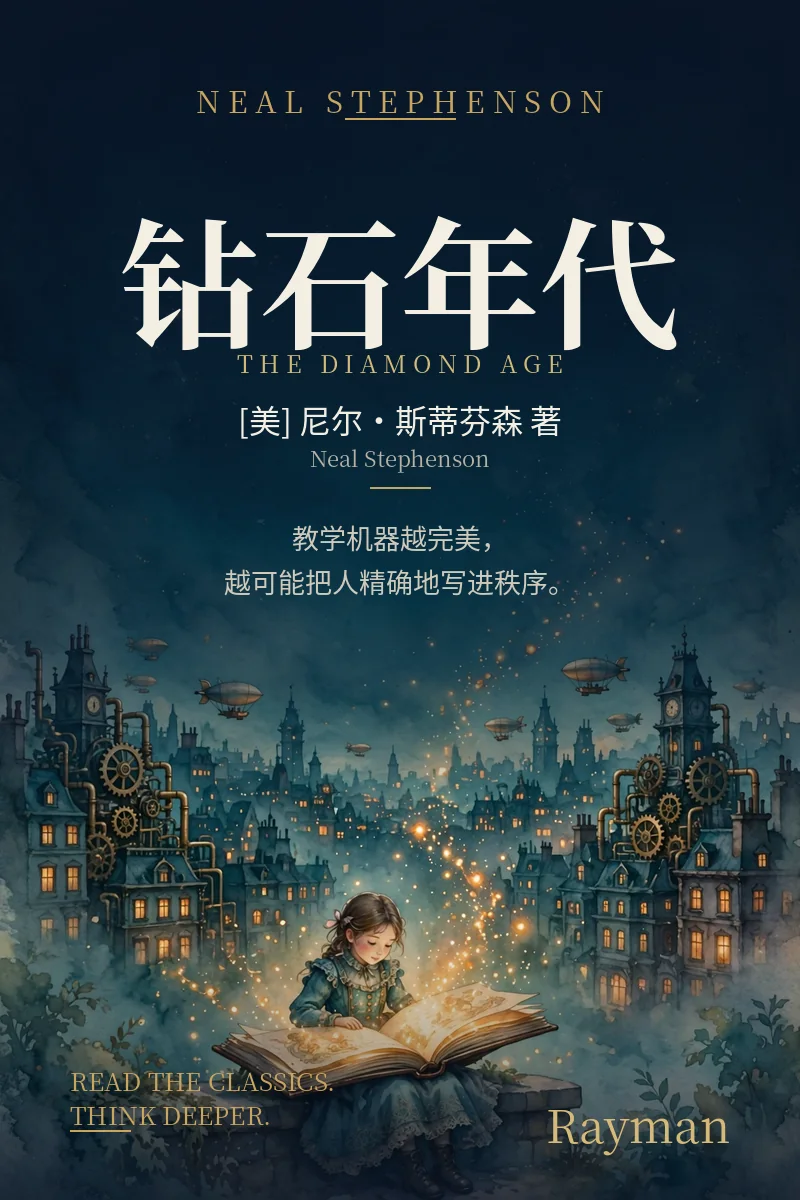
Literature & Fiction 1995 Daily Pick
The Diamond Age
《钻石年代》
- Published
- 1995
- Category
- Literature & Fiction
- Original language
- en
- Source list
- Daily Pick
A perfect teaching machine does not set anyone free; it may write people into an order with far greater precision
Imported from a third-party reading list or added as a daily pick — bibliographic facts, the source framing, and a full reading guide.
Source theme
A perfect teaching machine does not set anyone free; it may write people into an order with far greater precision
What is this book about?
Published by Bantam Spectra in 1995 under the full title The Diamond Age: Or, A Young Lady's Illustrated Primer, this novel by Neal Stephenson is set in a neo-Victorian world where nanotechnology is commonplace and people have regrouped into cultural phyles. Matter compilers can assemble goods on demand, so material scarcity has all but vanished, and what is scarce instead is manners, rank and membership in a community. An engineer, John Percival Hackworth, is commissioned to build an Illustrated Primer for the daughter of an affluent household. It is no ordinary electronic book: it rewrites its own narrative in response to the reader's circumstances, age and judgements, while human performers behind the scenes enact its characters in real time in conversation with the child. A copy finds its way to Nell, a girl from the margins, and the book follows two parallel lines of growing up: a textbook designed for one social position is being used by a child who was never on the list of intended readers. The question of whether education can be engineered is pursued as an institutional thread rather than a gadget, alongside the relations between compilers, phyles and sovereignty. A formal Chinese translation exists as 鑽石年代, published in 2010 by Kai Yuan Shu Yin in a translation by Cao Zhilian, ISBN 9789573057796, 512 pages; the title here is a simplified-character rendering of that edition, not a newly coined translation.
Why read it?
It converts a question usually treated as benevolent into a question about power. The counter-intuitive thesis is that teaching carried to perfection does not liberate by itself; it can place a person inside an existing order with far greater precision. The portable frame is the mismatch between the reader a system was designed for and the reader who actually uses it. Every adaptive system carries an implicit model of its ideal user, and its real values become visible only when it falls into the hands of someone outside that model. Applied to recommender algorithms, personalised learning and AI tutors, the first question is therefore who the assumed student is and which pupils the system handles as outliers. Nor is the novel an innocuous truth. Stephenson is regularly faulted for letting technological determinism crowd out politics and economic structure, and the settlement of the phyle order at the close remains contested; that vulnerability is part of why it repays rereading. What changes is the question, from how teaching can be improved to who holds the authority to define what counts as having been well taught. Evidence of standing: (1) a standalone English Wikipedia article for the book, recording the 1995 Bantam Spectra first edition, its publication history, awards and a separate Reviews section, rather than a mention on the author's page; (2) the 1996 Hugo Award for Best Novel, whose official winners page lists The Diamond Age by Neal Stephenson [Bantam Spectra, 1995], together with the Locus Award for Best Novel in the same year; a Nebula shortlisting is not counted as a win; (3) a Goodreads record of 4.16 from 94.4 thousand ratings and 4,276 reviews, above the 4.0 / 5,000 threshold; (4) a review in The New York Times Book Review by Gerald Jonas, listed in the article's Reviews section. These are four distinct source types: an encyclopedia entry, an official awards page, an international reader platform and an authoritative review outlet. First published in 1995, the book is 31 years old and clears the five-year test. The figure of 596 independent mentions in the Hacker Books candidate pool served only as a lead for selection and is not counted as evidence. Not counted: verifiable figures for the Douban rating of the formal Chinese edition, a WeRead recommendation value, adoption as required reading at two or more leading universities and a Google Scholar citation count were not obtained and are not listed as evidence.
Core Ideas
- The Primer supplies a portable checklist: who it was designed for versus who is actually using it. Every adaptive textbook encodes a model of its ideal reader. Nell is not on that list, so the same device changes from an instrument for maintaining rank into an instrument for stepping outside it. Applied to personalised learning today, ask first who the assumed pupil is and which circumstances the system treats as noise.
- The counter-intuitive claim is that more perfect teaching need not mean more freedom. The Primer schedules knowledge, feeling and moral judgement in real time against the reader's state, and the cost is that being carefully tended and being prescribed become hard to tell apart. Engineering education moves authority out of the visible teacher and into invisible parameters and defaults.
- Once scarcity disappears, what becomes scarce is order. Matter compilers let objects be assembled on demand, while phyles, manners and access become the new boundaries. This yields a portable question for thinking about technology: when an innovation removes one kind of scarcity, at which layer will a new scarcity reappear?
- The position is open to serious objection. Stephenson is often faulted for over-strong technological determinism, for treating politics and economic structure as an appendix to engineering problems, and for the way the phyle order resolves at the end. Reading the book as a set of claims to be tested, rather than a verdict on the future, is closer to its real use.
What questions does this book try to answer?
- Is a textbook that rewrites itself for each reader educating a person, or writing that person into an optimal path, and by what testable condition could the two be told apart?
- When content, pace and feedback are all tuned by a system against an ideal user, who decides on the student's behalf what counts as having learned, and can that authority be handed back? If it is, what remains of the teacher's role?
- If technology removes material scarcity, does stratification disappear with it, or does it migrate into manners, membership and access to information?
Who should read it?
Readers concerned with educational technology, adaptive learning and where the limits of an AI tutor should fall; people designing products or institutions who need to ask whom personalisation actually serves; and readers who enjoy pushing a technological premise to its extreme to watch a society reassemble itself. It is not for someone after hard nanotechnology popular science or a plot-driven adventure. What it offers is a framework of questions about teaching, rank and agency, with explicit room for disagreement.
How to Read It
Read the Primer and Nell as two parallel lines. Whenever the Primer explains how a judgement should be made, stop and ask whose ordering of values that judgement comes from. The middle sections on matter compilers and phyles look digressive but carry the argument about scarcity migrating once it is abolished, so they should not be skipped. The ending is the most contested part and is a useful test of how much of the author's technological determinism one is willing to accept. It pairs well with this edition's other book, The Ignorant Schoolmaster: an all-knowing teaching machine set against a teacher who insists on his own ignorance. The only formal Chinese translation is the 2010 Kai Yuan Shu Yin edition, 鑽石年代, by Cao Zhilian; do not confuse it with Chinese editions of the author's other novels such as Snow Crash.
