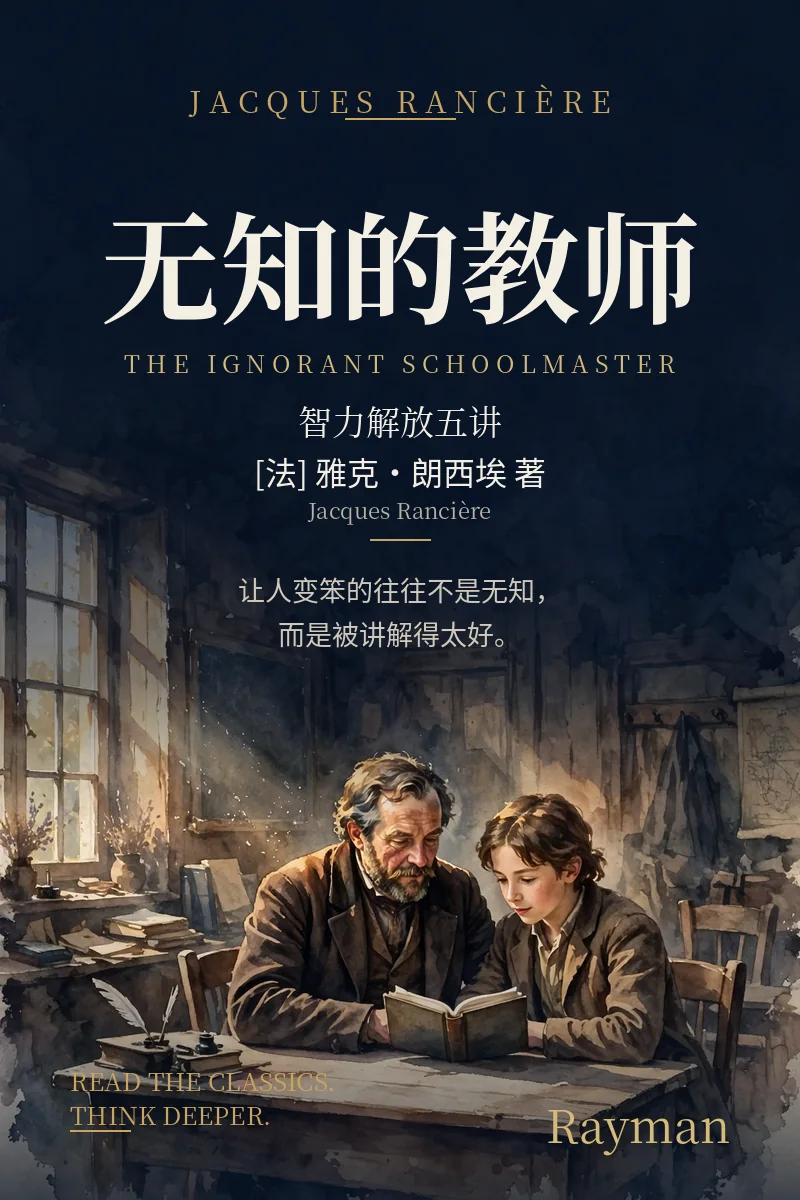
Education & Reflection 1987 Daily Pick
The Ignorant Schoolmaster
《无知的教师》
- Published
- 1987
- Category
- Education & Reflection
- Original language
- fr
- Source list
- Daily Pick
What stultifies people is rarely ignorance; it is being explained to too well
Imported from a third-party reading list or added as a daily pick — bibliographic facts, the source framing, and a full reading guide.
Source theme
What stultifies people is rarely ignorance; it is being explained to too well
What is this book about?
First published in French by Fayard in 1987 as Le Maître ignorant: Cinq leçons sur l'émancipation intellectuelle, and in English by Stanford University Press in 1991 as The Ignorant Schoolmaster: Five Lessons in Intellectual Emancipation, translated by Kristin Ross. The book turns on an accidental experiment by the nineteenth-century French teacher Joseph Jacotot: knowing no Dutch, he set Flemish students who knew no French to work through a bilingual edition of Fénelon's Télémaque, and they taught themselves to read French. From this he derived what he called universal teaching (enseignement universel). Rancière extracts a sharp distinction between explication and emancipation. To explain is to assume that the pupil cannot understand unaided and that knowledge must be broken into digestible steps; yet every step taken on the pupil's behalf confirms once more that without the explainer nothing can be understood, a process he calls stultification (abrutissement). Intellectual equality is therefore not a conclusion to be demonstrated or a goal to be reached, but the presupposition with which any teaching begins. The ignorant schoolmaster does not transmit subject matter he does not know; he asks for an account, demands that a passage be recited and its source checked, and so compels the pupil to put an intelligence he already possesses to work. Across five lessons the argument moves from method to social order, asking how those who explain the world produce the people who are held to need explaining. The formal Chinese edition is 无知的教师:智力解放五讲, translated by Zhao Zilong and published by Northwest University Press in January 2020, ISBN 9787560444901.
Why read it?
It turns something that looks beyond dispute, explaining things more clearly, into an object of enquiry. The counter-intuitive thesis is that what stultifies people is rarely ignorance but being explained to too well. Explanation appears to remove an obstacle while rehearsing a conclusion: without me, you cannot read this. The more expert the teacher, the more the pupil depends. The portable frame is the difference between equality as a presupposition and equality as a goal. As a presupposition it yields a working checklist: does this step require the pupil to exercise an intelligence of their own, or does it spare them the step? As a goal it can always be deferred. Applied to AI tutors and adaptive textbooks the point bites hard, since the more considerate the step-by-step scaffolding, the more likely understanding itself is outsourced. Nor is the claim innocuous. Critics object that intellectual equality as an unfalsifiable presupposition cannot be tested, that Jacotot's episode lacks reproducible evidence, and that the move from a classroom to the reproduction of social hierarchy is a leap. Holding that tension in view brings one closer to the argument than treating the book as a collection of educational maxims. What changes is the question, from how to explain more clearly to who becomes unnecessary to think for themselves because of that clarity. Evidence of standing: (1) a standalone English Wikipedia article, recording the 1987 French original Le Maître ignorant (Fayard), the 1991 Stanford University Press translation by Kristin Ross, the five-lesson structure and scholarly reviews and bibliography, rather than a mention on the author's page; (2) the Douban record for the Northwest University Press Chinese edition, 无知的教师:智力解放五讲, showing 8.8 from 2,190 ratings, above the 8.5 / 1,000 threshold. These are two distinct source types, an encyclopedia entry and a Chinese reader platform, and clear the two-item requirement. First published in 1987, the book is 39 years old and satisfies the five-year test. The Chinese edition is a formal licensed publication whose title follows its bibliographic record rather than a coinage. Not counted: Goodreads shows 3.97 from 1,937 ratings, below the 4.0 / 5,000 threshold, and is explicitly excluded; scholarly reviews in journals such as French Studies listed in the Wikipedia article are background only and are not counted as threshold items; a WeRead recommendation value, long reviews in the named review media, adoption as required reading at two or more leading universities and a precise Google Scholar citation count were not obtained and are not listed as evidence.
Core Ideas
- Explanation manufactures dependence. Breaking knowledge into more digestible steps also trains the pupil to believe that without someone doing the breaking, understanding is impossible. Rancière calls this stultification: not a loss of capacity but the institutionalisation of distrust in one's own capacity.
- Intellectual equality is a presupposition, not a goal. It is neither an empirical finding awaiting confirmation nor a destination eventually to be reached, but the assumption with which teaching starts. Once it is a presupposition, the measure of teaching shifts from whether the syllabus was completed to whether the pupil was compelled to use their own intelligence.
- The ignorant schoolmaster is not someone who knows less but someone who has vacated the position of explainer. He does not know the subject the pupil is learning, yet he can demand an account, the identification of a passage and a check of its source, moving authority from content to the organisation of attention. The distinction transfers to any relation between expert and outsider.
- The position is open to objection at every step: equality as an unfalsifiable presupposition, a universal conclusion resting on a single historical episode, and the extension from classroom to the reproduction of social hierarchy. Acknowledging those leaps is closer to the book's real claim than enshrining it as a set of educational maxims.
What questions does this book try to answer?
- If explanation itself produces dependence, what can a teacher still do without reoccupying the position of explainer, and can that boundary be stated as an operational test?
- Is intellectual equality as a presupposition a liberating assumption, or a belief that cannot be refuted and therefore cannot be examined?
- When a system breaks every step down on a learner's behalf, by what measure do we distinguish having learned from having had the work done for them?
Who should read it?
Readers working in education, training, knowledge products or AI tutor design who need to ask whether a clearer explanation is actually helping anyone; readers interested in how authority is produced and then internalised as self-doubt; and those willing to follow an argument from the classroom all the way into political philosophy. It is not for someone after classroom procedures or management techniques. The book declines to provide a list of methods, and the leaps in its argument remain open to objection.
How to Read It
Begin with the first two lessons to fix the accidental experiment and the definition of stultification, then take the later three, where the argument moves from the classroom into social order. The passages on explanation and on explaining the world are the easiest to flatten into slogans, so ask sentence by sentence whether the inference actually holds. Carry one objection throughout: if intellectual equality cannot be falsified, how much power of testing does the argument retain? It works best alongside this edition's The Diamond Age, one book building teaching into an all-knowing machine and the other insisting the teacher remain ignorant, each putting pressure on the other. Use the 2020 Northwest University Press Chinese translation by Zhao Zilong, 无知的教师:智力解放五讲, and check ISBN 9787560444901, since several of the author's other books are available in Chinese under similar-sounding titles.
