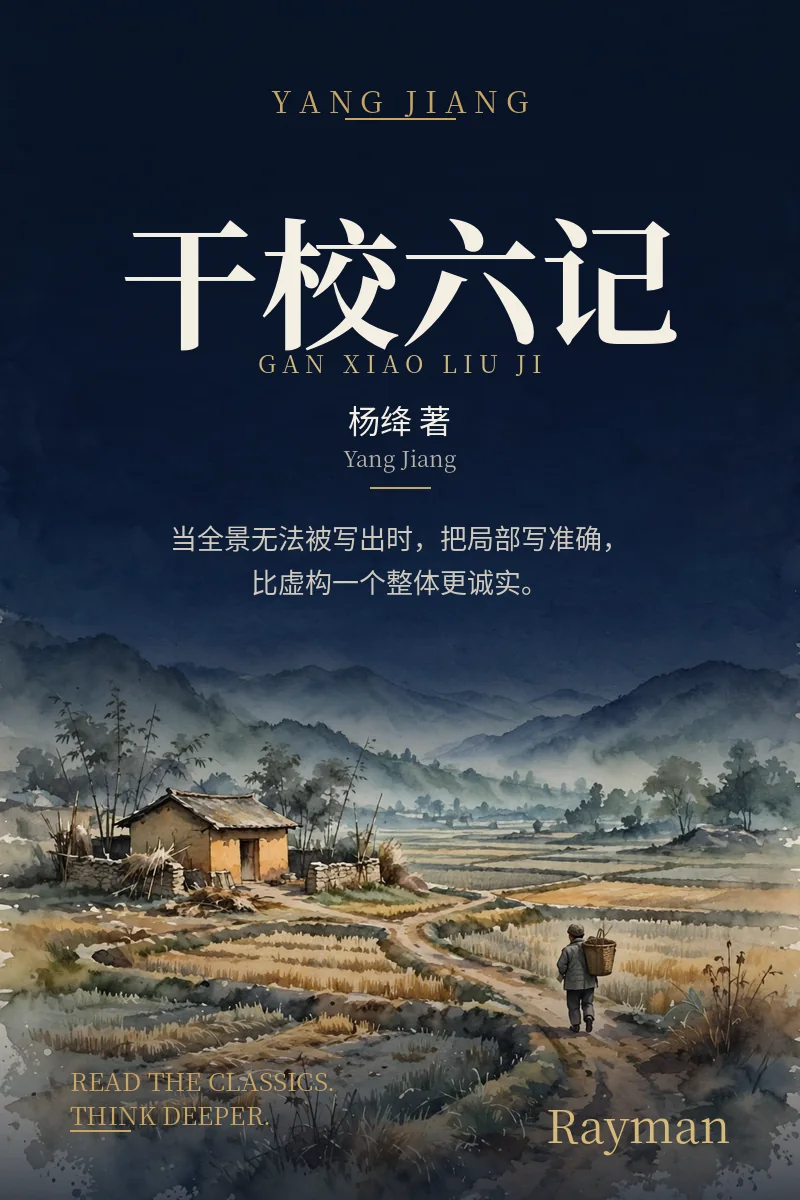
Classic Essays 1981 Daily Pick
Gan Xiao Liu Ji
《干校六记》
- Published
- 1981
- Category
- Classic Essays
- Original language
- zh
- Source list
- Daily Pick
When the whole cannot be written, accuracy about the part is more honest than inventing a totality
Imported from a third-party reading list or added as a daily pick — bibliographic facts, the source framing, and a full reading guide.
Source theme
When the whole cannot be written, accuracy about the part is more honest than inventing a totality
What is this book about?
First published in July 1981 by the Sanlian Bookstore (SDX Joint Publishing), this is a slim collection of six essays whose titles and structure deliberately echo Shen Fu's Six Chapters of a Floating Life from the Qing dynasty. It records ordinary episodes from the early 1970s, when the author was assigned to rural manual work in Henan: a farewell at a railway platform, the digging of a well, hours spent watching a vegetable plot, a small dog left behind, a visit made in the rain, a rumour that came to nothing. In a short preface Qian Zhongshu called these pieces small ornaments against a large backdrop, minor interpolations within a larger story, and in doing so supplied the way to read them: the interest lies precisely in how the small ornament registers the backdrop. The book offers almost no explicit judgement. It does not trace causes, does not convert experience into a lesson, and sets out verifiable details in sequence with emotion kept deliberately low, leaving the judgement to the reader. A standalone Chinese Wikipedia article records the six essay titles and the book's edition history; a 2010 Sanlian reprint carries ISBN 9787108034571. The title is given here in romanisation rather than through any unverified English coinage.
Why read it?
What it demonstrates is not a prose style but an ethic of narration that holds even when the available language is constrained. The counter-intuitive claim is that the sharpest testimony often carries no emotion at all: an impassioned accusation can be discounted as a position, whereas a line drawn with the feeling pared away leaves the facts to carry their own weight. The transferable frame is Qian Zhongshu's pairing of small ornament and large story. When the whole cannot be grasped, getting one checkable part right is more honest than inventing a complete explanation; applied now, it means asking of any grand subject how far down one's own verification actually reaches. Nor is the book safely unobjectionable. Restraint can itself be faulted as evasion, as a way of turning a structural condition into a matter of personal composure, and that tension is a good part of why it bears rereading. What changes is the question: from who is to blame to how a person manages not to lie when the language available has already been fixed. Evidence of standing: (1) the Douban record for the Sanlian edition, subject 4912688, shows 8.6 from 6,196 ratings, above the 8.5 / 1,000 threshold; (2) the WeRead page for 干校六记 (轻经典) shows a recommendation value of 90.6 percent (newRating 906, 510 readers), above the 80 percent threshold; (3) a standalone Chinese Wikipedia article covers the book, giving its 1981 first publication, six essay titles and edition history rather than a mention on the author's page. These are three distinct source types: a Chinese reader platform, a Chinese reading platform and an encyclopedia entry. First published in July 1981, the book is 45 years old and clears the five-year test, and the Sanlian edition is a formal domestic publication whose first printing ran to 20,000 copies. Not counted: Goodreads score and rating count, long reviews in the named review media, adoption as required reading at two or more leading universities, and Google Scholar citations were not obtained in this check. Domestic canonical lists such as the Hundred Outstanding Chinese Literary Books of the Century are outside the specified recognition list and serve only as context.
Core Ideas
- Restraint is an epistemic discipline, not merely a stylistic choice. Removing evaluative sentences, causal chains and uplifting conclusions leaves checkable detail in place, and only then does the reader have room to judge. What the author gives up is not a position but the authority to draw the conclusion on someone else's behalf.
- The pairing of small ornament and large story supplies a portable checklist. When the whole is out of reach, one accurate part carries more information than a rounded explanation. Of any grand narrative, ask first how far one's own verification reaches, and only then who is filling in the rest.
- The counter-intuitive point concerns the relation between emotion and force. The fuller the emotion, the more easily a passage is read as a stance and discounted; with feeling pared back, facts acquire a weight that cannot be reduced to opinion. This is why the book's strongest paragraphs are often those that merely record a small errand.
- The book also exposes its own limit. Restraint can be read as evasion, as the conversion of a shared condition into a matter of private composure. Acknowledging that vulnerability brings one closer to its real contribution than treating it as a model of decorous grief.
What questions does this book try to answer?
- When the available language has already been fixed, what is the minimal achievable form of not lying: withholding judgement, or writing only what one can verify?
- By what right does an accurately written part stand for an unwritten whole, and at what point does that correspondence collapse into the reader's own projection?
- Is restraint a form of resistance or a form of evasion, and should the line be drawn at the author's intention or at the effect the text actually produces?
Who should read it?
Readers concerned with how to stay honest when information is incomplete; writers of non-fiction, interviewers and oral-history editors who have to decide whether to draw conclusions on a subject's behalf; and anyone accustomed to explaining everything with a large framework who wants to practise a smaller scale. It is not for a reader after a panorama of the period or a concluded indictment. The book offers no answer, only a self-imposed discipline about who is entitled to conclude, and it leaves itself openly open to objection.
How to Read It
Begin with Qian Zhongshu's short preface, which establishes the small-ornament / large-story reading, then take the six essays in order. The digging of the well and the final essay about a rumour that comes to nothing deserve the slowest reading: the first is built almost entirely out of actions and objects, and the second refuses to comment on its own disappointment. Together they show how restraint does its work. Carry one question throughout: were the passages the author left out things she had no right to write, or things she preferred not to? Reading one emotionally expansive memoir from the same period alongside it will make the difference clearer than any abstract discussion. Use the Sanlian 读书文丛 edition with its six essays, and do not conflate this book with the author's other collections such as 将饮茶 or 我们仨.
