Artificial Intelligence 2007 Daily Pick
I Am a Strange Loop
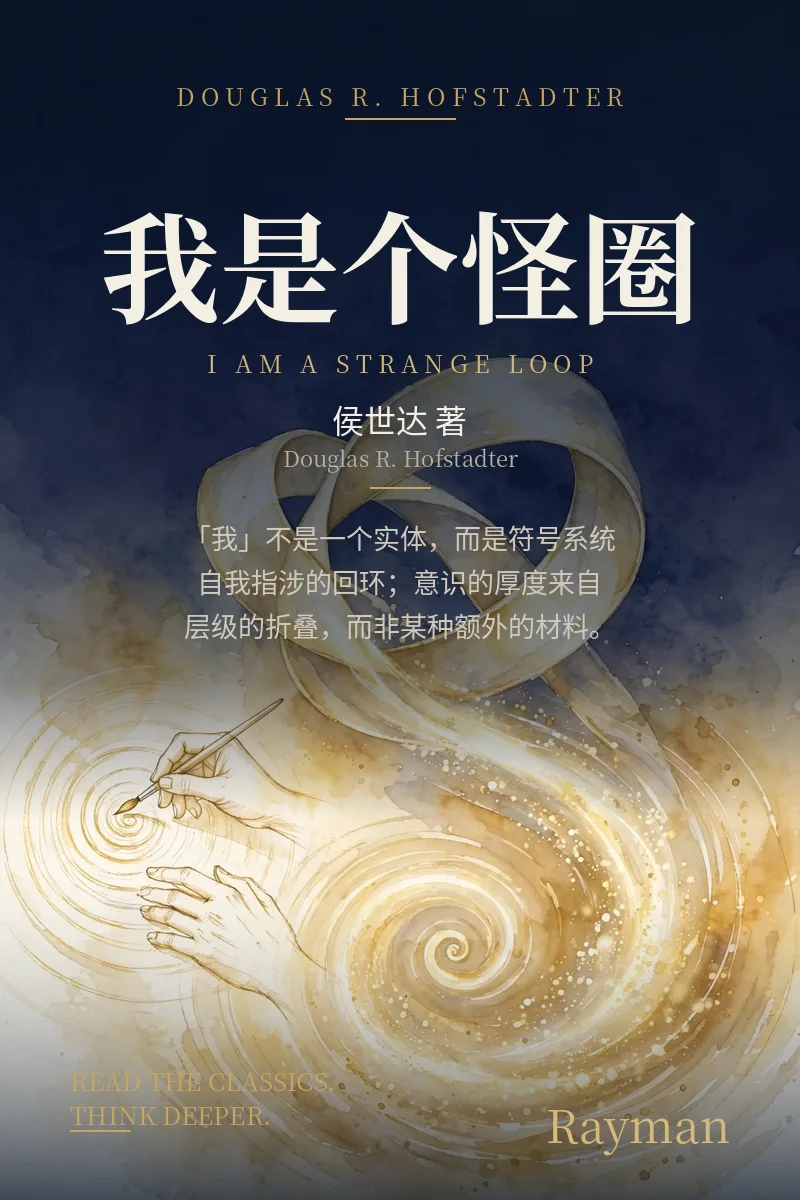
《我是个怪圈》
- Published
- 2007
- Category
- Artificial Intelligence
- Original language
- en
- Source list
- Daily Pick
The 'I' is not a thing but a loop: a symbol system folding back on itself, with depth coming from levels rather than from an extra ingredient
Imported from a third-party reading list or added as a daily pick — bibliographic facts, the source framing, and a full reading guide.
Source theme
The 'I' is not a thing but a loop: a symbol system folding back on itself, with depth coming from levels rather than from an extra ingredient
What is this book about?
Published by Basic Books on 26 March 2007 and running to 412 pages, this is Douglas R. Hofstadter's independent return to the single question behind Gödel, Escher, Bach (1979). In the preface to the twentieth-anniversary edition of that earlier book he complained that it had been received as a hodgepodge of interesting things with no centre, when what he had wanted to ask was how animate beings with a sense of 'I' could arise from inanimate matter. Here he strips away much of the music and the engravings and keeps one thread: the strange loop. Once a symbol system grows complex enough to represent and feed back upon its own symbols, levels close into a circuit and something appears to observe the system from inside. Hofstadter's claim is that the self is not an object lodged in the brain but a stable pattern formed as abstract symbols map back and forth across levels. He argues the case through three interwoven lines — Gödel's incompleteness theorems, the prints of M. C. Escher, and his own memories of his late wife — and draws out consequences for artificial intelligence, free will and personal identity. A Chinese edition, 我是个怪圈, was published by CITIC Press in a translation by Xiu Jiaming.
Why read it?
Because it converts what is usually treated as the starting point into the thing that needs explaining. The counter-intuitive thesis is that a self requires no additional mental substance and no observer sitting at the centre: a system able to represent its own symbols can, through the closing of levels alone, produce the conviction that there is an 'I'. The self is therefore real as a pattern with causal force and unreal as an entity. The transferable frame is the strange loop itself, a movement through levels that returns to its origin one level up. Applied to anything claiming to be a whole — an organisation, a model, a story about identity — it asks at which level the thing wrote itself into its own description. Nor is this an innocuous truth. The Wikipedia article records two serious objections: Slavoj Žižek argues in Less Than Nothing that this account of selfhood misses downward causality and the distinctive dignity of a person, while Martin Gardner, reviewing the book in the Notices of the American Mathematical Society, asks directly whether loops can explain consciousness at all. What changes is the question: from where is consciousness produced to how complex a system must be, and in what manner must it refer to itself, before it begins to insist that there is an 'I'. Evidence of standing: (1) a standalone English Wikipedia article for the book, giving first publication by Basic Books on 26 March 2007, 412 pages, ISBN 978-0-465-03078-1, with a dedicated Responses section on reception and criticism rather than a mention on the author's page; (2) a substantial review in The Wall Street Journal, John Derbyshire's 'The I's Have It' of 23 March 2007, a title on the specified list of review media. These are two distinct source types, an encyclopedia article and an authoritative review outlet. First published in 2007, the book is 19 years old and clears the five-year test. Not counted: the Chinese edition 我是个怪圈 holds 8.3 from 1,287 Douban ratings and the English edition 8.1 from 79, both below the 8.5 threshold; Goodreads score and rating count, Google Scholar citations, and adoption as required reading at two or more leading universities were not obtained in this check. The author's 1980 Pulitzer Prize for General Nonfiction was awarded to Gödel, Escher, Bach, not to this book, and is therefore excluded. The Chinese edition from CITIC Press, translated by Xiu Jiaming, is a formal licensed publication.
Core Ideas
- The 'I' is a conclusion awaiting explanation, not a premise. Cartesian certainty is recast as an engineering question: why would a symbol system insist that it has an owner inside? Treating the conviction as a phenomenon is the precondition for explaining it at all.
- The strange loop is a portable structure: a system moves up or down through levels and comes back to itself one level higher. Any system claiming to describe itself completely — a charter, a world model, a story about who one is — can be asked at which level it wrote itself into its own account.
- Distinguishing pattern from entity dissolves a false dilemma. The self is neither a mere illusion, since as a stable high-level pattern it constrains lower-level behaviour, nor a thing, since no corresponding part can be located. Causally effective abstraction answers the question better than either existence or non-existence.
- A counter-intuitive consequence is that each person carries simplified models of other people, so every 'I' is plural and graded. Personal identity becomes a matter of degree — the density of symbolic copies and the strength of a perspective — rather than a binary verdict.
- The position is expressly open to objection: whether downward causality is required, whether loops suffice to explain consciousness, and whether reducing human dignity to the integration of symbols leaves something out. These three objections keep it from being a sealed, self-consisting story.
What questions does this book try to answer?
- How complex must a system be, and in what way must it refer to itself, before it begins to insist that there is an 'I'? Could that threshold be stated as a testable condition?
- If the 'I' is a causally effective abstract pattern rather than an entity, at which level of the pattern should free will, responsibility and personal identity be attached?
- Does explaining consciousness through loops of levels merely relocate the difficulty, from what consciousness is to which instance of self-reference is supposed to count?
Who should read it?
Readers interested in the shared ground beneath mind, consciousness and artificial intelligence; people designing models or systems who need to judge when a system starts claiming to be a subject; and those who found Gödel, Escher, Bach dazzling but overextended and want its central thread developed on its own. It is not for a reader after experimental data on the neural correlates of consciousness or an implementation manual. What it supplies is a conceptual framework of self-reference and levels, not a measurement procedure, and it leaves room for explicit objections to its own position.
How to Read It
Start with the opening account of how Gödel, Escher, Bach was misread as a hodgepodge, since that establishes the question. Then read slowly through the chapters defining the strange loop and the movement across levels, and through the sections on other people being carried inside one's own head; these hold the transferable framework. The Gödel and Escher analogies can be sampled rather than worked through case by case. The passages about the author's late wife look digressive but are where the abstract argument is joined back to concrete experience, and should not be skipped. Keep one objection in view throughout: does explaining the self as a loop merely rename the problem? The criticisms by Žižek and Martin Gardner make an effective companion text. Use the CITIC Press Chinese translation 我是个怪圈 by Xiu Jiaming. Read against Gödel, Escher, Bach with the distinction in mind that the earlier book expands while this one converges; there is no need to work the same examples twice.
