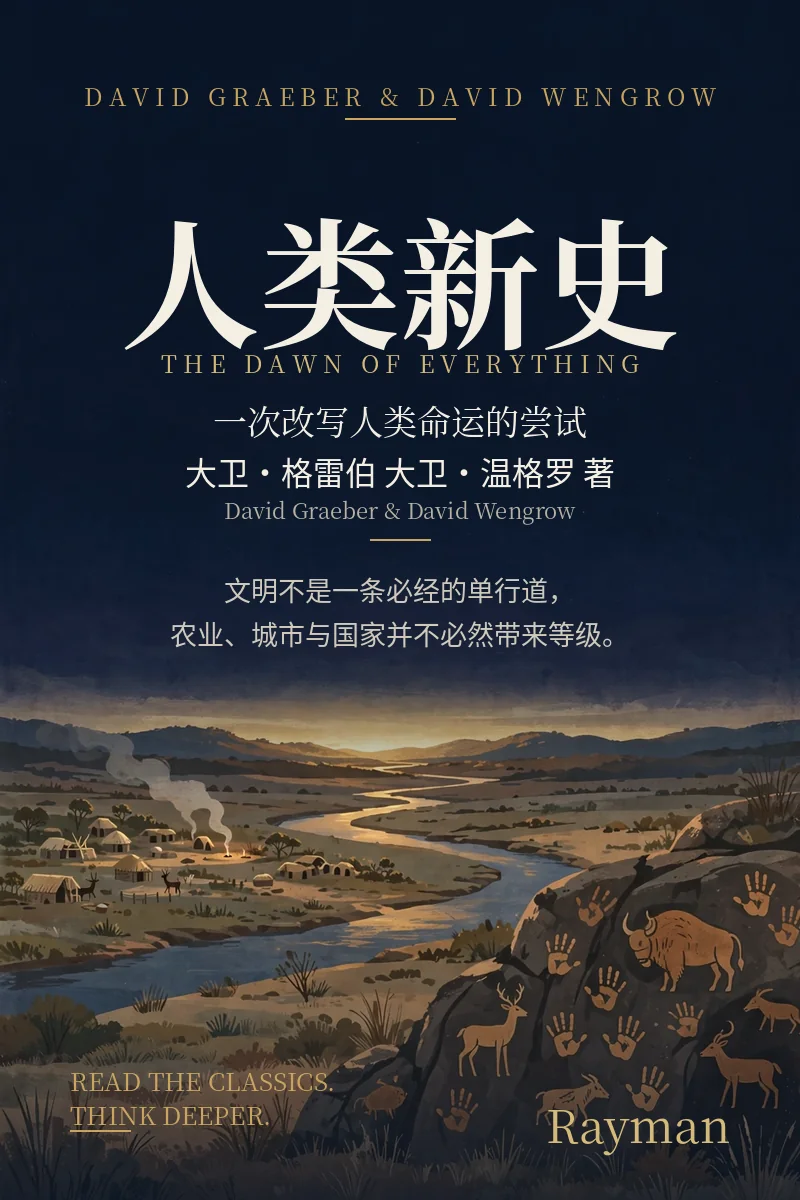
World History 2021 Daily Pick
The Dawn of Everything
《人类新史》
- Published
- 2021
- Category
- World History
- Original language
- en
- Source list
- Daily Pick
Civilisation is not a one-way road: farming, cities and states did not necessarily force hierarchy upon us
Imported from a third-party reading list or added as a daily pick — bibliographic facts, the source framing, and a full reading guide.
Source theme
Civilisation is not a one-way road: farming, cities and states did not necessarily force hierarchy upon us
What is this book about?
Published in October 2021 by Allen Lane, an imprint of Penguin Books, this is a reconstruction of human prehistory running to more than 700 pages by the anthropologist David Graeber and the archaeologist David Wengrow, and the last book Graeber completed before his death in 2020. Its point of departure is an argument rather than an excavation. The familiar ladder leading from farming through surplus and population growth to cities, states and inequality took shape in eighteenth-century Europe, the authors contend, as a conservative reply to incisive Indigenous criticism of European society, not as a conclusion forced by the archaeological record. They then test that ladder against recent evidence. Farming was taken up and abandoned repeatedly before it became permanent. Some of the earliest urban settlements show no trace of a central ruling apparatus. Certain societies appear to have moved seasonally between sharply different political arrangements, and large settled populations did not automatically generate hierarchy or organised violence. What the book supplies is not a rival origin story with the same architecture but a reopened question: how many ways of organising a society were actually available, and how did we come to believe there had only ever been one? A Chinese edition, 人类新史, was published by Jiuzhou Press in September 2024 in a translation by Zhang Fan and Zhang Yuxin.
Why read it?
Because what it dismantles is not a claim about a particular dynasty but inevitability itself. The counter-intuitive thesis is that inequality was not the admission price paid once societies grew large, and that farming and the state were not one-way gates; treating both as laws of nature is itself an inheritance from an eighteenth-century argument. The transferable framework is the book's three primordial freedoms — the freedom to move away from one's surroundings, to disobey arbitrary authority, and to create or transform social relations. Applied to any institution, it asks how much of each freedom has been given up rather than which stage of development the institution has reached. Cases of societies alternating between political forms with the seasons make the further point that a constitution can be a choice. Nor is the book safely unobjectionable. Its Wikipedia article records serious objections: Gary M. Feinman accuses the authors of cherry-picked and selectively presented examples, Kwame Anthony Appiah of a discordance between what the book says and what its sources say, David A. Bell of coming perilously close to scholarly malpractice, and Walter Scheidel of neglecting materialist perspectives. What changes is the question asked: from when did we lose equality to when did we start believing freedom had to be traded away, and which collective choices were later rewritten as laws. Evidence of standing: (1) a standalone Wikipedia article for the book, giving first publication on 19 October 2021 by Allen Lane, with dedicated sections on methodology and scholarly reception rather than a passing mention on an author page; (2) substantial reviews and essays in The New Yorker (Gideon Lewis-Kraus, Early Civilizations Had It All Figured Out), The New York Review of Books (an extended exchange between Kwame Anthony Appiah and David Wengrow, The Roots of Inequality), The Guardian (David Priestland, Inequality is not the price of civilisation) and the Times Literary Supplement (Richard Handler, Prehistory without hierarchy). These constitute two distinct source types, an encyclopedia and the review press. Not counted towards the threshold: shortlisting for the 2022 Orwell Prize for Political Writing, Book of the Year listings in the Sunday Times, Observer and BBC History, the Wenjin Book Prize of the National Library of China, the 2025 J. I. Staley Prize, and translation into more than thirty languages. First published more than five years before this recommendation, on 19 October 2021. The Chinese edition (Jiuzhou Press, September 2024, ISBN 9787522527949) scores 8.3 on Douban with 1,228 ratings, below the 8.5 threshold, so it is not used as threshold evidence. Goodreads figures and WeRead recommendation values were not obtained on this run and are not cited.
Core Ideas
- The ladder is the residue of an argument, not a finding of archaeology. Farming, cities, states and inequality were arranged into an irreversible sequence as a conservative European reply to Indigenous criticism in the eighteenth century. Ask who built the frame and against whom before asking whether the evidence supports it.
- Three primordial freedoms supply a portable checklist: the freedom to move away, the freedom to disobey arbitrary authority, and the freedom to create or transform social relations. Measuring how much of each an institution has taken away explains more than locating it on a scale of development.
- Farming, cities and states did not arrive as a package, nor were they necessarily irreversible. Agriculture was adopted and dropped again; some early cities had no central rulers; large settled populations could exist without hierarchy. Separating the variables reveals which coincidences were merely contingent.
- Political form was once treated as switchable. Societies that moved seasonally between sharply different arrangements show that one scale of population requiring one form of government is not a physical constraint but an imagination that later hardened.
- The gain is not a new answer but a reopened question. If several ways of living were once available, any institution described today as the only option has to argue again for its own necessity.
What questions does this book try to answer?
- If inequality was not the inevitable price of scale, why do nearly all modern states converge on a similar hierarchical structure?
- Does the view of farming and cities as one-way gates rest on archaeological evidence, or on a prior belief about progress?
- Once a political form can be switched with the seasons, how much of what we call natural law is genuinely necessary?
- Does answering a stage theory with selected cases repeat, in reverse, the methodological weakness it sets out to expose?
Who should read it?
Readers interested in where institutions come from rather than in the sequence of dynasties; people building organisations, platforms or products who take it for granted that scale requires hierarchy; and anyone who has been persuaded that history had only one road. It is not for someone after a clean chronological survey: the book offers no tidier master narrative, only evidence that disables the old one, and it openly concedes that its own case can be challenged.
How to Read It
Begin with the opening account of Kandiaronk and the Enlightenment encounter, since that is where the question of where the ladder came from is established. Then dwell on the chapters setting out the three freedoms and seasonal switching; these carry the transferable framework. The archaeological cases that follow can be sampled by interest rather than read page by page. Keep one objection in view throughout: were the cases used to dismantle stage theory themselves selected? The criticisms of Feinman, Appiah, Bell and Scheidel make an effective companion text. Use the Jiuzhou Press 2024 translation by Zhang Fan and Zhang Yuxin. Read against any environmental-determinist account that treats farming and settlement as a one-way gate, and note how differently the two books handle necessity.
Reading Notes
2026-11-09
This book uses prehistoric evidence against a single ladder of development, arguing that farming and hierarchical states were not necessarily linked. Its contribution is reopening a space of possibilities; its risk is disputed readings of individual cases. How secure the conclusions are is not the value of reopening the question.
The book takes apart a default premise. Grand narratives commonly present the arrival of farming, population concentration, surplus, hierarchy and the state as a ladder that almost unwinds by itself, so the varied arrangements of prehistoric groups can only appear as drafts of a stage not yet reached. Drawing on archaeological and ethnographic material, the authors point to seasonal gathering and dispersal, sizable settlements without centralised rule, and farming that was taken up and then abandoned. What changes is the scale of the question. It is no longer which step produced the state but which forms of organisation were actually tried and under what conditions the range narrowed. That move removes necessity from historical narrative and frees political imagination from taking its examples off a single track. Even if particular claims are later revised, the change at the level of questioning can survive. The easily missed point is the distance between material and conclusion. When cases from several continents and many millennia are placed together, the dating, function and comparability of each depend on substantial specialist judgement; several of those readings are genuinely disputed, especially where a site is said to show an absence of hierarchy or a deliberate choice. Stringing contested cases into an alternative narrative demands the same rigour of proof that the older narrative was criticised for lacking. The counter-case has to be put plainly. The real test is not that counterexamples were produced but what evidence would close the space of possibility again: if a site taken as egalitarian turned out to have stable hierarchy, or seasonal gathering proved to be a passive response to resource limits, part of the argument would have to be withdrawn. The live question is recordable: list the disputed cases with the evidence on each side, then measure how much of the reopened space remains.
