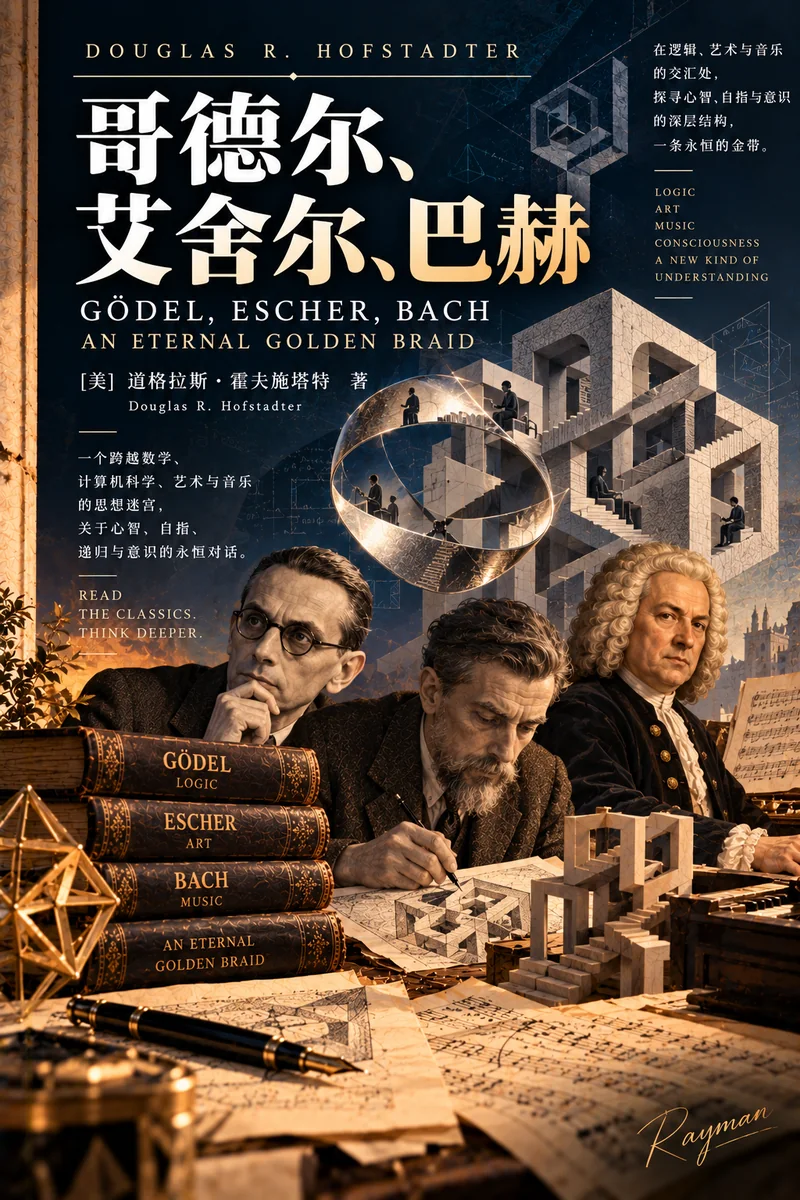
Technology & Science 1979
Gödel, Escher, Bach
《哥德尔、艾舍尔、巴赫》
An Eternal Golden Braid
- Published
- 1979
- Category
- Technology & Science
- Difficulty
- Advanced
- Reading time
- ~30 hours
- Original language
- en
The Classic Index is not an objective scientific measure. It is this site's personal curation score.
What is this book about?
Hofstadter weaves formal systems, recursion, self-reference, and isomorphism around a single thread: how meaning emerges from meaningless symbol manipulation. Using dialogues and puzzles, and braiding Gödel's incompleteness theorems with Escher's drawings and Bach's fugues, the book is a long argument about how a self is possible at all.
Why read it?
It demonstrates how cross-domain analogy can produce genuine insight rather than mere rhetoric. For anyone working in AI or cognitive science today, its discussion of how formal systems can refer to themselves remains one of the best entries into representation and self-models.
Core Ideas
- Self-reference is the key structure for understanding consciousness and self, letting a system talk about itself.
- Meaning is not a property of symbols but arises from isomorphism and mapping at the system level.
- Any formal system contains true statements it cannot prove — a structural limit rather than a defect.
- Recursion and levels are the bridge between simple rules and complex behavior.
What questions does this book try to answer?
- How does meaning arise from pure symbol manipulation?
- How can a system refer to and talk about itself?
Who should read it?
For readers drawn to logic, mathematics, music, and cognitive science alike. It is very demanding; slow reading and skipping some puzzles is expected.
Related Books
If you like this book