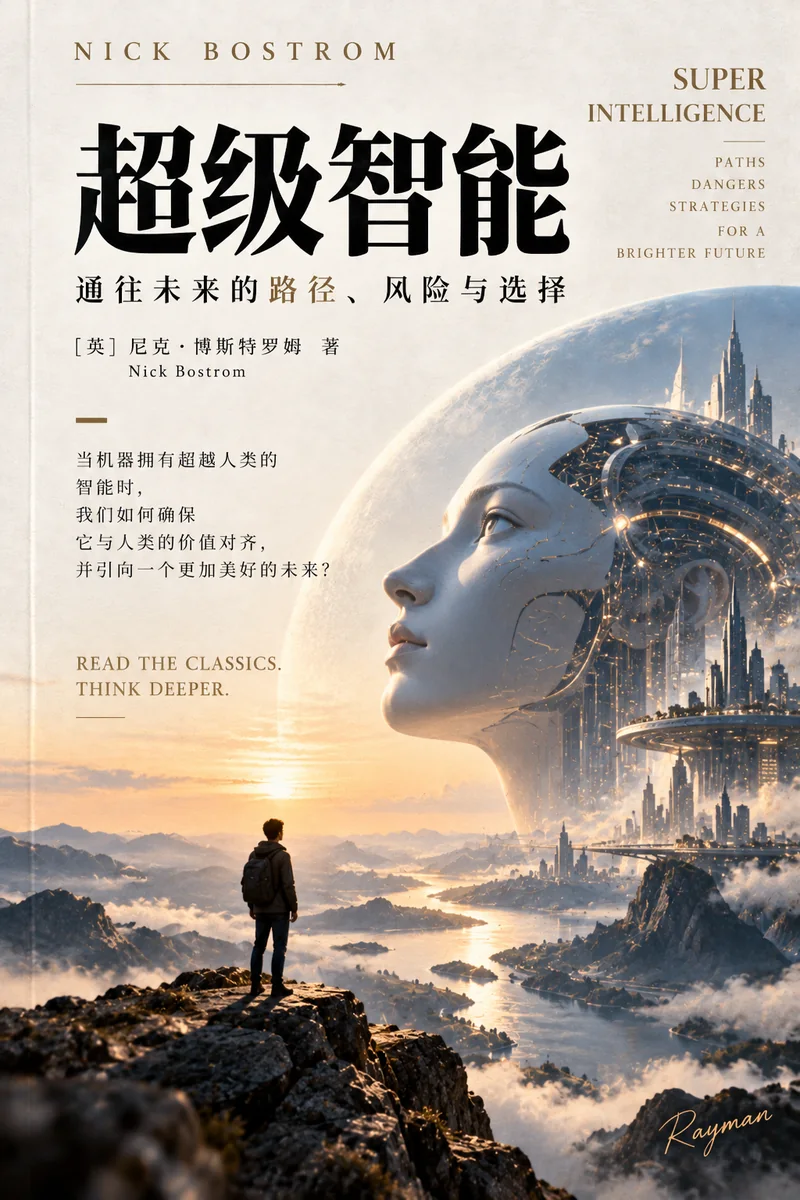
Superintelligence
《超级智能》
Paths, Dangers, Strategies
- Published
- 2014
- Category
- Artificial Intelligence
- Difficulty
- Advanced
- Reading time
- ~18 hours
- Original language
- en
The Classic Index is not an objective scientific measure. It is this site's personal curation score.
What is this book about?
Writing before superintelligence existed, Bostrom systematically asked how much leverage humanity would retain once an intelligence far beyond our own appeared. He breaks the question into the forms intelligence might take, the paths by which it might arrive, the mechanisms by which control could be lost, and whether any workable countermeasures remain before that point.
Why read it?
Its value is not prediction but method: when an outcome is extreme and irreversible, it deserves serious treatment even at low probability. That argument became the common starting point for later AI-safety debate and applies to high-stakes risks far outside technology.
Core Ideas
- Once intelligence can recursively improve itself, it may grow faster than humans can react.
- Specifying a goal and achieving a goal are separate problems: a powerful optimizer realizes exactly what you wrote, not what you meant.
- The winner-take-all character of a single superintelligence makes the first one to appear decisive.
- Alignment is not a technical footnote but the political and ethical question that determines the outcome.
What questions does this book try to answer?
- If machine intelligence far exceeds our own, can humans retain control?
- Can we solve alignment well enough before superintelligence arrives?
Who should read it?
For readers willing to reason abstractly about risk and decision theory. It demands tolerance for speculative argument rather than empirical evidence.
Reading Notes
2026-09-20
When capability grows faster than our understanding of our own goals, the danger is not a malicious machine but one that executes a vague goal with perfect precision.
The book's real value is not its timing but its move from science fiction to engineering: it turns "control" into a design problem. What changed for me is the question I now ask. Not "will AI go out of control," but "under what conditions would a system more capable than me do something I do not want?" That question is not about intelligence; it is about how goals are specified. It convinced me that alignment is a precondition, not a finishing step.
Related Books
If you like this book