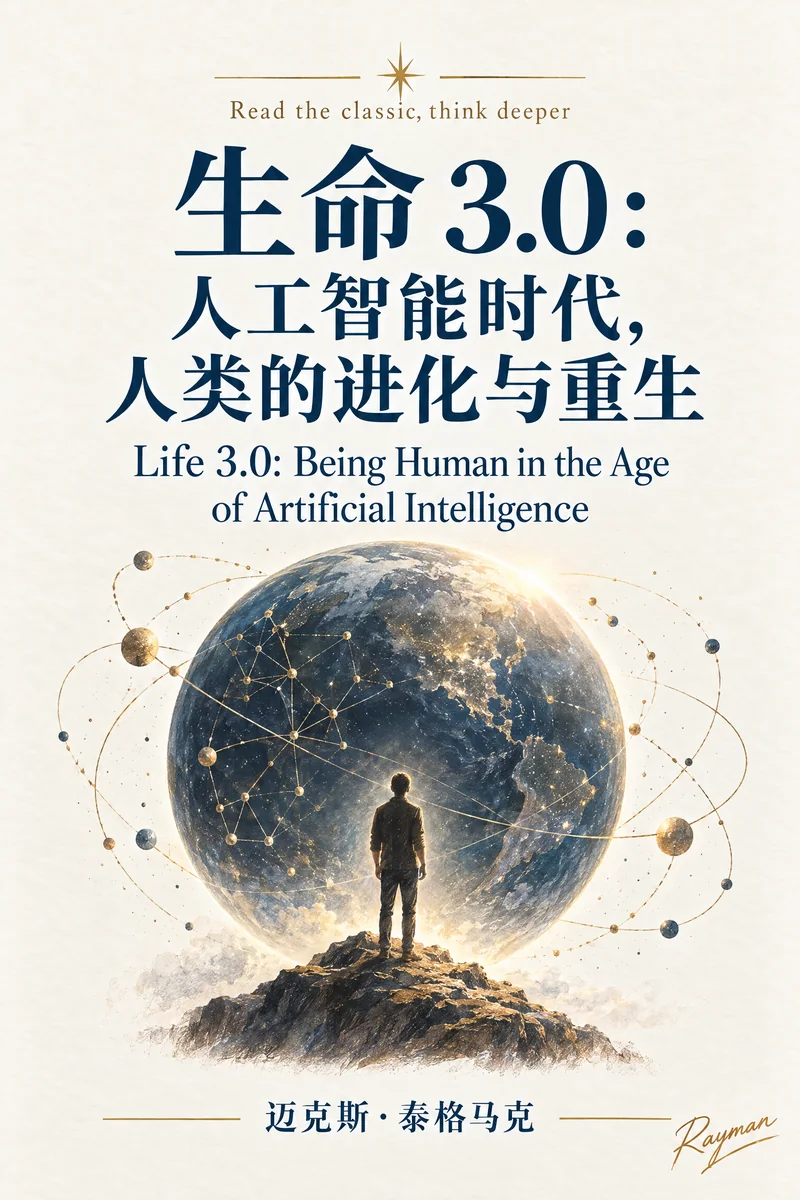
Life 3.0
《生命 3.0》
Being Human in the Age of Artificial Intelligence
- Published
- 2017
- Category
- Artificial Intelligence
- Difficulty
- Intermediate
- Reading time
- ~16 hours
- Original language
- en
The Classic Index is not an objective scientific measure. It is this site's personal curation score.
What is this book about?
Tegmark organizes a very broad question — from near-term automation and unemployment to a cosmos-scale intelligence — with a simple frame: life 1.0, 2.0, 3.0, depending on whether hardware and software can be designed. He does not prophesy; he lines up the possible futures and asks you to weigh them.
Why read it?
Its strength is scope and structure: technology, ethics, and politics on a single map, with a clear line between “technically possible” and “what we should choose.” You finish without answers but with a vocabulary for the debate.
Core Ideas
- Life can be staged by whether hardware and software can be designed, and humanity sits at the threshold from 2.0 to 3.0.
- Capability and wisdom do not grow together: the former accelerates while the latter barely moves, and that gap is the source of risk.
- The decisive question is not whether machines can surpass us but what humans choose to do with the capability.
- Debating long-term risk does not distract from present problems; it supplies the long-range coordinates for present decisions.
What questions does this book try to answer?
- When capability far outruns wisdom, what should humanity choose?
- Which futures do we actually want to live in, as opposed to merely being technically feasible?
Who should read it?
For readers who want the whole landscape of AI issues in one pass, especially those who want to connect technical detail to ethics and politics.
Related Books
If you like this book