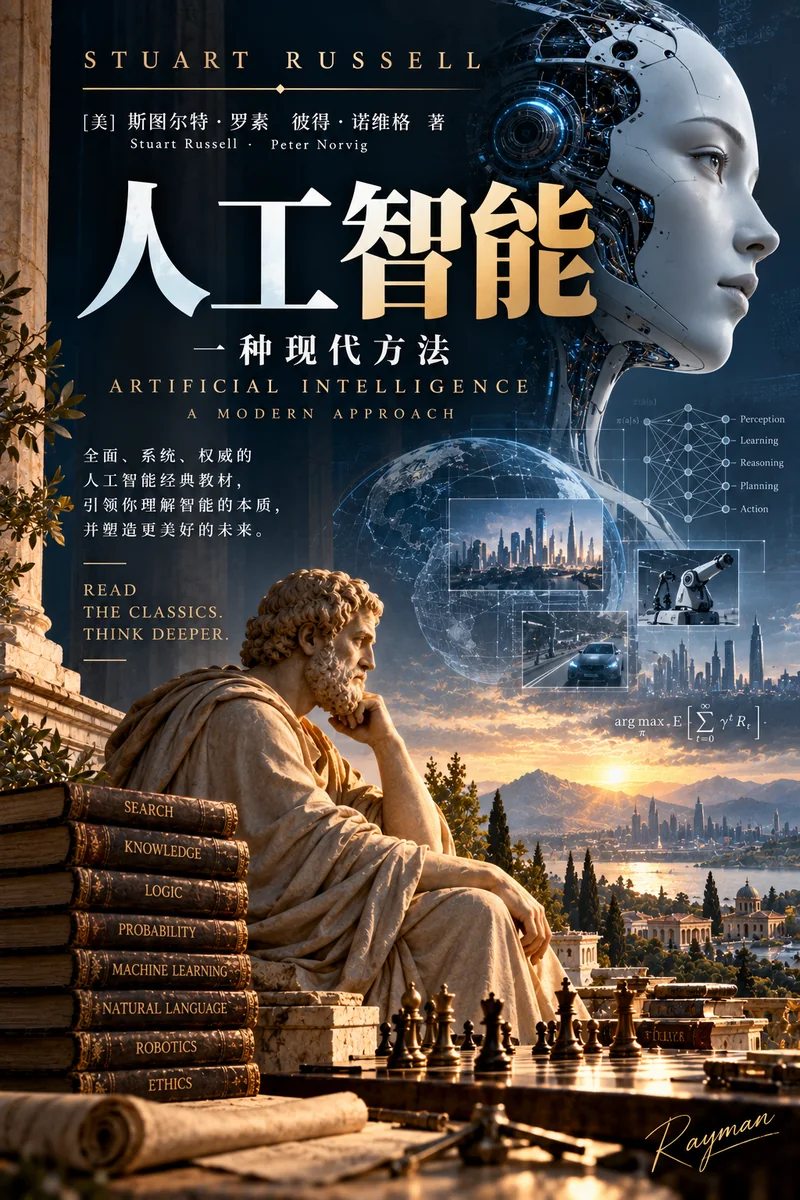
Artificial Intelligence
《人工智能》
A Modern Approach
- Published
- 1995
- Category
- Artificial Intelligence
- Difficulty
- Advanced
- Reading time
- ~60 hours
- Original language
- en
The Classic Index is not an objective scientific measure. It is this site's personal curation score.
What is this book about?
The book divides artificial intelligence into two traditions — thinking, built on logic and search, and acting, built on probability and statistics — and shows that both converge on the same goal: a rational agent choosing optimal actions in an environment. It is at once the most widely used AI textbook in the world and a map of the field's boundaries and ambitions.
Why read it?
Read in the age of large models, its value lies less in memorizing algorithms than in seeing which problems are fundamental: representation, search, inference, learning, and uncertainty. The textbook's framework lets you place each wave of hype on a stable coordinate system instead of chasing the latest vocabulary.
Core Ideas
- The agent is the unifying unit of analysis, letting perception, reasoning, and action be discussed in one framework.
- Search and logical inference handle a deterministic world; probability and utility theory handle an uncertain one.
- Learning is not a feature bolted on but the only viable strategy for an agent facing an environment it cannot enumerate.
- Intelligence is goal-directed rational behavior, whether or not it resembles how humans think.
What questions does this book try to answer?
- What capabilities does a rational agent need to act in an uncertain environment?
- Where does each approach — search, logic, probability, learning — apply, and where does it break down?
Who should read it?
For readers with programming experience and basic mathematics — probability, linear algebra — who want a systematic framework for AI. It need not be read cover to cover; individual chapters stand on their own.
Related Books
If you like this book