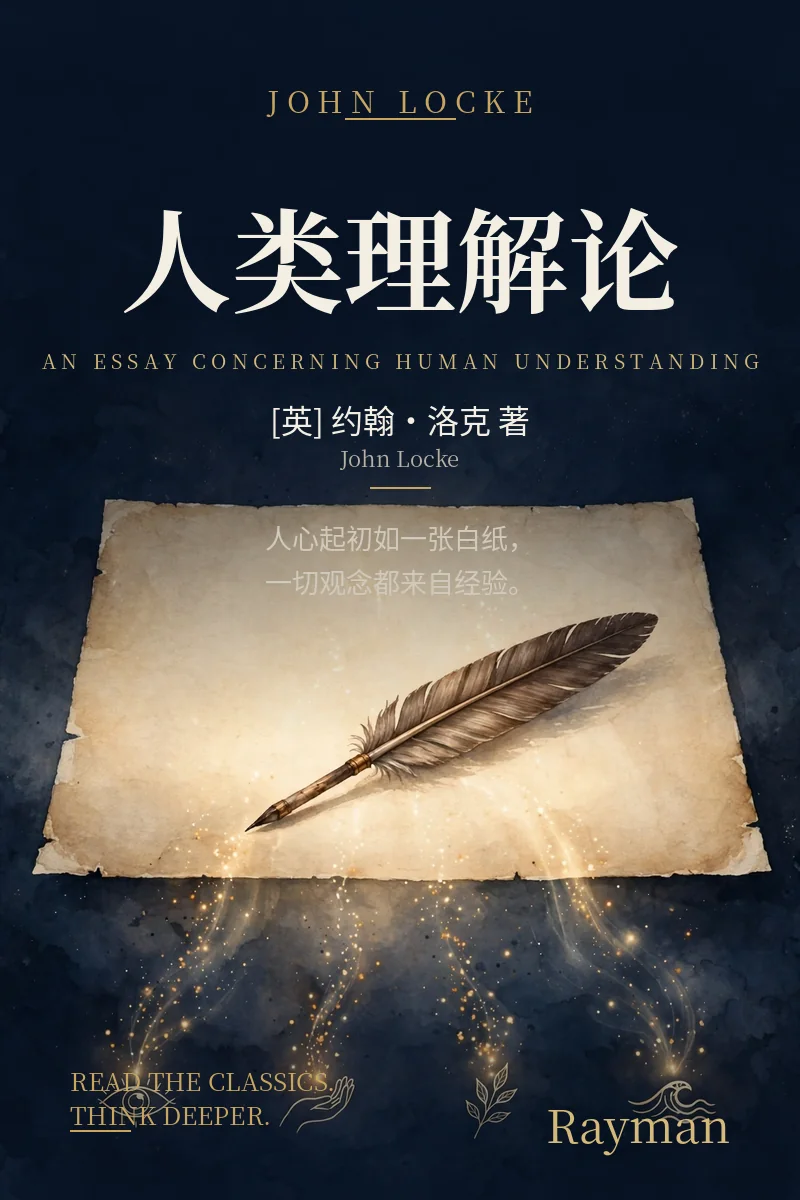
Philosophy 1690 Daily Pick
An Essay Concerning Human Understanding
《人类理解论》
- Published
- 1690
- Category
- Philosophy
- Original language
- en
- Source list
- Daily Pick
The mind begins as white paper; all ideas arrive through experience
Imported from a third-party reading list or added as a daily pick — bibliographic facts, the source framing, and a full reading guide.
Source theme
The mind begins as white paper; all ideas arrive through experience
What is this book about?
Published in 1690 after nearly two decades of work, An Essay Concerning Human Understanding runs to four books. Book I clears the ground: there are no speculative or practical principles to which all humanity assents, so the doctrine of innate ideas cannot stand. Book II builds the positive account. The mind begins as white paper; every idea enters through one of two channels, sensation and reflection; simple ideas are combined into complex ones; and the difficult notions of space, power and substance are traced to their origin. Book III turns to language, arguing that words are merely signs of ideas, that general terms answer to nominal rather than real essences, and that a great many philosophical disputes are quarrels about words. Book IV maps the limits of knowledge: knowledge is the perception of the agreement or disagreement of ideas, graded as intuitive, demonstrative and sensitive; universal knowledge reaches only nominal essences, while the real constitution of things leaves us with probability and belief.
Why read it?
Because the modern agenda of epistemology was drafted in this book. Three centuries of argument about where ideas come from, how far knowledge extends, and how language manufactures false problems are largely answers to Locke or rejections of him. It is also the genuine prehistory of cognitive science: the blank slate remains the most widespread default assumption about the mind, and Pinker's The Blank Slate is a sustained assault on it, so reading the two together is to watch a three-hundred-year collision at close range. It is also unusually readable. Locke writes as though thinking aloud with a friend, sets no terminological barrier, and is one of the few philosophical classics that can be entered directly.
Core Ideas
- There are no innate ideas: no speculative or practical principle commands universal assent, and the claim that children carry such principles already imprinted is an untested assumption.
- The mind begins as white paper. All ideas derive from sensation and reflection; simple ideas are material received passively, while complex ideas are the mind's own work of combining, comparing and abstracting.
- The distinction between primary and secondary qualities: extension, figure and motion belong to bodies themselves, whereas colours, sounds and smells are only powers in bodies to produce ideas in us.
- Substance is a support we cannot conceive: we perceive only collections of qualities, and of the substratum that supposedly bears them we have no clear idea at all.
- Words are signs of ideas. General terms answer to nominal rather than real essences, and much scholastic dispute over substantial forms is a dispute about words.
- Knowledge has limits. It is the perception of the agreement or disagreement of ideas, universal knowledge reaches only nominal essences, and beyond that line we must settle for probability and belief.
What questions does this book try to answer?
- Where do the ideas in the mind actually come from, and is there any content that is innate rather than acquired?
- How far can our knowledge of the external world extend, and what remains beyond that boundary?
- To what extent does language manufacture philosophical problems that look profound but are insoluble?
- When revelation and reason conflict, by what right does one decide which to obey?
Who should read it?
Readers of philosophy and cognitive science; researchers and writers concerned with what makes knowledge valid; and anyone who wants to know what the blank slate actually claims — a phrase cited far more often than it is read. No prior philosophical training is required, but patience is: the argument across the four books is cumulative, and skipping Book II leaves Books III and IV without support.
How to Read It
Read in order and do not skip. Book I is short and serves to clear the ground. Book II carries the weight, especially the chapters on power and on substance, where the technical content of the blank slate actually lies. Book III on words is the most underrated part and reads as a forerunner of twentieth-century philosophy of language. Book IV then closes the account of the limits of knowledge. Read it alongside The Blank Slate, recommended the same day: first Locke's argument that the mind arrives empty, then Pinker's argument that this assumption has costs of its own.