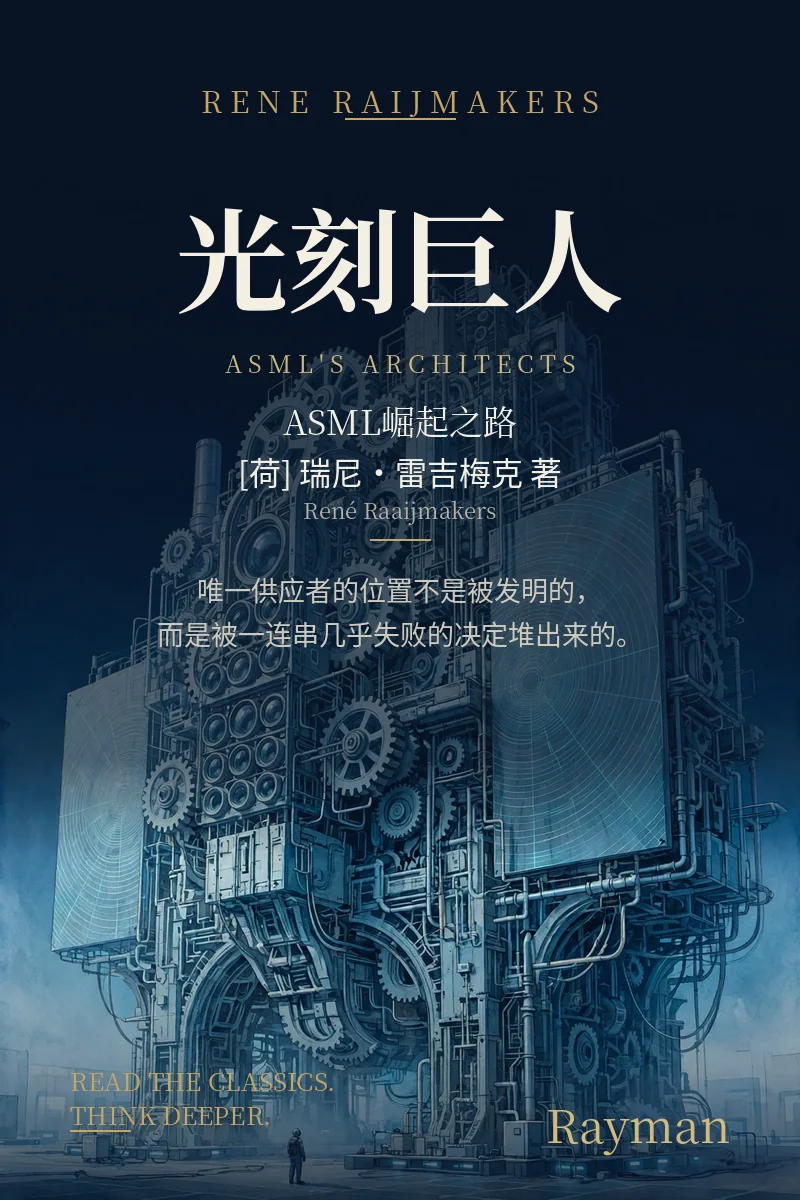
Technology & Science 2018 Daily Pick
ASML's Architects
《光刻巨人》
- Published
- 2018
- Category
- Technology & Science
- Original language
- en
- Source list
- Daily Pick
The position of sole supplier was not invented; it was piled up out of a series of decisions that nearly failed
Imported from a third-party reading list or added as a daily pick — bibliographic facts, the source framing, and a full reading guide.
Source theme
The position of sole supplier was not invented; it was piled up out of a series of decisions that nearly failed
What is this book about?
Published by Techwatch Books in 2018, ASML's Architects took René Raaijmakers seven years, more than eighty interviews and some three hundred hours of recordings. It is not a success manual but the record of an industrial transfer: in the 1980s the American lithography giants Perkin-Elmer and GCA lost a twenty-year monopoly under assault from Canon and Nikon, while an unloved wafer stepper in a Philips laboratory was carved out into a joint venture with ASM International and became ASML in 1984. The book moves year by year through technical documents, a fifty-fifty shareholding, capital injections and delivery deadlines, a decade of being outgunned by Japanese competitors, and the turn toward step-and-scan. Raaijmakers insisted on writing history rather than a management case, which is why the corporate politics, the misjudgements and the luck all survive on the page.
Why read it?
Because it explains how a chokepoint actually grows. ASML's position did not come from one stroke of genius but from a chain of decisions whose returns were invisible at the time: betting on the stepper rather than the mask aligner, accepting a joint-venture term sheet that was close to humiliating, pushing alignment precision past what rivals could reach, and tuning machines one at a time inside customers' fabs. For people in semiconductor materials and equipment this is primary industrial history; for strategists it is a complete case of how a second-tier player becomes the only player. It also yields a counterintuitive conclusion: technical leadership often follows organisational choices rather than technology roadmaps.
Core Ideas
- Industrial leadership was lost not to better technology but to organisational tempo and investor patience: the decline of Perkin-Elmer and GCA was first of all a corporate failure.
- A chokepoint is accumulated. Phase-grating alignment, through-the-lens alignment and the linear motor all began as capabilities with no clear commercial return.
- The joint venture was a forced move. Philips would not carry the risk alone, ASM wanted into equipment, and the fifty-fifty structure wrote decades of corporate politics into the company's DNA.
- The go-for-the-gold culture was not a slogan but a survival strategy produced by consecutive losses: without first place there was no reason to exist.
- The customer was not a market but a co-developer. Early machines were debugged inside customers' fabs, by customers' engineers.
- Once a company becomes the sole supplier, it stops being only a company and acquires a political identity by default.
What questions does this book try to answer?
- Under what conditions does a technology move from disregarded to irreplaceable?
- How does a latecomer win in a mature industry: on cost, on speed, or on a willingness to carry risks others refuse?
- Once a company becomes the single point in a global supply chain, can it remain a purely commercial entity?
- To what extent do an organisation's memories, its documents and its internal fights determine which technical path it takes?
Who should read it?
People working in semiconductors and electronic materials, especially in equipment, process and supply chain; analysts doing industrial and geopolitical research; managers and founders in technology companies. No optics or mechanical engineering background is needed, since the author deliberately keeps terminology minimal and puts people and decisions in the foreground. Some patience is required: the early chapters are dense with names that recur throughout.
How to Read It
Chapters 1 to 5 cover the technical prehistory, from the Philips Natlab through David Mann to the rise of GCA; chapters 6 to 8 cover delivery and the cash-flow crisis; chapters 9 and 10 cover step-and-scan and the Asian customers. Read it alongside Chip War, Moore's Law and Crystal Fire already in this library to form a single line running from equipment to materials to industrial policy, or alongside The Gates of Europe, recommended the same day: one book is about a position that was given, the other about a position that was built.