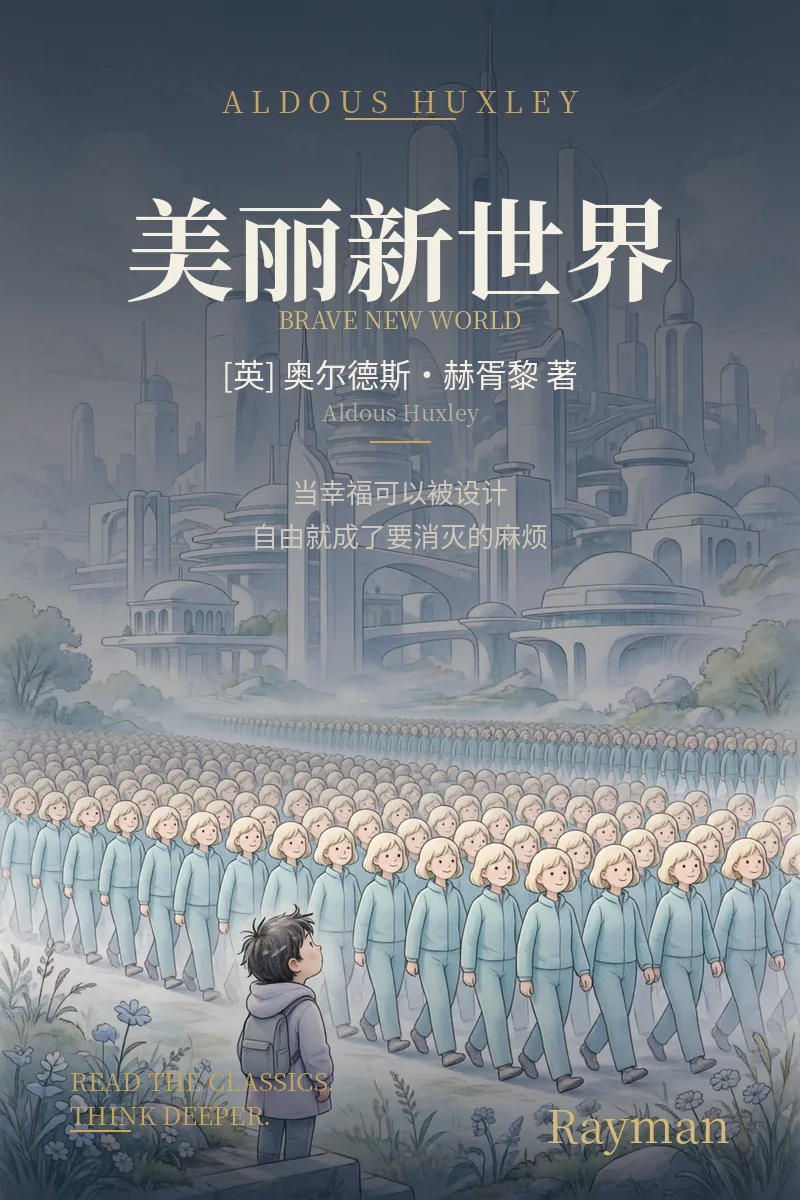
Literature & Fiction 1932 Daily Pick
Brave New World
《美丽新世界》
- Published
- 1932
- Category
- Literature & Fiction
- Original language
- en
- Source list
- Daily Pick
When happiness can be engineered, freedom becomes a nuisance to be eliminated
Imported from a third-party reading list or added as a daily pick — bibliographic facts, the source framing, and a full reading guide.
Source theme
When happiness can be engineered, freedom becomes a nuisance to be eliminated
What is this book about?
Brave New World is Huxley's 1932 dystopia, set in the World State in the year 632 AF (After Ford). Society is stratified from conception into five castes, Alpha through Epsilon; infants are conditioned by hypnopaedia to prefer their station; a drug called soma smooths away every unease; and a sexual ethic of everyone belonging to everyone replaces family and romantic love. Bernard Marx and Lenina Crowne travel to a Savage Reservation and bring back John, a young man raised on the values of the old world. Confronted by the Controller Mustapha Mond's case — that stability requires the abolition of art, religion, deep love and pain — John refuses, yet finds no third path. The novel's force lies less in predicting technology than in imagining a society in which no one suffers, and therefore no one rebels.
Why read it?
It is the most unsettling of the dystopias because no one in it is tortured: everyone is kept comfortable, healthy and content. That sharpens the real question — if stripping your freedom made everyone happier, on what grounds would you object? Huxley pushes the idea that comfort itself can be a means of control to its limit: no secret police are needed, only people conditioned from infancy to love their place. This is the mirror of today's recommendation algorithms, attention economy and paternalistic governance. Read it not for a bad future but to calibrate your present default assumption: are you choosing freely, or choosing among options designed in advance for you?
Core Ideas
- Stability is the highest value, purchased by abolishing everything that might disturb it: art, religion, deep love, solitude and discontent are all redefined as dangers.
- Control need not rely on violence; making people love their condition is more thorough, since hypnopaedia and caste design turn the ruled into accomplices of their own obedience.
- Pleasure is an instrument of rule, not liberation: soma and undifferentiated sex dissolve pain, and with it the tension that meaning requires.
- The Savage's dilemma is the book's core: he can accept neither engineered happiness nor the old world already lost, so freedom appears as a pain that has nowhere to go.
What questions does this book try to answer?
- Is a society without pain but also without freedom worth wanting? On what grounds can we tell real happiness from conditioned contentment?
- When discomfort, art and transcendence are engineered away, what is left of a person? Does being human necessarily include the capacity to bear pain?
- If control arrives in the guise of doing you good, how do we recognise and keep our own judgement without resorting to violent refusal?
Who should read it?
For readers of political philosophy, technology ethics and the dystopian tradition; and for anyone thinking about recommendation algorithms, the attention economy and soft paternalism. Those wanting pure plot-driven adventure will be disappointed — the book is closer to an experiment in ideas. Readers certain that liberty trumps all should read it most: it forces the question of how much pain freedom is worth.
How to Read It
It is short enough to read in one sitting. Read it against Orwell's Nineteen Eighty-Four: control there runs on fear and punishment, here on pleasure and comfort, and the two logics complement each other. Notice that Huxley deliberately gives the book no villain — Mond is reasonable and charming, which makes criticism hard and is precisely the book's sophistication. For the author's own reassessment two decades on, follow with Brave New World Revisited (1958), where he concedes that overpopulation and propaganda techniques have brought the prophecy closer to fact.