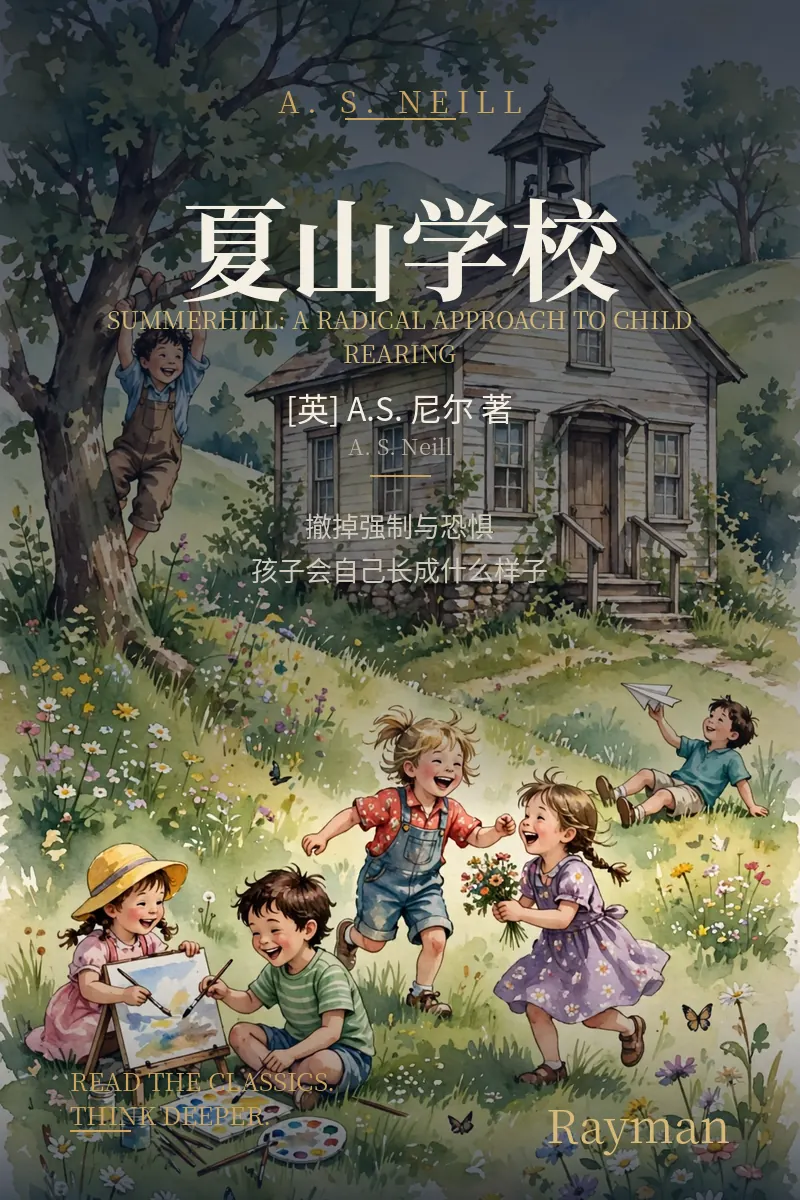
Education & Reflection 1960 Daily Pick
Summerhill
《夏山学校》
- Published
- 1960
- Category
- Education & Reflection
- Original language
- en
- Source list
- Daily Pick
What a child becomes when coercion and fear are removed
Imported from a third-party reading list or added as a daily pick — bibliographic facts, the source framing, and a full reading guide.
Source theme
What a child becomes when coercion and fear are removed
What is this book about?
Summerhill is the British educator A. S. Neill's 1960 account of the school he founded in 1921 and later moved to Leiston, Suffolk. Its practice was close to heresy at the time: children could attend lessons or skip them for a whole year; rules were made democratically at a whole-school meeting where staff and pupils each had one vote; there was no corporal punishment, no scolding, no ranking. Neill's core belief was that children are not naturally bad, and that so-called problem behaviour is mostly the product of adult coercion and fear; the first task of education, therefore, is not to fill heads with knowledge but to help a child become emotionally healthy. The book uses many individual cases to show children recovering from timidity, defiance or numbness, and it records failures and controversies candidly. It is less a methods manual than a report on an experiment in freedom and authority.
Why read it?
It pushes the question of whether education can survive without coercion to an extreme, forcing you to examine your default beliefs about authority, discipline and doing what is good for the child. Neill's most counter-intuitive claim is that fear, not permissiveness, is the root of bad behaviour. This is especially relevant now, when learning depends more on self-direction and AI can supply almost limitless material for self-study: what school is actually for, and on what authority it rests, becomes a real question again. Read it without needing to agree — read it to argue. A report on an experiment listed as required reading in more than six hundred university education courses deserves its strongest case to be taken seriously, not waved away as too idealistic.
Core Ideas
- Children are not naturally bad; problem behaviour is mostly the product of adult coercion and fear. Repair the emotional life first, then speak of knowledge — the order cannot be reversed.
- Freedom is not license: freedom at Summerhill is freedom inside a democratic community, where rules are made by staff and pupils voting as equals, so the boundary of freedom is drawn by the community itself.
- Self-government teaches responsibility better than external discipline: having children make and enforce rules internalises order more deeply than making them obey.
- The aim of education is for a child to live his own life, not the life adults expect — a declaration that is also the book's most contested claim.
What questions does this book try to answer?
- Can children learn, without coercion, the things they would rather not learn but must? Will the cost of freedom fall on the children least able to discipline themselves?
- Beyond its curriculum, what does a school teach through its structure of authority? When a child is made to obey unconditionally, does he learn knowledge, or obedience itself?
- Pushed to its limit, does letting a child live his own life become an abdication of responsibility for his future? Where is the line between freedom and protection?
Who should read it?
For educators, parents and anyone seriously thinking about the relation between authority and freedom. Sceptics of progressive education should read it most — this is one of the fullest and most honest statements of that position, far stronger than second-hand summaries. Readers wanting a ready-to-copy teaching method will be disappointed: Neill offers principles and cases, not a manual, and he never hides the experiment's costs.
How to Read It
The book is organised into thematic chapters and cases, so it can be read selectively, but a workable order is: first the opening description of daily life at Summerhill, then the chapters on freedom and self-government, and finally his passages on sex education and troubled children, where the controversy concentrates. Keep two cautions while reading: first, Neill's evidence is mostly anecdote and observation, without controls or long-term tracking, so his conclusions should not be taken as settled; second, Summerhill was a small experiment with self-selecting families, and transplanting it to a large public system meets entirely different constraints. Read it alongside Dewey and Illich to see the differences within the tradition of free education.