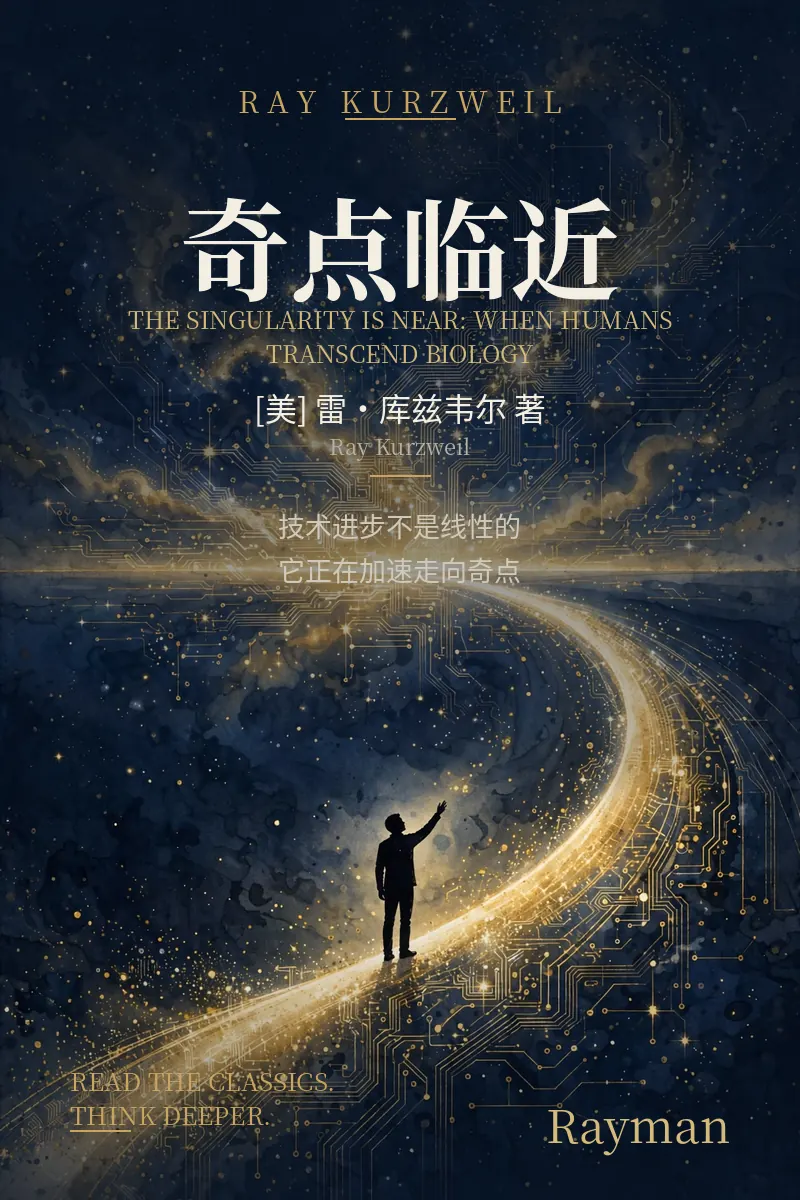
Artificial Intelligence 2005 Daily Pick
The Singularity Is Near
《奇点临近》
- Published
- 2005
- Category
- Artificial Intelligence
- Original language
- en
- Source list
- Daily Pick
Pushing the intuition that technological progress is non-linear to its limit, and drawing out the consequences
Imported from a third-party reading list or added as a daily pick — bibliographic facts, the source framing, and a full reading guide.
Source theme
Pushing the intuition that technological progress is non-linear to its limit, and drawing out the consequences
What is this book about?
The Singularity Is Near is Ray Kurzweil's 2005 work of futurology, built around three mutually accelerating fields he groups as GNR: genetics, nanotechnology and robotics (meaning strong artificial intelligence). His claim is that all three follow exponential rather than linear curves, and will therefore converge around 2045 into a 'singularity' — a point at which machine intelligence exceeds the sum of human intelligence and the boundary between people and machines dissolves. To support this he deploys dozens of charts plotted on logarithmic axes, and takes up in turn reverse-engineering the brain, nanomedicine and life extension, energy and resource limits, and the possible reorganisation of economic and political order. A closing chapter answers his critics. It remains the fullest popular statement of the accelerationist position.
Why read it?
Its value is not in whether you believe the year 2045 but in the way it drives the intuition that technological progress is not steady to its logical end and forces you to examine your own default assumption: do you think the future arrives gradually or in steps? It is also a primary source. Much of today's public argument about AGI timelines, AI and employment, and human enhancement inherits its structure directly from this book. Anyone who wants to refute it should read it first, because the version usually attacked is not the one Kurzweil actually argues.
Core Ideas
- The law of accelerating returns: the price-performance of information technology improves exponentially, because each generation of technology is used to design the next, creating positive feedback; on a logarithmic axis this growth appears as a roughly straight line.
- The singularity is a point where prediction fails: once machines can improve themselves, the rate of change exceeds human extrapolation, so the society after it cannot be described with present-day intuition — only the mechanism of its arrival can be.
- GNR are not three parallel tracks but three curves that accelerate one another: genetics depends on computation, nanotechnology supplies the means of fabrication, and AI supplies the capacity to design. The singularity is where they meet.
- A person can be treated as software: Kurzweil argues that the information pattern of consciousness can be preserved and migrated off its biological substrate, which redefines ageing and death as engineering problems rather than metaphysical facts.
What questions does this book try to answer?
- Under what conditions does exponential growth hold, and under what conditions is it broken by physical limits, energy constraints or social institutions?
- If machine intelligence really catches and passes us within a few decades, how much of our present arrangement of education, work and meaning survives?
- Treating a person as an uploadable information pattern — what does it leave out about the body: embodied experience, feeling, mortality itself?
Who should read it?
For readers concerned with the long-run direction of AI, the philosophy of technology and futurology; and for writers and commentators who need to recognise where accelerationist arguments come from. Sceptics of the exponential premise should read it most of all — this is the fullest and most serious statement of that position, far stronger than second-hand summaries. It is not for readers wanting a neutral survey: the book is a polemic with a thesis.
How to Read It
At over seven hundred pages with uneven density, it need not be read cover to cover. A workable order: the opening chapter on the six epochs of the singularity for the frame, then the chapter on the law of accelerating returns to see how the argument is built, then straight to the closing chapter answering critics, where Kurzweil addresses the objection that exponential curves hit walls. For every chart, ask two questions: is the vertical axis logarithmic or linear, and how wide is the time window? Published in 2005, several of its specific forecasts — the timing of speech recognition, for instance — have since been tested by events, which makes them useful calibration material.