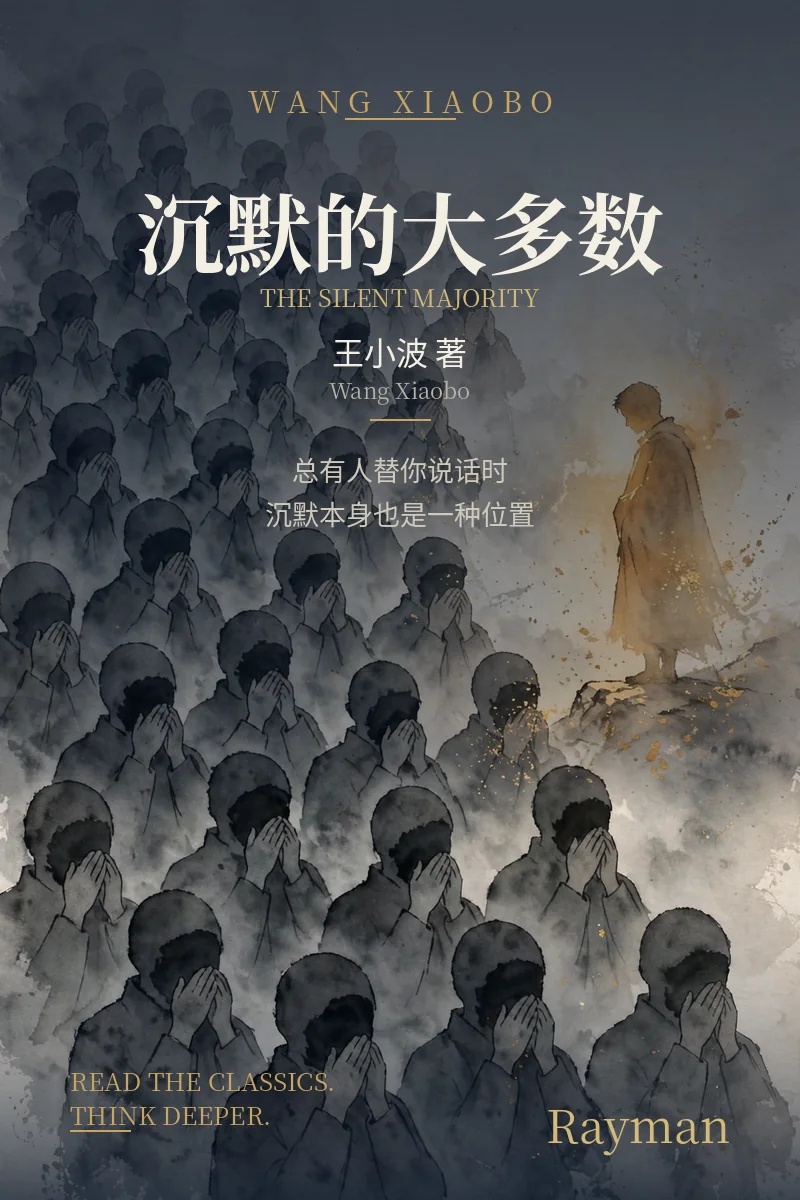
Classic Essays 1997 Daily Pick
The Silent Majority
《沉默的大多数》
- Published
- 1997
- Category
- Classic Essays
- Original language
- zh
- Source list
- Daily Pick
In a setting where someone is always speaking for you, silence is itself a position
Imported from a third-party reading list or added as a daily pick — bibliographic facts, the source framing, and a full reading guide.
Source theme
In a setting where someone is always speaking for you, silence is itself a position
What is this book about?
The Silent Majority is Wang Xiaobo's collection of essays, published by China Youth Press in 1997 and gathering dozens of pieces he wrote during the 1990s. The title comes from one of them: in an environment where someone is always speaking on your behalf, most people choose not to open their mouths, and the silence itself becomes a position. The subjects are wide-ranging — from Hemingway's The Old Man and the Sea to Beijing vernacular, from the 'national studies' boom to personal dignity, from the scientific spirit to prejudice against minorities — but the stance running through them is consistent: against grand discourse overriding personal experience, and for treating the pleasure of thinking as a basic need rather than a luxury. His method sets argument and mockery side by side, using jokes to take the lectern away and let the reasoning stand on its own.
Why read it?
It demonstrates a rare quality in Chinese prose: making serious arguments without heaviness. Wang does not rely on rhetoric but on clean reasoning and exact metaphor, and he shows that opposing one tone of voice does not require adopting another. For a Chinese public writing culture long accustomed to emotional expression, the book offers a technique of reasoning — how to complete a rebuttal in three paragraphs, how to state a position clearly without slogans. That is precisely what becomes scarcer in the age of AI: when generation is cheap and opinions are in surplus, telling whether a passage is actually reasoning matters more than being able to produce one.
Core Ideas
- Silence is not the absence of opinion but a position shaped by structure: where speaking power is unequal, not speaking is often the rational choice, which makes silence itself an object of analysis.
- The pleasure of thinking is its own end and needs no utilitarian justification; someone who does not enjoy the process is easily absorbed by ready-made answers, because thinking is merely instrumental for him.
- Against 'killing with reason': suppressing a particular person in the name of a correct slogan is harder to recognise than plain malice, and easier to forgive in oneself.
- Humour is an instrument of knowledge, not just a style: place authoritative speech in a mismatched context and its emptiness exposes itself without further argument.
What questions does this book try to answer?
- When is silence a clear-eyed choice, and when is it merely a cowardly retreat? How can the two be told apart from outside?
- Can a person keep to everyday order while remaining inwardly disobedient — and does that inner emigration eventually become another kind of silence?
- Why does reasoning seem so hard in Chinese public expression? Is Wang's method a craft that can be learned, or a gift peculiar to him?
Who should read it?
For readers who enjoy essays and care about public expression and personal stance; especially useful for writers, who can watch him complete a rebuttal in three paragraphs and make metaphor carry an argument rather than decorate it. Readers unfamiliar with the mainland intellectual mood of the 1990s will need some background to feel where the attacks land. Those seeking systematic theory will be disappointed: these are essays, not a treatise.
How to Read It
It is a collection, so no need to read in order. Start with the title essay and 'The Pleasure of Thinking' to set the tone, then 'A Maverick Pig' to see him replace argument with fable. Two things to watch: first, most pieces were written for columns, so they are short and often aimed at a specific opponent — read out of context, the fire seems scattered; second, his argument rests on common-sense intuition, and on topics that genuinely require expertise it stays essayistic, so it should not be cited as rigorous analysis. Read it alongside his translation of Duras or his novella The Golden Age to see the same ear for language deform across genres.