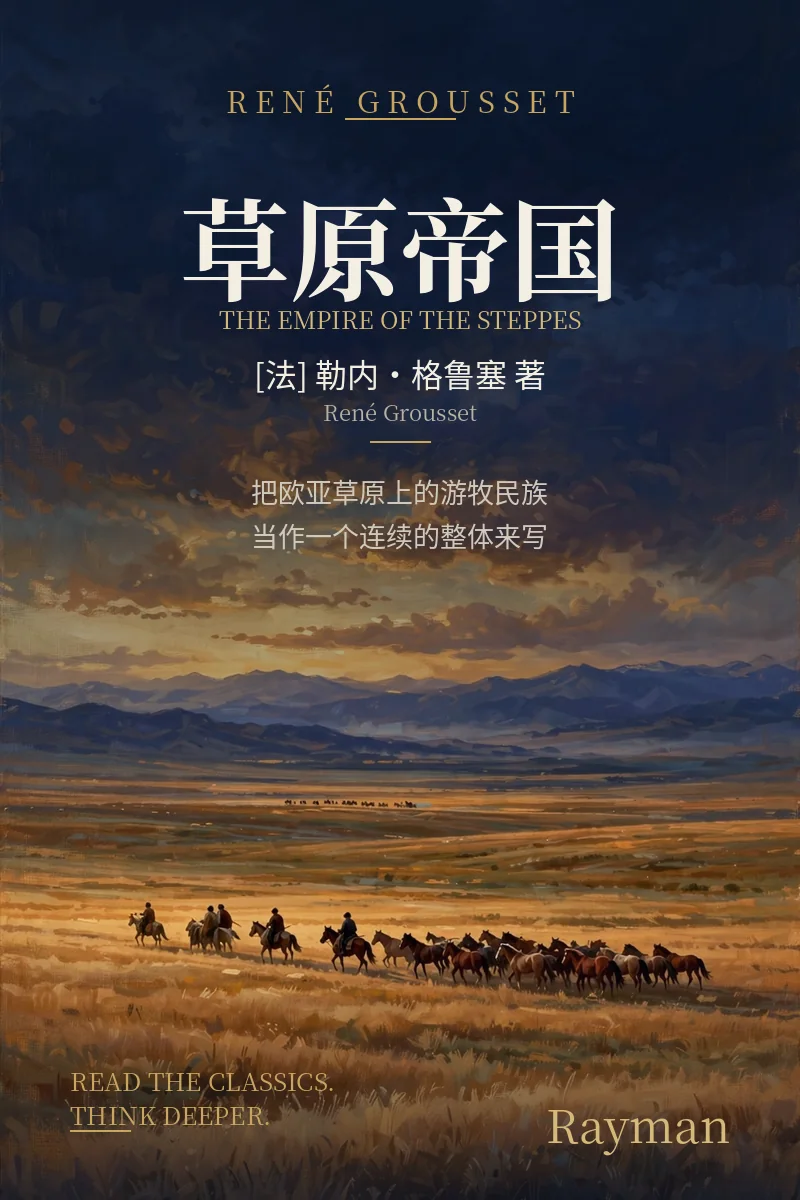
World History 1939 Daily Pick
The Empire of the Steppes
《草原帝国》
- Published
- 1939
- Category
- World History
- Original language
- fr
- Source list
- Daily Pick
Writing the nomads of the Eurasian steppe as one continuous whole
Imported from a third-party reading list or added as a daily pick — bibliographic facts, the source framing, and a full reading guide.
Source theme
Writing the nomads of the Eurasian steppe as one continuous whole
What is this book about?
The Empire of the Steppes is René Grousset's 1939 general history of Central Asia. It does something few works had done before: instead of treating the Huns, Xianbei, Turks and Mongols as isolated 'barbarian invasions', it treats the Eurasian steppe from the Black Sea to Lake Baikal as a single continuous geographic and political unit, and traces in sequence the empires that rose there. The book falls into three parts: the high plateaus of Asia before the thirteenth century, the Mongols of Genghis Khan, and the last Mongols. Using figures such as Attila, Genghis Khan and Tamerlane as threads, Grousset examines the interaction between nomadic and agrarian civilisations — raiding, trade, conquest and fusion — drawing on the archaeology and linguistics of his time. It was the pre-war West's summary of Turco-Mongol scholarship and remains a reference point in the field.
Why read it?
What it offers is a transferable perspective: how to re-read a marginal force long treated as an 'interlude' as a structure with its own logic. You read it not to memorise Genghis Khan's campaigns but to learn to ask why the steppe could repeatedly organise empires spanning Eurasia, and what relations besides war linked nomads and farmers. That habit of treating the periphery as a centre is useful for understanding any force that mainstream narratives overlook.
Core Ideas
- 'Steppe empire' is a unit of analysis: only by placing scattered nomadic polities in one geographic space can their succession and rivalry be seen, rather than a string of isolated invasions.
- Nomad and farmer were not a 'civilised vs barbarian' binary but a long-term symbiotic exchange system — raiding, trade, tribute, intermarriage and religious transmission coexisted.
- Geography is an explanatory variable: the steppe's ecology (mobile herds, horse and bow) shaped the military organisation and rhythm of nomadic expansion.
- Imperial rise and fall is cyclical: the collapse of one steppe polity is often not an endpoint but the starting point of the next consolidation.
What questions does this book try to answer?
- Why could the same steppe repeatedly organise empires spanning Eurasia, while agrarian empires rarely did?
- Was the nomads' impact on the agrarian world destructive, or structural?
- What does writing 'the steppe' as a whole reveal — and what does it obscure?
Who should read it?
For readers interested in world history, Central Asian history and the Mongol empire; and for writers and researchers who want to learn how to build a narrative frame for a marginalised past. For Chinese readers it supplies a parallel thread outside the Central Plains perspective. Those wanting a light popular history will find it dense.
How to Read It
It need not be read linearly. Start with Part Two on Genghis Khan and the Mongol empire, the book's centre of gravity and its most complete section; then return to Part One to grasp the steppe genealogy before the Mongols. Grousset builds his narrative around figures and campaigns, so watch how he uses geography as an explanatory variable. Pair it with The Secret History of the Mongols or a modern Central Asian history, and bear in mind the book dates from 1939 — some archaeological and ethnographic judgements have since been revised.