Economics 2013
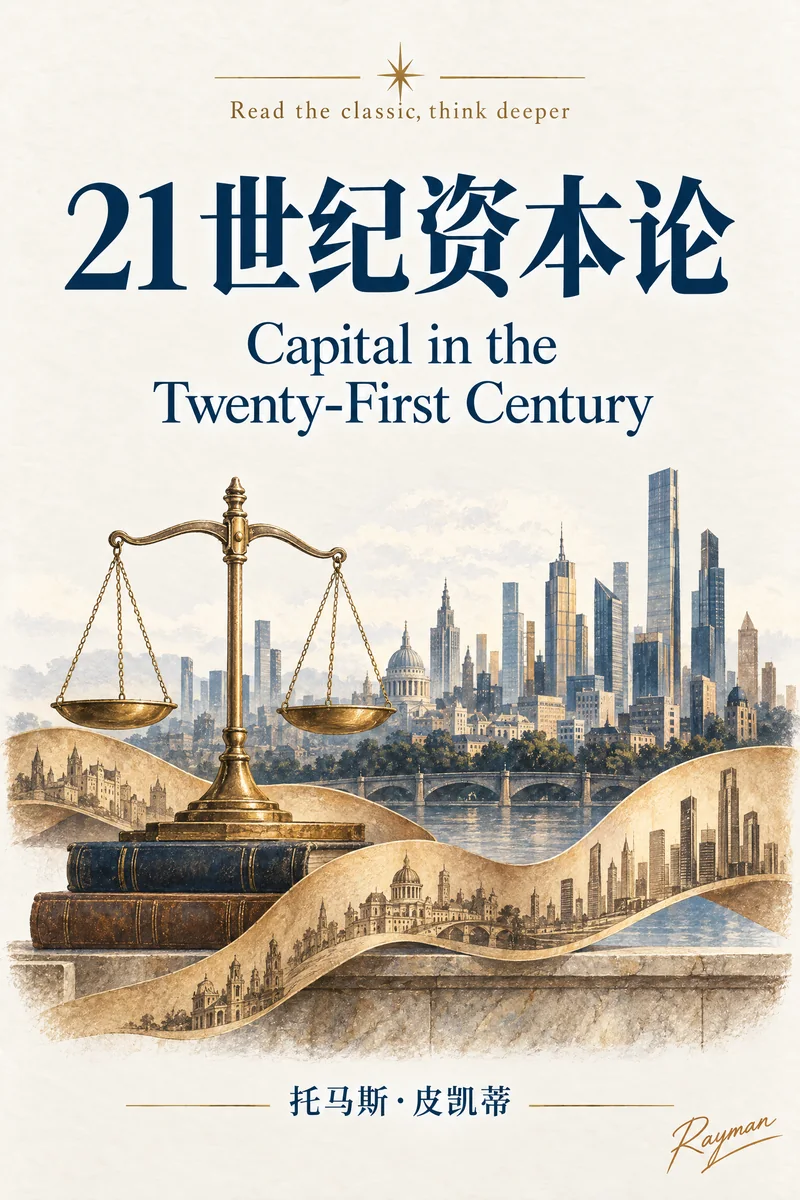
Capital in the Twenty-First Century
《21 世纪资本论》
- Published
- 2013
- Category
- Economics
- Difficulty
- Advanced
- Reading time
- ~22 hours
- Original language
- fr
The Classic Index is not an objective scientific measure. It is this site's personal curation score.
What is this book about?
Piketty uses tax and inheritance records going back to the eighteenth century to argue that when the return on capital exceeds the growth rate over long periods (r > g), wealth concentrates — and that this tendency is not reversed by market adjustment alone. The book’s data methods and theoretical assumptions have drawn extensive scholarly criticism.
Why read it?
It returned the study of inequality to long-run historical data, and whether or not one accepts its conclusions, the r > g framework has become an unavoidable reference in later debates on wealth distribution. Part of its value lies in how fiercely it has been contested.
Core Ideas
- When the return on capital exceeds the growth rate over long periods, inherited wealth grows faster than labour income and concentration increases.
- The history of wealth distribution is not one of steady equalization; the mid-twentieth-century compression owed much to war and policy.
- Capital is not homogeneous — housing, financial assets, and productive capital differ in return and risk, which weakens a single capital-tax rate as an explanation.
- The disputes over its data and assumptions are themselves a good case study in the limits of empirical economics.
What questions does this book try to answer?
- How does the long-run relationship between returns on capital and growth shape wealth distribution?
- Was the mid-twentieth-century compression a structural trend or a historical accident?
Who should read it?
For readers interested in inequality and tax policy, with some grounding in economics and statistics. Read it alongside critiques of its data methods.
Related Books
If you like this book