World History 2014 Daily Pick
Empire of Cotton
《棉花帝国》
- Published
- 2014
- Category
- World History
- Original language
- en
- Source list
- Daily Pick
Rewriting five centuries of capitalist expansion through the single commodity of cotton
Imported from a third-party reading list or added as a daily pick — bibliographic facts, the source framing, and a full reading guide.
Source theme
Rewriting five centuries of capitalist expansion through the single commodity of cotton
What is this book about?
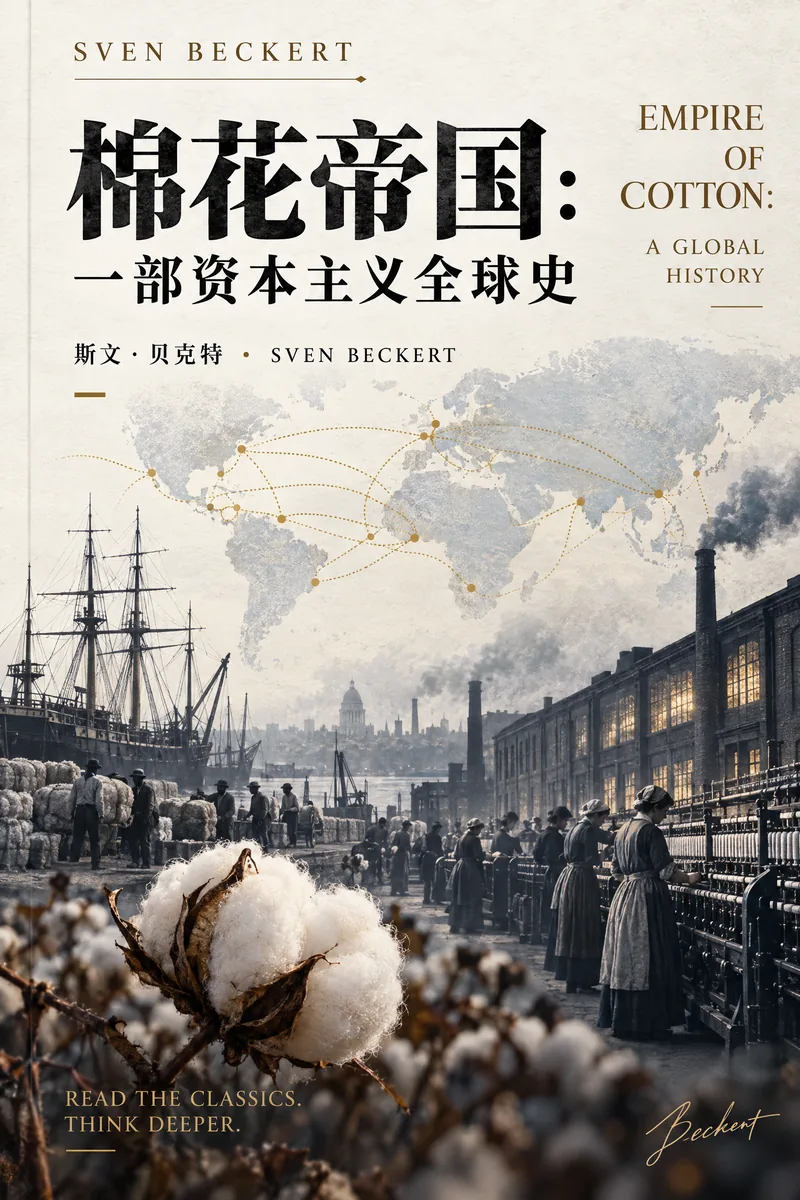
This is a history of global capitalism told through a single commodity. Beckert follows one fibre from the handlooms of the Indian subcontinent through workshops in the Ottoman lands and West Africa, slave plantations in the Americas and steam-powered mills in Lancashire, until it knits five continents into one commercial network. The book turns on a three-stage argument: war capitalism, in which Europeans used force, slavery and colonial land seizure to secure raw material; industrial capitalism, in which the factory and wage labour reorganised production; and global capitalism, in which capital and labour completed their worldwide circulation by the end of the nineteenth century. Cotton was both the fuel of this transformation and its product. Without cotton the industrial revolution would have taken far longer to lift off, and the industrial revolution in turn set the basic shape of today's world economy. The book won the 2015 Bancroft Prize and was a finalist for the Pulitzer Prize.
Why read it?
It breaks the overused word capitalism back down into traceable logistics, land, law and physical coercion. Beckert's method is what convinces: rather than narrating institutions in the abstract, he follows a bale of cotton and shows at which link state violence was required, at which link factory discipline, at which link global credit. It is especially useful to people who build and finance real industry, because it explains why supply chains have never formed naturally but have been repeatedly shaped by power, and why today's arguments about deglobalisation carry so much friction. The Chinese edition was published by Democracy and Construction Press in 2019.
Core Ideas
- War capitalism preceded industrial capitalism. Before the factory existed, Europeans had already built global networks of raw material and trade through force, slavery and colonial seizure. Capitalism did not grow out of free markets; violence was a necessary moment in its primitive accumulation.
- Cotton was the first truly global commodity. Earlier than any other product, it bound American plantations, African labour, European capital and Asian markets into one chain, forming the first genuine global supply chain.
- The state is the underlying instrument of industrial competition. From British protection of Lancashire, through Civil War cotton diplomacy, to twentieth-century textile programmes, the history of cotton shows that shifts in industrial structure always come with state power rather than pure firm-level rivalry.
- The dominated shape the system too. Slave flight, strikes and colonial independence were not accidents of capitalism but internal forces that changed its form: capital must constantly reorganise labour in order to keep accumulating.
What questions does this book try to answer?
- Did capitalism rise on free markets and contract, or on violence, slavery and colonial expropriation? Are the two faces of one process, or can they be separated?
- How does the global circulation of an ordinary commodity keep redistributing power between the exploited and the beneficiaries, and ultimately rearrange the standing of states?
Who should read it?
Readers concerned with global supply chains and geoeconomics; people in manufacturing and trade who need to understand how industrial structure is shaped by power; and history readers who want to move past institutional determinism and see capitalism's coercive foundation. It also gives investors the historical depth behind today's deglobalisation debate. Patience is required, economic training is not.
How to Read It
The Chinese edition was published by Democracy and Construction Press in March 2019. Read the introduction and conclusion first to fix the three-stage framework, then take the body in chronological order; the chapters on war capitalism and on global reconstruction are the hinges of the book. It can be paired with The Great Transformation and Capital in the Twenty-First Century, already in this library, which offer competing accounts of capitalism's origins.