Psychology & Cognitive Science 2011 Daily Pick
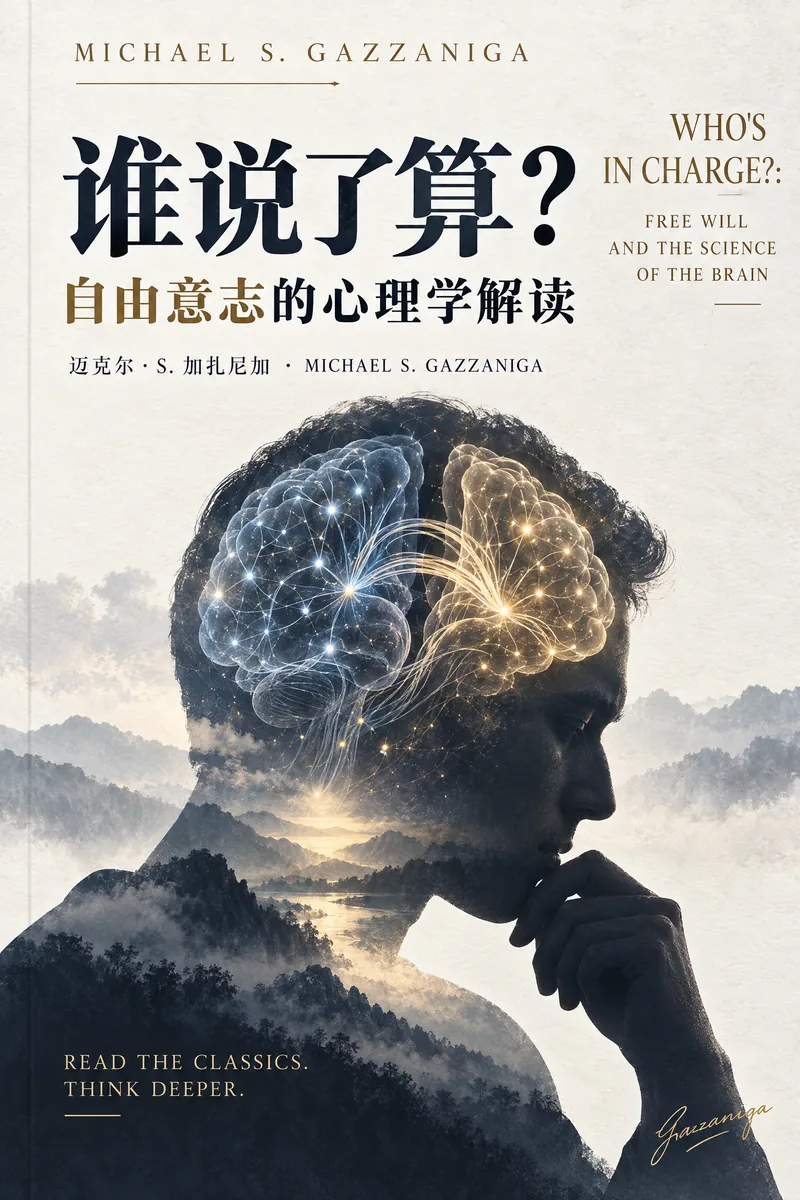
Who's in Charge?
《谁说了算?自由意志的心理学解读》
- Published
- 2011
- Category
- Psychology & Cognitive Science
- Original language
- en
- Source list
- Daily Pick
If the I does not command the brain, on what can free will and responsibility rest
Imported from a third-party reading list or added as a daily pick — bibliographic facts, the source framing, and a full reading guide.
Source theme
If the I does not command the brain, on what can free will and responsibility rest
What is this book about?
Gazzaniga is one of the founders of split-brain research. In Who's in Charge? he gathers half a century of observation on the division of labour between the hemispheres and on the brain's interpreter mechanism into a systematic answer to the problem of free will. His argument has three layers. First, the brain is made of many semi-independent modules working in parallel, and consciousness touches only a small part of their output. Second, the left hemisphere's interpreter invents plausible reasons after the fact for behaviour already under way, which makes us believe we formed an intention before we acted. Third, free will therefore cannot be reduced to the level of individual neurons; it is a social concept that emerges at a higher level. This leads to his reversal: responsibility is not grounded in free will, but is a way society keeps order. We hold people responsible because the brain is itself a social organ.
Why read it?
Free will is one of the few problems pressed simultaneously by neuroscience, law and ethics, and Gazzaniga is unusual in being both the scientist who poses it and the philosopher who admits it has no tidy solution. He does not use neuronal determinism to abolish moral responsibility. Instead he argues that the question must be moved to the right level: asking whether a neuron is free is a category error, whereas asking whether a person should be held responsible is meaningful at the social level. This emergentist position speaks directly to managers, institutional designers and anyone wondering why the law is written the way it is.
Core Ideas
- The brain is a modular confederation. Many semi-autonomous processing units work in parallel, consciousness reads only a small fraction of their output, and the unified self is to a large extent a construction after the fact.
- The left hemisphere's interpreter automatically invents reasons for behaviour already under way. People often act first and only then feel that they intended to, so introspective reports are not reliable accounts of the causes of behaviour.
- Free will is a level-bound concept rather than a property of neurons. Discussing freedom at the level of a single neuron is a category error; freedom and responsibility become meaningful only at the level of the whole person embedded in social relations.
- Responsibility precedes free will. Society holds people accountable in order to sustain order and cooperation; moral responsibility is a product of social practice rather than a logical corollary of metaphysical free will.
What questions does this book try to answer?
- If consciousness has access to only a fraction of brain activity, to what extent is the I the author of its own actions?
- Once neuroscience keeps showing that behaviour is driven by unconscious mechanisms, can law and morality still hold people responsible for what they do?
Who should read it?
Readers of cognitive science interested in consciousness, free will and determinism; people in law, ethics and public policy who must work with the concept of responsibility; and practitioners of management and institutional design concerned with how people are motivated and constrained. The book is clearly written and full of cases, requires no neuroscience background, but asks the reader to accept that no clean conclusion is on offer.
How to Read It
The Chinese edition, Who's in Charge? Free Will and the Science of the Brain, was published by Zhejiang People's Publishing House in 2013. Read the introduction and the conclusion first to capture the central claim of emergence across levels, then return to the middle chapters for the split-brain experiments and the evidence for the interpreter. The later chapters on law and responsibility are where the book lands, so do not skip them. It can be read against Consciousness Explained by Dennett and Consciousness and the Brain by Dehaene, already in this library, which offer three different accounts of consciousness and the self.