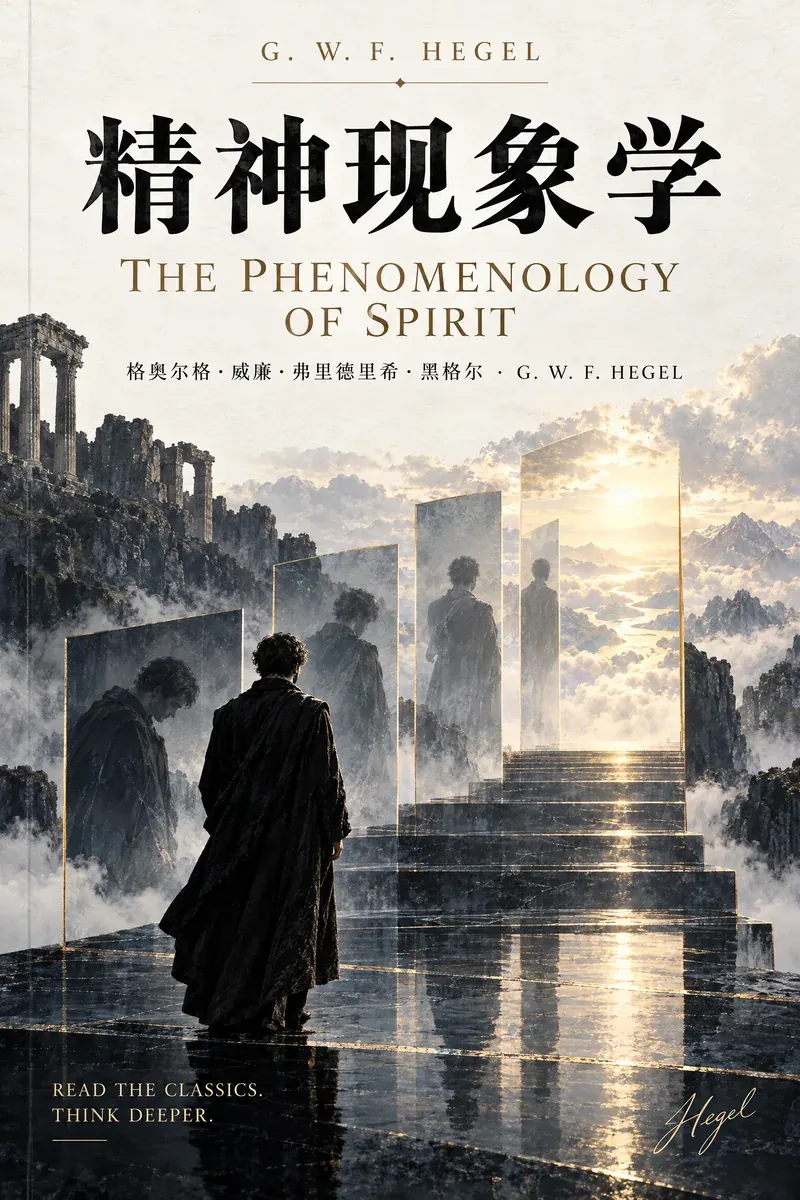
Philosophy 1807 Daily Pick
The Phenomenology of Spirit
《精神现象学》
- Published
- 1807
- Category
- Philosophy
- Original language
- de
- Source list
- Daily Pick
How consciousness advances toward absolute knowledge through self-negation and mutual recognition
Imported from a third-party reading list or added as a daily pick — bibliographic facts, the source framing, and a full reading guide.
Source theme
How consciousness advances toward absolute knowledge through self-negation and mutual recognition
What is this book about?
The Phenomenology of Spirit, published in 1807, is Hegel's first independent book and the pivotal text of German idealism. Its guiding thread is the experience of consciousness. Consciousness begins with the simplest form of sense-certainty, passes through perception and understanding, and arrives at self-consciousness, where for the first time a self becomes aware of itself as acknowledged by another self-consciousness. From this follows the celebrated dialectic of master and slave. Consciousness then rises through reason, spirit and religion until it reaches absolute knowing. Hegel's method is not to prove a proposition but to let each position collapse under its own presuppositions, so that a higher shape of consciousness can absorb it. This is the dialectic. The book is read as a wholesale rewriting of modern epistemology: knowledge is not something a subject simply possesses, but something that comes into being historically and socially.
Why read it?
No serious account of post-Kantian German philosophy can avoid this book: Marx's alienation, Nietzsche's critique, Kierkegaard's and Heidegger's existential analyses, and twentieth-century politics of recognition all argue with it. Its real difficulty lies less in the vocabulary than in the method. Hegel asks the reader to give up the posture of judging from outside and to travel the road consciousness has travelled. For anyone working on the history of ideas or on concepts themselves, it is a mountain that must be crossed; readers who want only the core can still take the preface, the introduction and the master-slave section.
Core Ideas
- The dialectic is not a method applied from outside but the movement of the thing itself: every position generates its own internal contradiction and is displaced by a higher shape, and truth is the whole rather than an isolated proposition.
- Self-consciousness depends on another self-consciousness. Desire does not merely consume its object but seeks recognition from another; the master-slave dialectic exposes the asymmetry of recognition and shows how labour in turn remakes both master and slave.
- Spirit is historical. Reason, ethical life, religion and knowledge are not private achievements of individuals but social shapes that come into being within a community and a history, so there is no knowing subject outside history.
- Knowing is a process of becoming rather than a possession. Consciousness repeatedly experiences its own untruth and advances through that negation, which is precisely what the word phenomenology means here.
What questions does this book try to answer?
- Through which stages must consciousness pass in order to move from immediate sense-certainty to absolute knowing, and is that path necessary or can it be skipped?
- Why must self-consciousness depend on recognition from another, and what historical consequences follow from the asymmetry of that recognition?
Who should read it?
Students of philosophy and historians of ideas; readers concerned with the dialectic, recognition theory and German idealism; and anyone who wants to understand where Marx, Nietzsche and Heidegger got their questions. It offers no easy reading and demands patience and note-taking, but the reward is a whole framework for thinking about how meaning comes into being in history. Suited to those willing to read slowly.
How to Read It
The standard Chinese version is the Commercial Press edition in the World Classics of Academic Scholarship series, translated by He Lin and Wang Jiuxing (volume one first published in 1962 and revised in 1979, volume two in 1979); a newer translation by Xian Gang appeared from People's Publishing House in 2013 and is useful for comparison. Read the preface and introduction first to grasp the method, then the master-slave section of the self-consciousness chapter, and only then proceed in order from the beginning. It can be paired with the Critique of Pure Reason, already in this library, to see the starting point it responds to.