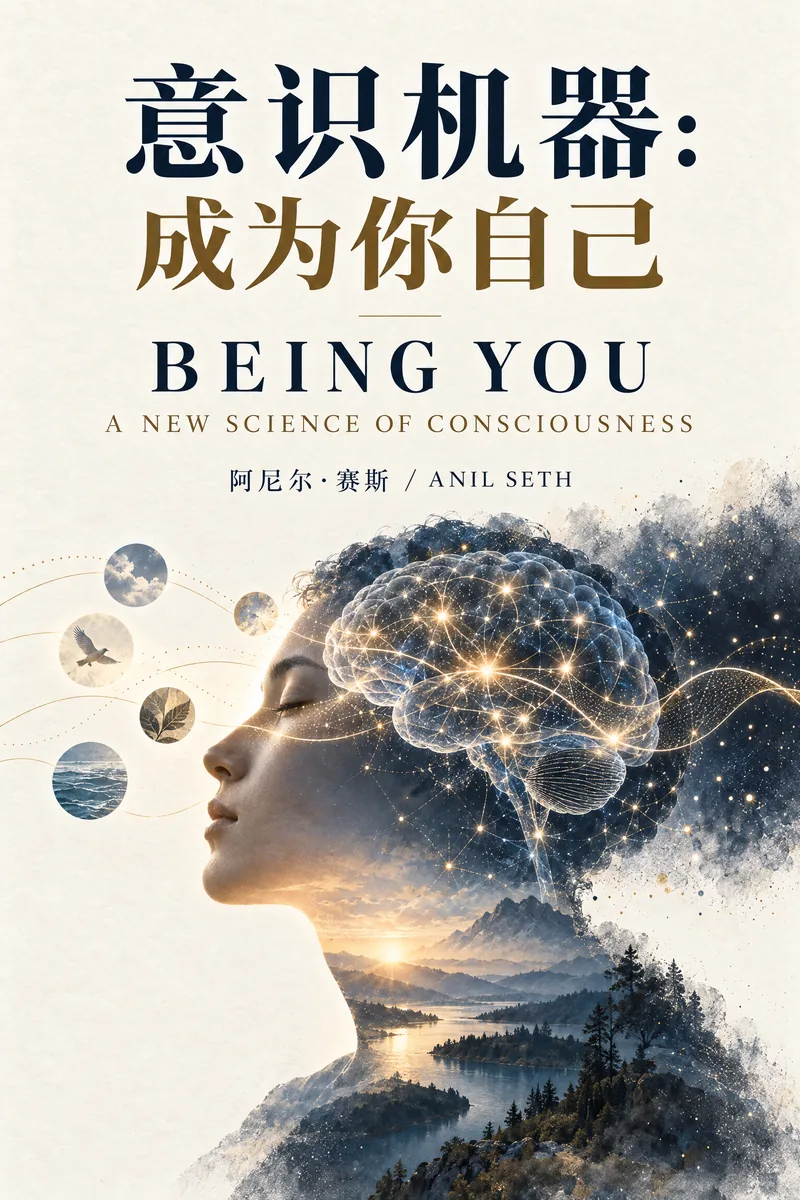
Psychology & Cognitive Science 2021 Daily Pick
Being You
《意识机器》
- Published
- 2021
- Category
- Psychology & Cognitive Science
- Original language
- en
- Source list
- Daily Pick
Perception is a controlled hallucination; the self is a process the brain keeps constructing
Imported from a third-party reading list or added as a daily pick — bibliographic facts, the source framing, and a full reading guide.
Source theme
Perception is a controlled hallucination; the self is a process the brain keeps constructing
What is this book about?
Being You is a 2021 book on the science of consciousness by the British cognitive and computational neuroscientist Anil Seth. It starts from a counterintuitive claim: we do not passively receive the external world but actively generate it — perception is a controlled hallucination that the brain continually maintains while being constrained by sensory input. Drawing on his own research and a wide range of experiments, Seth discusses colour, pain, the sense of self, free will, animal consciousness, and even machine consciousness. He proposes a beast machine theory: consciousness is continuous with emotion and bodily regulation, an evolved prediction mechanism whose purpose is to keep the organism alive. The subtitle points to the conclusion: the self is not a fixed entity waiting to be discovered but a process the brain keeps constructing.
Why read it?
It is one of the clearest and most readable surveys of the current science of consciousness, written by someone who is both an active researcher and a leading public voice in the field. Its value lies in turning consciousness from a metaphysical puzzle into an experimental, testable scientific question without dodging the philosophical difficulties. It is especially useful for people working in AI: the framework of predictive processing and controlled hallucination bears directly on how we should read the understanding and self narratives attached to today's large models. It is not a book of answers but an update to how the questions are asked.
Core Ideas
- Controlled hallucination: perception is not a direct read-out of the world but the result of top-down prediction continually corrected by sensory input; seeing is, in a sense, dreaming under constraints.
- The beast machine: consciousness is continuous with emotion, interoception, and bodily regulation, and its evolutionary function is to keep the organism alive rather than to represent the world accurately.
- The self as multi-layered construction: the bodily self, the perspectival self, and the narrative self depend on different brain mechanisms; the self is a process, not an entity.
- The diversity of consciousness: consciousness is not one thing but a space of dimensions; being conscious is not an on/off switch, which gives finer criteria for animal and machine consciousness.
What questions does this book try to answer?
- Why does subjective experience accompany the brain's information processing at all, rather than not?
- If perception is a controlled hallucination, on what grounds can we trust our knowledge of the world?
- How is the sense of self constructed by the brain, and under what conditions does it break down?
Who should read it?
It suits general readers curious about consciousness, self, and mind; engineers and researchers working at the intersection of AI and neuroscience who care whether machines can be conscious; and psychology and medicine readers interested in predictive processing, interoception, and the relation between body and emotion. No neuroscience background is required, but a willingness to accept that common-sense intuition may be wrong is.
How to Read It
The book is clearly structured and can be read in order. The opening chapters establish controlled hallucination as the core framework and are the foundation, so read them carefully. The middle chapters on the bodily self, free will, and whether the self is an illusion speak most directly to everyday puzzlement. The later chapters turn to animal and machine consciousness and are well read alongside Consciousness and the Brain (Dehaene) and Consciousness Explained (Dennett), to see where the three accounts diverge. Short on time? Read the introduction and conclusion first, then fill in the case studies.