Philosophy Year unverified Daily Pick
Zhuangzi
《庄子》
- Published
- Year unverified
- Category
- Philosophy
- Original language
- zh
- Source list
- Daily Pick
Wandering without dependence, equalizing all things: revaluing every distinction at the limits of language and self
Imported from a third-party reading list or added as a daily pick — bibliographic facts, the source framing, and a full reading guide.
Source theme
Wandering without dependence, equalizing all things: revaluing every distinction at the limits of language and self
What is this book about?
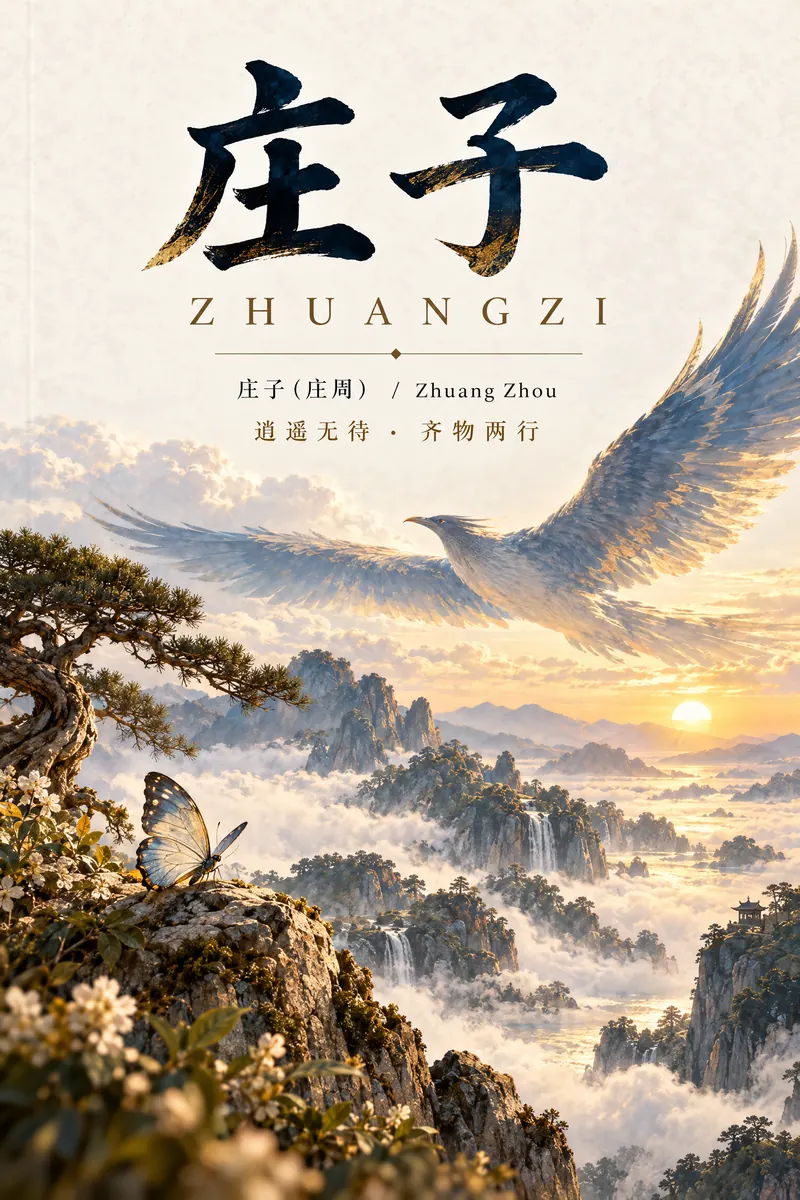
The Zhuangzi is a collection of philosophical writings attributed to Zhuang Zhou, a thinker of the Warring States period, together with later followers. The received text runs to thirty-three chapters, conventionally divided into Inner, Outer, and Miscellaneous sections. Written largely in fable, invented dialogue, and paradoxical aphorism, it uses figures such as the giant Peng bird, the butcher Cook Ding, the butterfly dream, and talking skulls to ask how a person can become free in a world of fixed opinions, endless contention, and inescapable death. The seven Inner Chapters are generally regarded as closest to Zhuangzi's own thought and treat free wandering, the equalizing of things, nurturing life, the human world, the sign of virtue complete, the great master, and responding to emperors and kings. It is neither a systematic ethics nor a religious scripture, but a philosophical experiment conducted in literary form.
Why read it?
It offers a set of questions fundamentally different from those of Western philosophy: rather than asking what is true, it asks who is judging and on what authority, treating the very distinction between right and wrong as something to be dissolved rather than defended. It is also a high point of classical Chinese prose, so densely packed with fables that reading it is at once doing philosophy and reading literature. And it speaks directly to a modern predicament — being compared, defined, and chased by time — with workable attitudes such as dependence-free wandering, walking the double path, and settling into the times, rather than abstract concepts.
Core Ideas
- Free and easy wandering without dependence: genuine freedom comes not from satisfying desires or changing circumstances, but from a way of living that depends on nothing external.
- Equalizing things and walking two paths: right and wrong, great and small, beautiful and ugly are products of particular perspectives; equalizing does not erase differences but lets perspectives run side by side without one suppressing another.
- The limits of language: language is both instrument and cage; catching the meaning and forgetting the words suggests that meaning can never be fully fixed in speech and must be grasped in practice.
- Settling into the times: toward death, change, and what cannot be controlled, do not wage war but follow the natural course, so that sorrow and joy no longer enter.
What questions does this book try to answer?
- Can a person become free without changing external circumstances — and if so, by what means?
- When we call something right or wrong, are we describing the world or exposing our own position and prejudice?
- Can language carry the Way? If not, what forms of expression remain for philosophy?
Who should read it?
It suits readers interested in comparative philosophy who want to understand the non-systematic side of Chinese thought; scholars and enthusiasts in cognitive science, philosophy of language, and philosophy of mind looking for a different account of self and language; and anyone under pressure, comparison, and time anxiety who wants a way of settling that is neither religious nor motivational. Readers wary of classical Chinese can begin with an annotated modern translation.
How to Read It
Begin with the seven Inner Chapters in order — the densest and most likely authentic part of the book. Free and Easy Wandering and On the Equality of Things are the core and reward rereading. From the Outer and Miscellaneous chapters, Autumn Floods, Perfect Happiness, Full Understanding of Life, and The Tree on the Mountain are the most literary. Do not hunt for theses; notice instead what presupposition each fable is dismantling. A good entry point is Chen Guying's annotated modern translation; read it alongside the Tao Te Ching and the Analects to see how Confucianism and Daoism answer the question of order differently.
Reading Notes
2026-10-29
The case for uselessness in the Zhuangzi is not an invitation to withdraw from the world. It is the harder observation that a thing is priced by whoever intends to use it, so being useless is the only way to take that pricing power back. The text also admits the limit: between being useful and being useless is not a solution but an acknowledgement that there is none.
What matters in this book is a pair of stories placed side by side. In the Inner Chapters, the carpenter Shi dismisses the great oak that the village worships as a shrine: it is a worthless tree, and precisely because it is good for nothing it has lived so long. Elsewhere, Zhuangzi sees woodcutters pass over an unshapely tree in the mountains, and then watches his host kill a goose because it cannot honk. The disciple asks the obvious, uncomfortable question: yesterday survival came from being useless, today death came from being useless — which side is one supposed to take? Zhuangzi answers that he would place himself between usefulness and uselessness. It reads like evasion; read strictly, it is the opposite. He has first shown that usefulness is a road to being consumed, then conceded that uselessness is no safe position either — both are coordinates inside someone else's evaluation. What this genuinely changes is the question: not what is this thing good for, but who is doing the pricing, by what standard, and who bears the consequence. The caution worth keeping is that people who adopt uselessness as a strategy are usually still working for the same evaluative system, merely in a different posture; the posture separates from the strategy only when a person stops caring how others assess his use. It forms a deliberate counterweight to the essay on this site about the invisibility of maintenance: that piece argues that useful things are undervalued because they are invisible, while this book argues that visible usefulness is itself a danger.