Psychology & Cognitive Science 1991 Daily Pick
The Embodied Mind
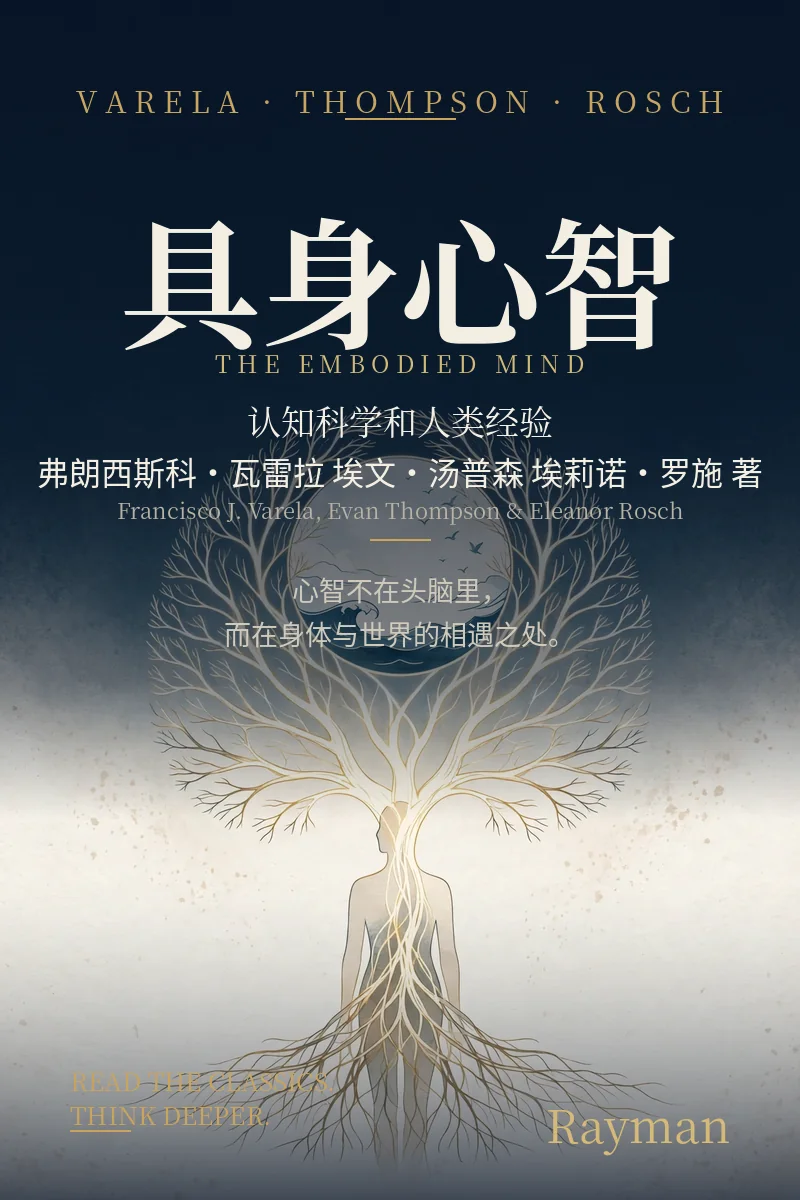
《具身心智》
- Published
- 1991
- Category
- Psychology & Cognitive Science
- Original language
- en
- Source list
- Daily Pick
Cognition is not representation but embodied action, enacted through an organism's history of structural coupling
Imported from a third-party reading list or added as a daily pick — bibliographic facts, the source framing, and a full reading guide.
Source theme
Cognition is not representation but embodied action, enacted through an organism's history of structural coupling
What is this book about?
Written by the biologist Francisco Varela, the philosopher Evan Thompson and the psychologist Eleanor Rosch, and published by MIT Press in 1991, The Embodied Mind is the founding statement of the enactive approach to cognition. The authors observe that cognitivism, which likens the mind to a symbol-processing computer, and connectionism, which likens it to an emergent network, appear opposed but share one premise: that the mind's central task is to build internal representations of a pregiven world. The book dismantles that premise. Cognition, they argue, is embodied action — living beings bring forth a meaningful world through a history of structural coupling with their environment. Colour perception serves as the key case: colour is neither an intrinsic property of objects nor an arbitrary construction of the brain. Adaptationist optimisation is replaced by 'natural drift'. The final chapter draws on Nagarjuna's Madhyamaka and on mindfulness to discuss groundlessness and ethics.
Why read it?
If you want to know what the overused word 'embodied' actually means, this book is one of its sources. It delivers three things at once: a clear critique of cognitivism and connectionism, a workable alternative, and a methodology that puts third-person science and first-person experience at the same table. Its implications for artificial intelligence are direct: intelligence does not first build a model of the world and then act; it generates a world in the acting.
Core Ideas
- Enaction: cognition is not the representation of a pregiven world but embodied action — organisms bring forth their own world through a history of structural coupling.
- The colour case: colour is neither in the object nor merely in the head; it is enacted in the interaction between perceiver and environment.
- A double critique of representationalism: symbolic computation and connectionism both assume that the mind's job is internal representation, and so neither resolves the relation of mind to body and world.
- Natural drift: evolution is not a climb toward optimality but a historical process of satisficing and drift — and so is cognition.
- A middle way between science and experience: phenomenological description and mindfulness practice can serve as first-person methods complementing third-person science, while the Buddhist doctrine of no-self supplies resources for dissolving dualisms.
What questions does this book try to answer?
- If the mind does not represent the world, how can it act effectively?
- Can first-person experience be a rigorous object of inquiry rather than a residue excluded from science?
- Must evolution and cognition be measured on a scale of optimality?
- If the self is a process rather than a substance, what remains of ethics and responsibility?
Who should read it?
Researchers and engineers in cognitive science, neuroscience and AI; readers interested in the relation between consciousness, selfhood and contemplative practice; and philosophically inclined readers who have met phenomenology and want to see it enter empirical science. Buddhist terms appear throughout, but the authors explain them plainly and no prior background is assumed.
How to Read It
Start with the introduction, which lays out the problem and the structure of the five parts. Chapters 3 and 5, on cognitivism and connectionism, can be read quickly as the critique. Chapter 8 on enaction and chapter 9 on natural drift are the hinge of the book and deserve slow reading. Chapters 10 and 11, on Madhyamaka and ethics, may be skipped on a first pass and returned to later. Read alongside Phenomenology of Perception to see the line running from phenomenology into cognitive science.