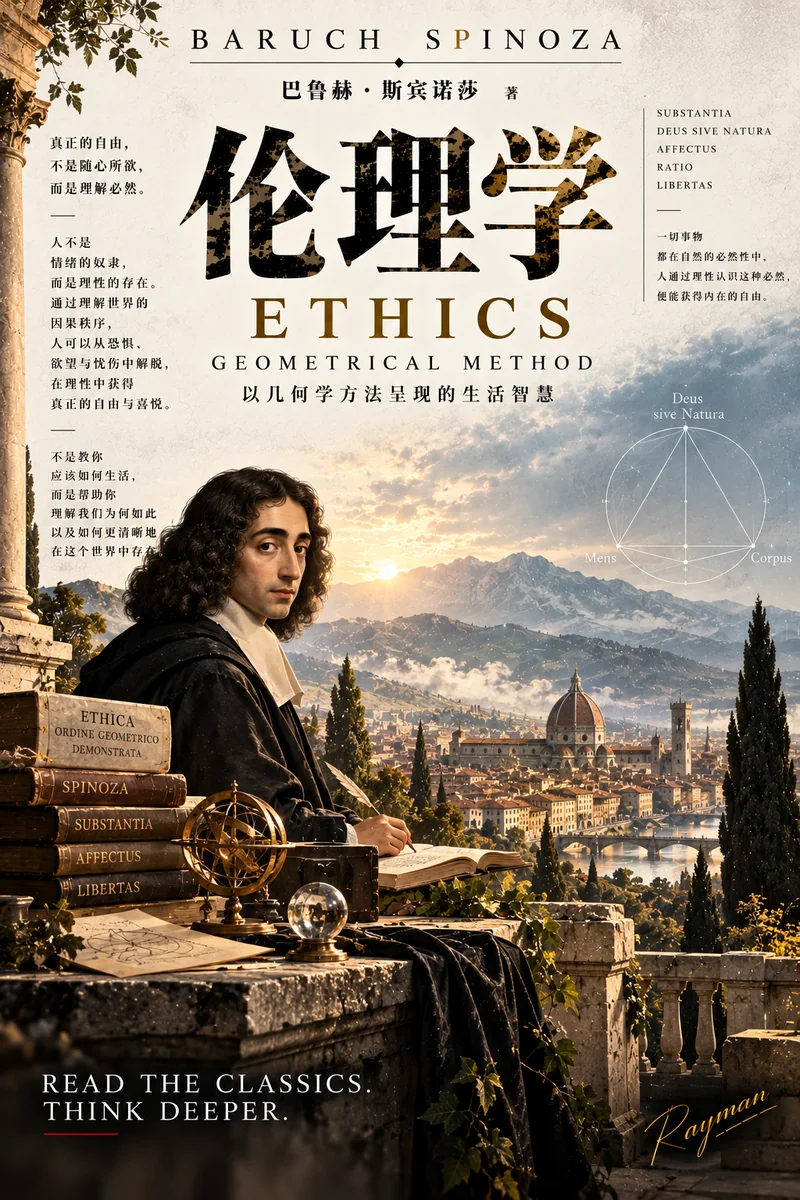
Philosophy 1677 Daily Pick
Ethics
《伦理学》
- Published
- 1677
- Category
- Philosophy
- Original language
- la
- Source list
- Daily Pick
There is only one substance: how Spinoza used geometry to show that God is Nature and freedom lies in understanding necessity
Imported from a third-party reading list or added as a daily pick — bibliographic facts, the source framing, and a full reading guide.
Source theme
There is only one substance: how Spinoza used geometry to show that God is Nature and freedom lies in understanding necessity
What is this book about?
Ethics is the masterpiece of the Dutch philosopher Baruch Spinoza, written in Latin and published in 1677, the year of his death. Modelled on Euclid's Elements, it proceeds through definitions, axioms, propositions, and proofs, drawing metaphysics, epistemology, psychology, and ethics into a single system. Spinoza holds that there is only one substance, which he calls God or Nature (Deus sive Natura): mind and body are not two things but two attributes of one and the same substance. He treats the human emotions as natural phenomena — desire, pleasure, pain, and everything derived from them arise from conatus, the striving of each thing to persevere in its own being. The work has five parts: on God, on the mind, on the emotions, on human bondage, and on human freedom. It issues no moral commandments; it argues instead that bondage to the emotions springs from inadequate ideas, while freedom comes from understanding necessity.
Why read it?
It is the most thoroughgoing monist system in the history of Western philosophy, and the only serious attempt to ground ethics directly in necessity. The arguments now running about consciousness and the body, determinism and freedom, reason and emotion all find here an extreme and rigorous position: if mind and body belong to one substance, and if everything follows from necessity, what becomes of human freedom, emotion, and happiness? Reading it is not merely learning a doctrine but training in reasoning that starts from first principles and leaves no step unproved — a discipline of use in engineering judgement and investment decisions alike. Its answer to the mind-body problem also opens a three-century conversation with the embodied turn in contemporary cognitive science.
Core Ideas
- Substance monism: there is only one substance, God or Nature, and every particular thing is a mode of it; mind and body are two attributes of one substance rather than two separate worlds.
- God is Nature: Spinoza's God is not a personal creator who intervenes in the world but the necessary, infinite whole of nature — a position for which his contemporaries charged him with atheism.
- Conatus: every thing strives to persevere and increase in its own being, and human desire and emotion are derived from this striving; emotions are in themselves neither good nor evil, only increases or decreases of power.
- Three kinds of knowledge: imagination or opinion, reason, and intuitive knowledge; only the latter two yield true ideas, and they determine whether a person remains in bondage to the emotions or becomes free.
- Freedom is the understanding of necessity: one cannot escape causal necessity, and freedom is not arbitrary choice but the comprehension of the necessary order of oneself and all things, turning from passive emotion to activity.
- The intellectual love of God (amor Dei intellectualis): the highest happiness is not an external reward but the knowledge and love of nature as a whole, through which the mind touches what is eternal in itself.
What questions does this book try to answer?
- If everything follows from necessity, what remains of human freedom and moral responsibility?
- What is the relation between mind and body — two substances, or two descriptions of one and the same substance?
- Can the emotions be understood and transformed by reason, or is reason after all only the slave of the passions?
Who should read it?
Suited to readers drawn to metaphysics, ethics, and the mind-body problem — students and researchers in philosophy, cognitive science, psychology, and intellectual history among them. It also speaks to general readers concerned with such fundamental questions as free will and determinism, or whether reason or emotion drives us. It asks for patience rather than specialist training.
How to Read It
There is no need to give equal weight to all five parts. Begin with Part Three, on the emotions, and Part Four, on human bondage, which stay closest to lived experience; then return to Part One, on God, for the doctrine of substance; and finish with Part Five, on human freedom, where the whole work comes to rest. Attend to the geometric structure of definition, axiom, proposition, and proof, and when a step seems to jump, look back to the definitions. Among Chinese editions, He Lin's translation (Commercial Press) serves well. Read it against the Meditations on First Philosophy to see how Spinoza rewrites Descartes' dualism of mind and body.