Technology & Science 2013 Daily Pick
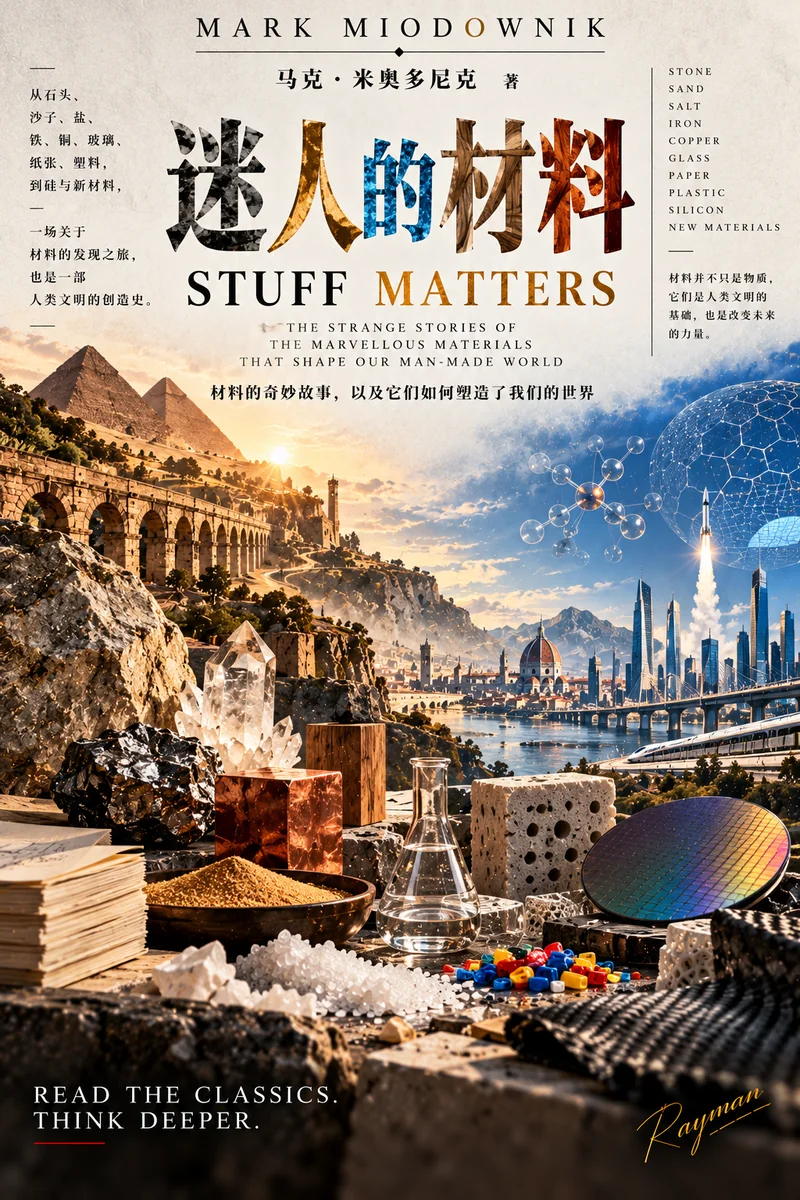
Stuff Matters
《迷人的材料》
- Published
- 2013
- Category
- Technology & Science
- Original language
- en
- Source list
- Daily Pick
How matter shapes civilisation: a materials-science tour from steel and glass to graphite and aerogel
Imported from a third-party reading list or added as a daily pick — bibliographic facts, the source framing, and a full reading guide.
Source theme
How matter shapes civilisation: a materials-science tour from steel and glass to graphite and aerogel
What is this book about?
Stuff Matters is a work of popular science published in 2013 by the British materials scientist Mark Miodownik, and winner of the Royal Society Winton Prize for Science Books in 2014. Taking the objects he encounters in ordinary life as its thread, the book examines ten materials that have shaped the modern world: steel, paper, concrete, chocolate, ceramics, glass, plastic, graphite and diamond, aerogel, and the materials implanted in the human body. Each chapter begins in a concrete scene — a razor blade, a teacup, an aircraft window, a dental implant — and moves down to atomic structure and manufacturing process, showing how a material's properties follow from its internal arrangement and how people have invented new materials by controlling that arrangement. The costs are not glossed over: the brittleness of concrete, the pollution of plastics, and the fragility of ceramics are all presented as they are. The book turns the plain question of why things are the way they are into a guide to the material basis of civilisation.
Why read it?
It turns the most easily overlooked things into the most worth asking about: why will steel bend while glass only shatters? Why is concrete at once the skeleton of modern civilisation and one of its weakest points? Miodownik re-explains everyday objects through the eyes of materials science, so that a knife, a cup, or a screen begins to show the traces of atomic arrangement and manufacturing process. For anyone working in semiconductors, electronic materials, or manufacturing, it is a rare kind of upstream literacy: it deals with the common ground of every device — how materials are designed, how they fail, how they are replaced. It also reminds us that nearly every leap of civilisation has followed close behind a breakthrough in materials.
Core Ideas
- Structure determines properties: the same element, arranged differently at the atomic level, can be soft graphite or the hardest diamond; the central proposition of materials science is that structure is function.
- Materials are invented, not given by nature: steel, glass, concrete, and plastic all come from human control of composition and process, and each answers a set of civilisational needs.
- Craft often precedes science: glass, ceramics, and steel were made at scale long before anyone understood their principles, and science explained only later why they worked.
- No material wins on every count: strength, toughness, corrosion resistance, cost, and recyclability conflict with one another, so engineering choice is always a trade-off rather than a search for a single optimum.
- Materials shape life in return: transparent glass changed architecture and sanitation, steel frames changed the height of cities, and semiconductor materials changed how information is processed.
- New materials are still being invented: graphene, aerogel, and biocompatible materials show that materials science remains open territory rather than finished knowledge.
What questions does this book try to answer?
- Why, when both are carbon, is graphite soft and diamond hard — and what really determines a material's properties?
- How did people make glass and steel before understanding their principles, and how do they invent wholly new materials once they do?
- When strength, toughness, cost, and sustainability conflict, on what basis is a choice of material made?
Who should read it?
Suited to practitioners in materials, semiconductors, electronics manufacturing, and hardware as a primer on the upstream ground beneath their work. It also serves general readers curious about the history of science, craft, and the objects of daily life. No specialist background is required — school-level physics and chemistry suffice.
How to Read It
The chapters can be read independently and in any order. Begin with steel and glass to fix the basic intuition that structure determines properties; then read concrete and plastic for the social costs of materials; and finish with aerogel and implant materials for the frontier of the field. Read it alongside Crystal Fire for the origins of semiconductor materials, and The Innovators to see how materials and devices advance each other.