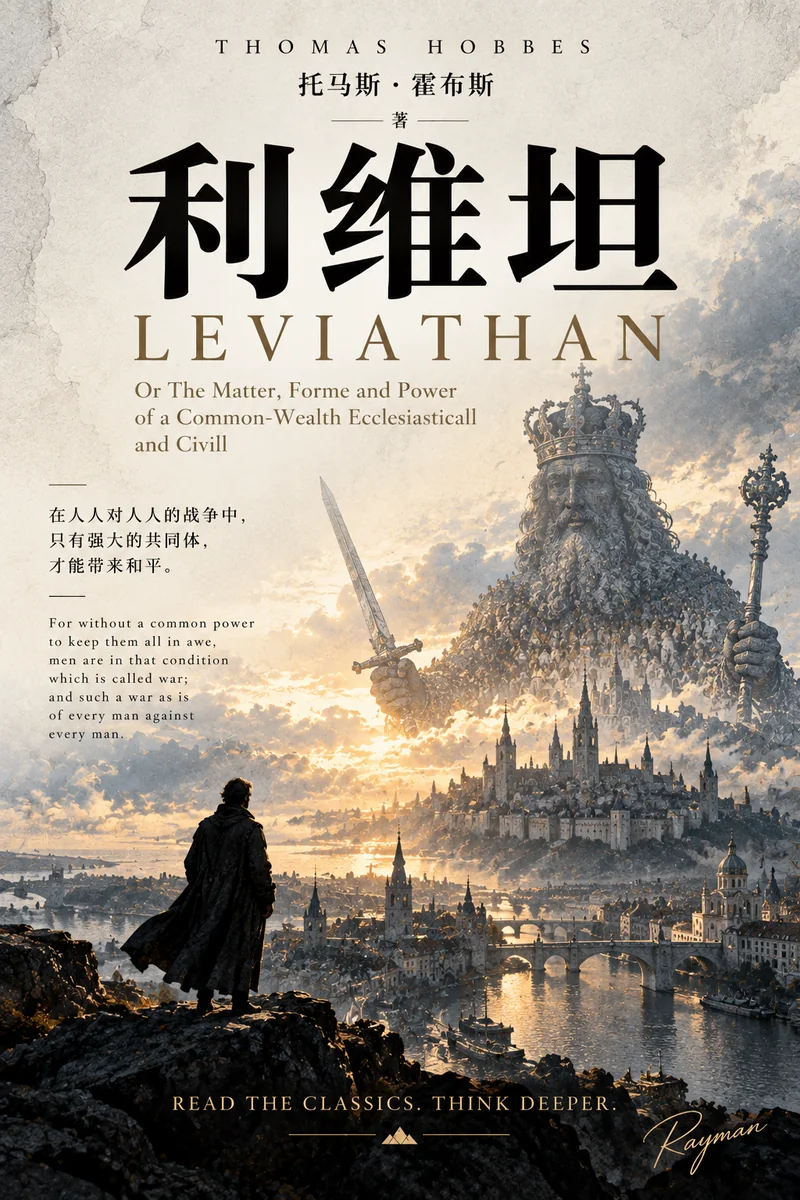
Leviathan
《利维坦》
- Published
- 1651
- Category
- Society & Civilization
- Difficulty
- Advanced
- Reading time
- ~15 hours
- Original language
- en
The Classic Index is not an objective scientific measure. It is this site's personal curation score.
What is this book about?
Starting from the thought experiment of a state of nature, Hobbes argues that without a common power, human equality and desire generate continuous suspicion and conflict. To escape that condition, individuals authorize a sovereign through a social contract, producing what he calls Leviathan.
Why read it?
It established the basic framework of modern political philosophy: the source of political obligation, the limits of sovereignty and resistance, and the relation between order and liberty. Nearly all later discussion of state legitimacy unfolds within coordinates Hobbes set.
Core Ideas
- In a state of nature there is no common power, and the logic of suspicion and preemption makes cooperation unsustainable.
- The social contract is conceived as mutual authorization among individuals, giving the sovereign a non-religious foundation.
- Hobbes holds that sovereignty must be indivisible, arguing that divided power dissolves the state — a claim that became a central point of dispute.
- Within his system the laws of nature are dictates of reason, while only civil law carries binding force.
What questions does this book try to answer?
- If political authority does not come from divine grant, where does its legitimacy come from?
- Between order and liberty, is there a trade-off that must be paid for?
Who should read it?
For readers of political philosophy, law, and history; the seventeenth-century English and argumentative style are distant for modern readers, so a guide helps.
Related Books
If you like this book