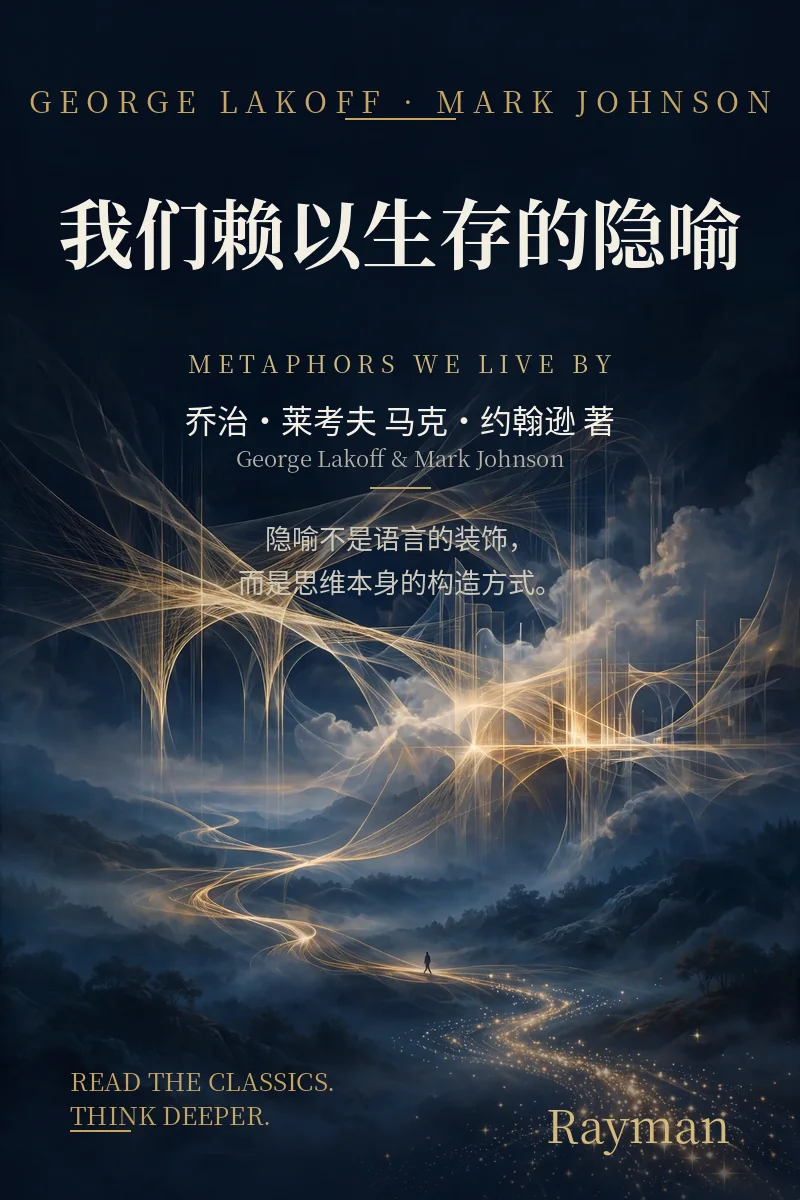
Psychology & Cognitive Science 1980 Daily Pick
Metaphors We Live By
《我们赖以生存的隐喻》
- Published
- 1980
- Category
- Psychology & Cognitive Science
- Original language
- en
- Source list
- Daily Pick
Metaphor is not decoration on language but the architecture of thought itself
Imported from a third-party reading list or added as a daily pick — bibliographic facts, the source framing, and a full reading guide.
Source theme
Metaphor is not decoration on language but the architecture of thought itself
What is this book about?
Published by the University of Chicago Press in 1980, Metaphors We Live By is a founding text of cognitive linguistics. Lakoff and Johnson made a claim that was then close to offensive: metaphor is not ornament but the structure of thought itself, and the ordinary conceptual system by which we think and act is metaphorical in nature. Drawing on a large body of everyday English, they show how conceptual metaphors such as argument is war, time is money, more is up and good is up systematically map one domain of experience onto another, and they distinguish structural, orientational and ontological metaphors. The second half turns philosophical: they attack both the myth of objectivism and the myth of subjectivism and propose an experientialism grounded in the body, in which truth is always relative to a system of understanding. A second edition in 2003 added an afterword responding to two decades of argument.
Why read it?
Because it hands you a tool you can use daily. Faced with any piece of persuasive language you can ask which source domain is being mapped onto which target, and what that mapping is designed to hide. The same analysis works on advertising copy, on a sales pitch, on a policy document. More important is the philosophical consequence: if concepts depend on bodies and experience, then neutral description does not exist, only partial truths lit by one metaphor or another.
Core Ideas
- The essence of metaphor is understanding and experiencing one kind of thing in terms of another. It operates at the level of concept, and metaphor in language is only its surface symptom.
- Conceptual metaphors are systematic: once one holds, it generates a whole family of expressions, inferences and actions, not merely a few turns of phrase.
- Orientational metaphors come straight from the body. Standing, lying down, increasing and decreasing are used to organise abstractions such as mood, status and quantity.
- Every metaphor highlights and hides at once. Framing argument as war makes attack and defence visible and makes negotiation and joint construction invisible.
- Objectivism and subjectivism are both myths. Their third path is experientialism: meaning arises from the interaction of body and environment, and truth is relative to a way of understanding.
- Metaphor is therefore not interchangeable wording. Changing the dominant metaphors of a society changes what that society is able to reason its way to.
What questions does this book try to answer?
- If the conceptual system is metaphorical through and through, what is left of the meaning of objective truth?
- Why do some metaphors get reused endlessly within a culture while others never take hold?
- When one family of metaphors monopolises public debate, which questions become impossible to ask?
- Can the hiding be undone by swapping in another metaphor, or does every frame exact that price?
Who should read it?
For writers, marketers and salespeople, product and design people, and anyone working on policy or communication, as well as general readers curious about how language and thought relate. No linguistics background is needed; almost every example comes from ordinary English.
How to Read It
Chapters 1 to 3 establish the definitions, 4 to 6 cover orientational metaphors where bodily experience is most direct, 7 to 9 take up ontological metaphor and personification, and 10 to 13 handle structural metaphor together with highlighting and hiding. Chapters 25 to 30 settle the philosophical account and deserve slow reading. Read it against Nietzsche's The Birth of Tragedy: one treats metaphor as artistic illusion, the other as cognitive machinery, and the two verdicts sit in direct opposition.