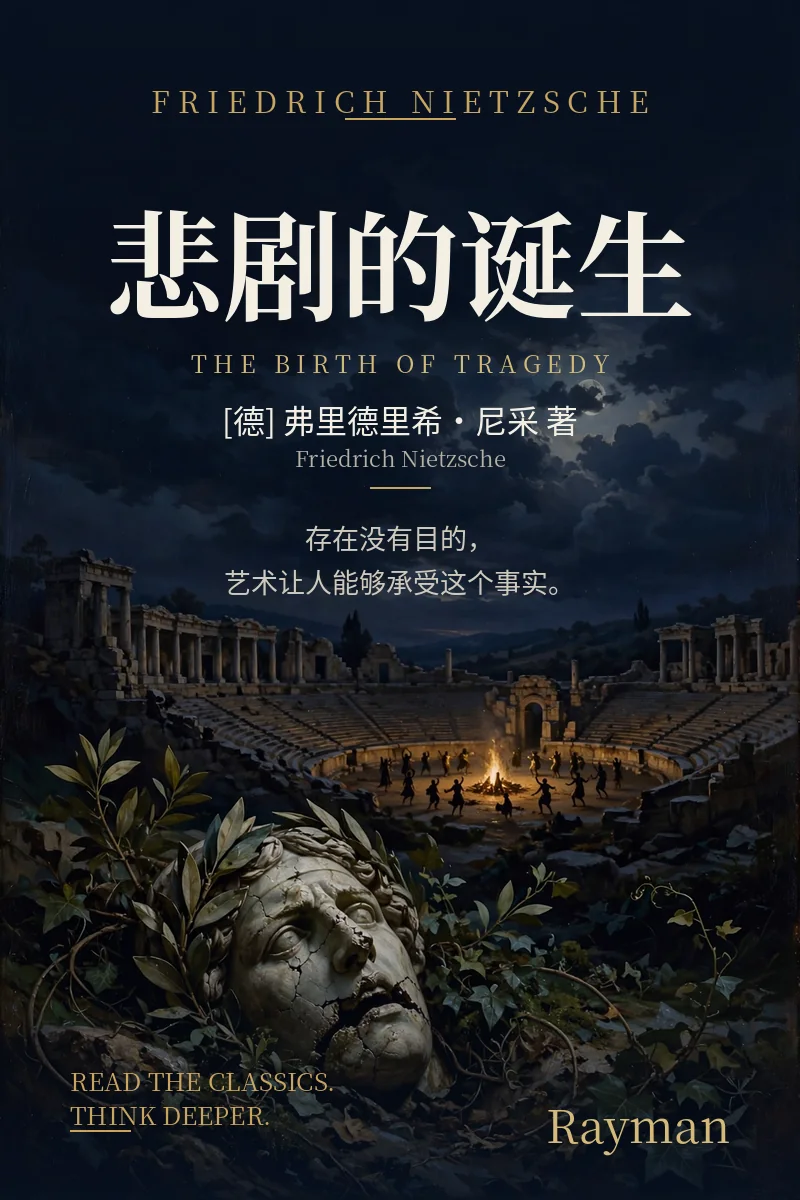
Philosophy 1872 Daily Pick
The Birth of Tragedy
《悲剧的诞生》
- Published
- 1872
- Category
- Philosophy
- Original language
- de
- Source list
- Daily Pick
Existence has no purpose, and art is what makes that fact bearable
Imported from a third-party reading list or added as a daily pick — bibliographic facts, the source framing, and a full reading guide.
Source theme
Existence has no purpose, and art is what makes that fact bearable
What is this book about?
Published in 1872, The Birth of Tragedy was Nietzsche's first book, originally titled The Birth of Tragedy out of the Spirit of Music and dedicated to Richard Wagner. It explains the origin of Greek tragedy through two artistic drives: the Apollonian, which belongs to dream, image and the principium individuationis, and the Dionysian, which belongs to intoxication, music and the dissolution of individual boundaries. Tragedy, on this account, is their brief union between chorus and stage. Nietzsche then asks why tragedy declined, and points to Euripides bringing the spectator onto the stage and to the optimism of the Socratic theoretical man, who believes knowledge can fathom and correct existence. The book ends on an aesthetic verdict: only as an aesthetic phenomenon are existence and the world eternally justified. For the 1886 reissue Nietzsche added an Attempt at a Self-Criticism, conceding that the book owed too much to Schopenhauer and Wagner while still defending its Dionysian core.
Why read it?
Because it turns a question that sounds soft, what use is art, into a hard line of argument: if existence has no purpose of its own, what keeps a person going? Nietzsche offers no consolation, only affirmation after the horror has been admitted. The book is also the gateway to twentieth-century aesthetics: from Freud to Heidegger, from modernist art to the casual Dionysian rhetoric of popular culture, the vocabulary is still his. There is a side effect. You begin to suspect that rational optimism is a cultural choice rather than the default destination of civilisation.
Core Ideas
- Art does not imitate the world; it is the product of two natural drives, dream and intoxication. The Apollonian and the Dionysian are not styles but two basic modes of human experience.
- Apollo works through individuation: it draws boundaries, gives form, and lets a person believe they are a whole. Dionysus works by tearing that boundary down and returning the person to an undifferentiated whole.
- The greatness of Greek tragedy is not optimism but the willingness to put the most terrible things on stage and still make life worth living.
- Tragedy dies of Socratism: once knowledge is assumed to explain and cure everything, suffering that cannot be explained loses its place, and drama degrades into plot and debate.
- Only as an aesthetic phenomenon are existence and the world eternally justified. This is the book's central proposition and a position Nietzsche never abandoned.
- The optimism of the theoretical man is a form of concealment: it mistakes provisional effectiveness for final intelligibility, and the success of a method for a victory over existence.
What questions does this book try to answer?
- If the world has no purpose or meaning of its own, on what grounds can a person still affirm it?
- Under what conditions does a culture lose the capacity to endure tragedy and begin to believe every problem can be solved?
- Reason or ecstasy, which is closer to the truth about being human?
- Is art an escape from reality, or the only technique that makes reality habitable?
Who should read it?
For readers interested in aesthetics, classical scholarship and the origins of modern philosophy, and for writers and makers, since its subject is how form and ecstasy depend on each other. If you know Nietzsche only through Thus Spoke Zarathustra, this is the book that comes before the aphorisms.
How to Read It
Start with the 1886 Attempt at a Self-Criticism: it is the best guide and a warning against reading the book as a system. Then build the two concepts in sections 1 to 4, hold on to the line about aesthetic justification in section 5, follow the Socratic problem through 7 to 15, and enter the genesis of music and tragedy in 16 to 25. Read it alongside Aristotle's Poetics, and alongside On Truth and Lie in an Extra-Moral Sense, written in 1873 and published only after Nietzsche's death.