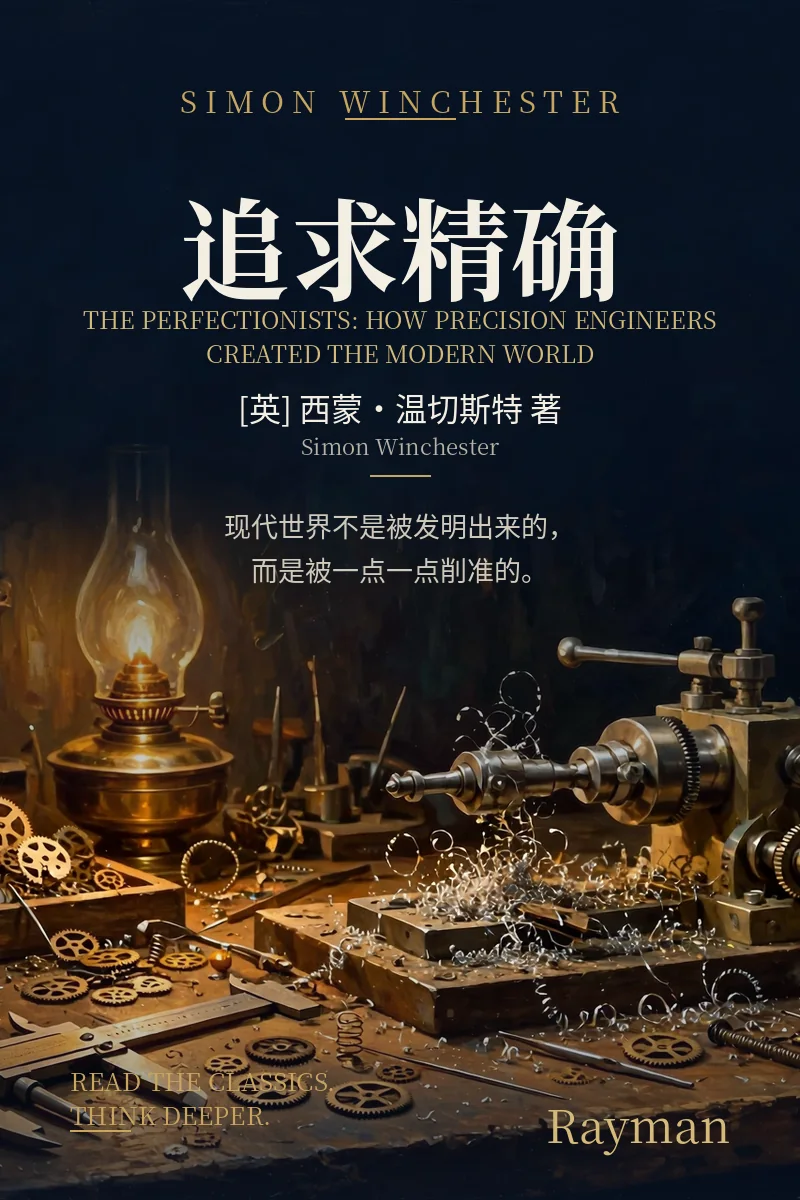
Technology & Science 2018 Daily Pick
The Perfectionists
《追求精确》
- Published
- 2018
- Category
- Technology & Science
- Original language
- en
- Source list
- Daily Pick
The modern world was not invented so much as machined into tolerance — how precision became civilisation's unit of measure
Imported from a third-party reading list or added as a daily pick — bibliographic facts, the source framing, and a full reading guide.
Source theme
The modern world was not invented so much as machined into tolerance — how precision became civilisation's unit of measure
What is this book about?
This is a book not about invention but about accuracy. In the eighteenth century John Wilkinson built a boring machine precise enough to give steam engines a truly round cylinder; in the nineteenth Joseph Whitworth standardised the screw thread and made interchangeable parts possible for the first time; in the twentieth the same pursuit was pushed to its limits — blade clearances in jet engines, the oscillation of atomic clocks, interferometer arms kilometres long listening for gravitational waves, and nanometre alignment in the lithography that writes circuits onto silicon. Simon Winchester uses tolerance as a single thread through 250 years of industrial history: from a tenth of an inch down to 10⁻³⁵ metres, and each order of magnitude opens a new class of things that become possible. He also asks the opposite question — whether precision has a limit, what endless approximation costs, and why the Japanese aesthetic of wabi-sabi amounts to a rebuttal of perfectionism.
Why read it?
Most histories of technology record who invented what; this one records who could make it more accurately, and that is where the real watershed of modern industry lies. It is especially useful for anyone in manufacturing: tolerance is not a quality-control figure but the origin of product definition, process routing and cost structure. After reading it, a ±0.01 on a drawing stops being a number and becomes a threshold of capability, equipment and supply chain.
Core Ideas
- The decisive variable of modernity is tolerance, not invention: each order of magnitude of accuracy unlocks an entire class of products and science that was previously impossible.
- Interchangeability was precision's first social dividend — standard threads and gauges detached parts from individual craftsmen and made mass production and repair systems possible.
- Precision is a system capability rather than a single-point skill: machine tools, metrology, materials, temperature control and traceability must advance together, and the weakest link sets the ceiling.
- Accuracy has diminishing returns and a philosophical boundary: endless approximation is expensive and not always meaningful, and a wabi-sabi sense of 'just enough' is a legitimate rebuttal of perfectionism.
What questions does this book try to answer?
- Why does 'making it more accurately' explain the making of the modern world better than 'inventing something new'?
- Does precision have an endpoint? When cost rises exponentially with accuracy, where should engineering judgement stop?
- Does standardisation, while raising efficiency, also destroy kinds of craft knowledge that cannot be replaced?
Who should read it?
Manufacturing and hardware engineers, especially in precision machining, ceramic structural parts, packaging and equipment; technical salespeople who need to explain to customers why a given part costs what it costs; and general readers interested in the history and philosophy of craft.
How to Read It
Read it in the order of magnitude it follows — each chapter broadly corresponds to one order-of-magnitude breakthrough, and the pace picks up once jet engines and gravitational-wave detectors push accuracy into the microscopic. Pay particular attention to the Whitworth chapter on standardisation, which explains the premise of the entire modern supply chain. If silicon is your interest, jump to the wafer and lithography material first, then go back for the earlier groundwork.