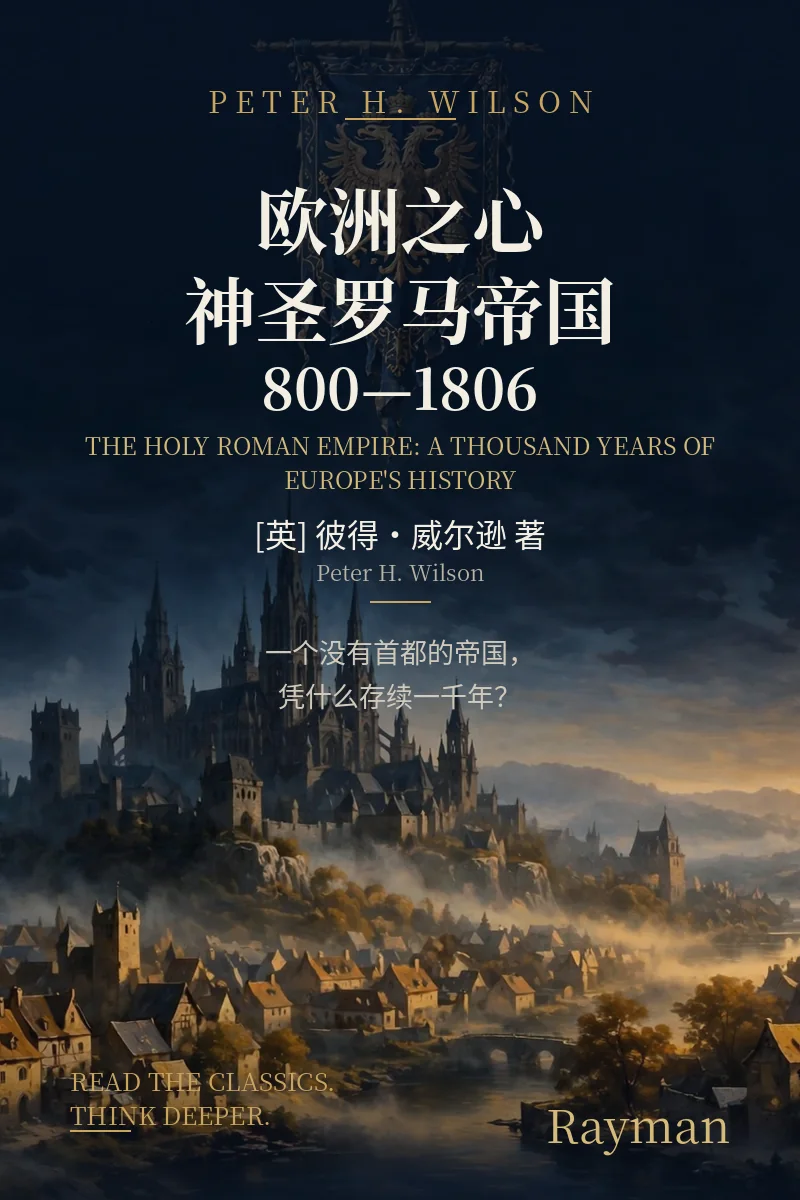
World History 2016 Daily Pick
The Holy Roman Empire
《欧洲之心》
- Published
- 2016
- Category
- World History
- Original language
- en
- Source list
- Daily Pick
How an empire with no capital, no common language and no single sovereign lasted a thousand years
Imported from a third-party reading list or added as a daily pick — bibliographic facts, the source framing, and a full reading guide.
Source theme
How an empire with no capital, no common language and no single sovereign lasted a thousand years
What is this book about?
On Christmas Day in the year 800, Pope Leo III placed a crown on the head of Charlemagne while he was saying mass in St Peter's, and a political body that would last 1,006 years began. It claimed to inherit Rome, yet it had no fixed capital, no common language, no single patron saint and not even a clear frontier. Voltaire's jibe that it was neither holy, nor Roman, nor an empire was repeated as settled verdict for two centuries. Peter Wilson, a historian at Oxford, overturns that verdict across a thousand pages. He abandons chronological narrative and organises the book around four themes — idea, belonging, governance and society — asking how emperor, pope, princes, imperial diet, imperial courts and city leagues shared sovereignty, and how the whole thing ran on consensus-seeking and negotiation rather than on command. A chronology of more than seventy pages at the back repairs the temporal discontinuities that a thematic structure creates.
Why read it?
Most readers inherit their image of the Holy Roman Empire from Voltaire's joke, and the value of this book lies precisely in turning that joke back into a prejudice. It demonstrates an unusual way of writing history: not dynasties in sequence, but a single question — what holds a polity together. What remains afterwards is a transferable analytical frame: when a system has no centre, no shared language and no monopoly on force, why does it not fall apart? That question bears directly on the European Union, on federalism, on alliance structures and on any loosely coupled organisation.
Core Ideas
- The Empire was not a failed state but a different kind of polity: sovereignty was held jointly by emperor, pope, princes, diet, courts and cities, and it ran on negotiation and compromise rather than top-down command.
- The Voltairean verdict is a product of Enlightenment and nation-state assumptions; it measures a polity that never aimed at unitary sovereignty with a ruler built for something else, and so necessarily finds deformity.
- The Empire was held together by ideas and ritual: the claim to Rome, a universal Christian mission, and the procedures of election and coronation produced legitimacy that worked without a standing bureaucratic machine.
- Imperial plurality was a resource rather than a defect — Prussia, the Dutch Republic, Switzerland, Austria and the Italian city-states all grew out of this parent body, and a good part of Europe's diversity traces back to it.
What questions does this book try to answer?
- What holds a polity together for a thousand years when it has no capital, no common language and no single sovereign?
- Must an empire be defined by unitary sovereignty and centralisation? If not, how should it be described instead?
- Why does the interpretation of a single historical entity keep reshaping itself according to present political needs — German nation-state, template for the EU, foreign oppressor?
Who should read it?
Readers with a basic interest in European history who want more than a sequence of dynasties; anyone studying institutions, federalism or polycentric governance; and managers or organisational researchers who need to think about how loosely coupled systems survive over time.
How to Read It
Start with the introduction and Part One, 'Idea', which sets out the three pillars of the Empire's self-description — holy, Roman, empire — and is the premise for everything else. After that, read out of order: jump to 'Governance' or 'Society' depending on the question you currently care about. Seven hundred pages of body text is tiring, so take one theme at a time and use the chronology at the back to fix the dates. If you want a sense of chronology first, read the appendix before the main text.